
Train stations in Munich
München Hbf handles most long-distance trips; S1 and S8 reach central Munich from the airport in about 40 minutes, together every 10 minutes by day.
- Stations
- 3
- Primary station
- München Hbf
- Passenger operators
- 5
- Routes covered
- 14
Use München Hbf for most journeys, but check München Ost or München-Pasing when your train or accommodation makes them the better choice.
München Hbf is the default station
Choose München Hbf for most long-distance, international and city-centre journeys. DB ICE and IC trains use the station, along with ÖBB Railjet, WESTbahn and regional services. If a booking displays only Munich, open the train details and confirm the full station name before paying.
The station has 32 surface tracks for regional and long-distance trains. The S-Bahn uses two more underground. Surface departures are split between the main train shed and the Holzkirchner and Starnberger wings, so the platform area matters as much as the number when you have a short connection.
Rebuilding work can change passenger routes around the station. Leave extra time to find the right entrance or wing, particularly with luggage or when moving between a surface train and the S-Bahn. Look at the live platform and station map before setting out.
München Ost and München-Pasing suit specific trips
München Ost is useful when the booked train calls there or the final address is east of the centre. Some Nightjet and EuroNight services use Ost rather than Hbf. A reservation marked München Ost is not referring to the main station, so read the station name again before leaving.
A normal through S-Bahn takes about nine minutes between Hbf and Ost. Allow time at both ends to reach the underground platforms at Hbf and find the onward train at Ost. The station change is longer than the ride alone suggests.
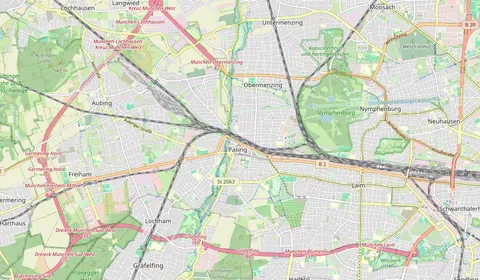
München-Pasing works well for a western address or a westbound train that stops there. Long-distance and regional timetables include services towards Augsburg and Stuttgart. For a central stay, continue to Hbf unless Pasing gives a clearly shorter local journey.
The S-Bahn is the normal airport connection
Use the S1 or S8 between Munich Airport and the city centre. The train to München Hbf takes about 40 minutes, before allowing for the walk between the airport station and the terminal. At Hbf, follow the green S symbol downstairs instead of waiting in the surface train hall.
The S1 crosses western Munich, while the S8 approaches through the east and München Ost. Each normally runs every 20 minutes, creating a combined ten-minute daytime pattern between the airport and central Munich. Take the next useful train for your station, and check the exact departure for an early or late journey.
Make sure the ticket covers the airport leg. The Bayern-Ticket and Deutschlandticket are valid on eligible S-Bahn journeys, including this one, but their wider conditions differ. A long-distance booking includes the S-Bahn only when that segment appears on it.
Representative routes depend on operator and station
DB long-distance trains connect Munich with cities including Nuremberg, Frankfurt, Berlin and Hamburg. A direct ICE to Berlin can take about four hours. Treat that as orientation, then confirm the exact train, Munich station and any engineering changes before paying.
For Vienna, direct choices include ÖBB Railjet Xpress and selected WESTbahn trains. BRB runs the regional RE5 from München Hbf and München Ost to Salzburg Hbf. The tickets and stopping patterns differ, so compare the complete journey instead of treating every Austria-bound train as interchangeable.
Direct EuroCity Express (ECE) trains can reach Zürich HB in about 3 hours 40 minutes. They normally use the Starnberger wing at Hbf, an important detail when the preceding train arrives elsewhere in the station. Find the platform area before arrival, not just the train number.
Nightjet and EuroNight services also use Munich, with some calling at München Ost. Routes and station calls can shift with the timetable. Confirm Hbf or Ost, the operator, accommodation type and compulsory reservation before planning the final city leg.
German fares trade price for flexibility
Choose a DB saver fare when the date and departure are firm. Super Sparpreis and Sparpreis bind the long-distance part of the journey to the booked service. Flexpreis allows eligible trains on the booked route and day, which can be worth paying for when a flight, meeting or separate ticket makes the timing uncertain.
On most domestic ICE and IC journeys, the ticket and seat reservation are separate. A standalone DB reservation costs €5.50 in second class and €6.90 in first class, so confirm the current charge when booking. First-class Flexpreis includes a reservation when bought with the ticket. Check whether the selected fare already includes one before paying again.
International and overnight trains can have stricter rules. Interrail and Eurail pass holders must buy a separate reservation for their seat, couchette or sleeper on an ÖBB Nightjet. The pass may cover the journey, but it does not replace the compulsory reservation.
Regional passes suit regional trains
A second-class Bayern-Ticket costs €34 for one person and €44 for two. It covers regional trains and participating local transport, but not ICE or IC services. On weekdays you can use it from 09:00 until 03:00 the next day. At weekends and on specified public holidays, it can be used from midnight.
The Bayern-Ticket can cover the airport S-Bahn and eligible regional travel as far as Salzburg Hbf. Before buying, confirm the current price and validity conditions for your travel date, passenger count and train category.
The Deutschlandticket costs €63 per month and is a personal subscription. Confirm the current monthly price and subscription conditions before signing up. It covers participating buses, trams, U-Bahn, S-Bahn, RB and RE services, normally in second class. It does not cover ICE, IC or EC trains, so it cannot replace a long-distance ticket to Berlin, Frankfurt or Vienna.
Interrail and Eurail cover participating DB and ÖBB services when the pass includes the relevant countries and travel days. WESTbahn also accepts a valid pass covering Austria and Germany in Standard Class, though a seat reservation costs extra. Match both pass and reservation to the named operator.
The final Munich leg belongs in the booking decision
Plan the journey from Hbf, Ost or Pasing to the actual hotel or event before buying the long-distance ticket. Munich's MVV network includes S-Bahn, U-Bahn, trams and buses. The useful line and fare depend on the station and final address, and the fastest train into Munich can still leave an awkward trip back across the city.
At Hbf, moving between a surface platform and the underground S-Bahn or U-Bahn adds walking time. Ost and Pasing can shorten the local leg for the right neighbourhood. Check the final stop, the last useful service and whether the long-distance booking includes that onward journey.
Luggage, accessibility and disruption need margin
Tight changes are harder when they involve a side wing or the underground platforms. Find the platform area before arrival, then follow the live departure board. With luggage or children, allow enough time to walk the length of the platform and change levels.
Travellers who need step-free access or boarding assistance can arrange help through the DB Mobility Service Centre. Check the live lift information as well. Construction or a lift outage can change the practical route even when the timetable still offers the connection, so recheck the station route shortly before travel.
Where to book
Train tickets
- Check times & prices
Omio
Omio connects you with over 1,000 transport providers - trains, buses, flights, and more - to simplify your travel planning.
Rail Europe
Rail Europe is a leading travel tech company specializing in European train bookings for over 15,000 travel professionals worldwide.
Trainline
Trainline sells rail and coach tickets worldwide on behalf of major UK and European transport companies.


Passenger train operators
- Check times & prices
Deutsche Bahn (DB) is Germany's national railway, running ICE, IC and regional trains with Flexpreis, Sparpreis and Super Sparpreis fares.
Official website - Check times & prices
ÖBB is Austria's national railway, with Railjet high-speed and Nightjet sleeper services plus regional trains across Austria and neighbouring countries.
Official website - Check times & prices
SNCF operates France's TGV and regional trains. SNCF Connect books domestic and many international journeys, with fares ranging from flexible to non-refundable.
Official website - Check times & prices
Trenitalia runs Italy's Frecce high-speed, Intercity and regional trains; Super Economy fares are cheapest but allow no changes or refunds.
Official website - Check times & prices
WESTbahn is a private Austrian operator linking Vienna and Salzburg in about 2.5 hours. WESTspar fares are non-refundable and tied to a train and date.
Official website
Train stations in Munich

Train routes to and from Munich
Find places to stay in Munich
Frequently asked questions
Is München Hbf the same as Munich Central Station?
Yes. München Hauptbahnhof, München Hbf and Munich Central Station refer to the same station. Tickets and German departure boards normally use München Hbf. Search with the German name, then match it to the station printed on the booking before payment.
Are there luggage lockers at München Hbf?
München Hbf has luggage lockers, but rebuilding can change the practical route to them. Check the live station map and locker access if storage is essential, especially for a large case or a late arrival.
Can children travel free on a Bayern-Ticket?
Up to three children aged 6 to 14 can travel free with a Bayern-Ticket, whether it is bought for one or more fare-paying travellers. Children aged five and under also travel free. Add all fare-paying adults when booking.
How early should I request DB mobility assistance in Munich?
Request DB mobility assistance by 20:00 on the day before a domestic journey. For an international trip, book at least 24 hours ahead. Confirm the meeting point and allow more time if construction changes the route through München Hbf.
Are there ticket barriers at München Hbf?
München Hbf has no ticket barriers between the main concourse and the surface platforms. You still need a valid ticket before boarding, and local tickets can have their own purchase or validation rules. Keep the ticket ready for inspection.