
Train stations in Visp
For Visp, check the confirmed train, ticket conditions and final transfer, allowing extra time when connections are separate.

- Stations
- 1
- Primary station
- Visp
- Passenger operators
- 7
- Routes covered
- 1
When your itinerary uses Visp, plan the confirmed train, its ticket terms and the final transfer together before you pay.
Start with the confirmed arrival
Use the station shown on the confirmed itinerary as the starting point for the final part of the journey. Do not rely only on a city search result or a route suggestion from a booking site. Before you pay, compare the arrival time with the accommodation address, a meeting point or the next part of the trip.
The useful question is not only whether a train reaches Visp. It is whether that arrival works for the whole day. Save the full address and decide what happens after you leave the platform. If the final leg is unclear, resolve it before you choose between two similar rail options.
This avoids a common problem: a traveller selects the first or fastest-looking result, then finds that the final transfer is difficult with luggage or does not fit the actual arrival time. A slightly less convenient rail time can be the better choice when it gives a simpler final route. Check both the timetable for the selected train and the route to the final address before booking.
Keep the booking confirmation and arrival details together. A screenshot, downloaded ticket or saved reference is useful when mobile coverage, battery life or a change of plan makes a last-minute search less convenient. The aim is a complete arrival plan, not just a train reservation.
Choose connections for a realistic margin
Open the details for every leg before you select an itinerary. Confirm the departure station, arrival station, connection point and travel date. Similar city-pair results can hide different changes, ticket conditions or arrival times. The short summary beside a search result is not enough to judge the risk of a connection.
Choose a connection margin that fits the rest of your trip. A short change may be reasonable when the legs are protected by the same booking and you understand the station layout. It can be a poor choice when tickets are separate, you are arriving from a flight or coach, or missing the later train would cause a serious problem.
The mistake to avoid is treating the shortest advertised journey as the safest journey. A small saving can disappear if an earlier delay leaves you unable to use the next ticket. Check what the later ticket allows if you arrive late. If the answer is unclear, choose more time or a more flexible option.
Make the margin visible in your plan. Write down the train that you expect to use and the practical fallback if it does not work. This does not mean you need to predict disruption. It means you should know which part of the trip is least forgiving before you commit to it.
Check the ticket you are actually buying
Before paying, read the conditions for the exact fare and departure. Check whether the ticket is restricted to one train, whether changes are allowed and what happens if your plans move. Do not assume that the cheapest result gives the same flexibility as the next option.
Compare the ticket with the risk in the earlier part of the journey. A fixed ticket can suit a simple trip that starts close to the departure station. It may be less suitable after a flight, a separate rail ticket or an appointment that could run late. The useful choice is the fare whose conditions you can meet without relying on perfect timing.
If you use a rail pass, inspect the selected train separately. A pass can be useful on a wider trip, but it does not remove the need to check conditions that apply to a particular service. Confirm any instruction that affects your train before travel day, rather than finding it while you are already on the way to the station.
Keep the ticket and any supporting information accessible during the trip. If there is a change, look first at the conditions of the ticket you hold. General advice from a search result may not apply to the fare, route or date you selected.
Plan the final transfer before travel day
Treat the route after the train as a separate part of the itinerary. Check the destination address, the likely arrival time and the options you can use with your luggage. A rail journey is only useful when the final leg is workable too.
Do this while you can still change the train choice. If an arrival leaves little time before a hotel check-in, a fixed meeting or another departure, build in a margin. A plan that works only if the train arrives exactly on time leaves little room for ordinary delays or a slow exit from the station.
For a late arrival, decide on a simple fallback. That might be a later local connection, a taxi option or a person you can contact. The exact option depends on your address and date, so check the current local information for your own journey. The important step is to decide before you are tired, carrying bags and choosing under time pressure.
If someone is meeting you, share an arrival window rather than only the scheduled train time. This reduces confusion if a connection changes. Check the final route again shortly before travel, because the plan should reflect the train and address you actually have, not an earlier draft of the trip.
Before you leave
Review the complete chain in one place: the confirmed train, each connection, the ticket conditions and the final transfer. Check the travel date and the station named on the booking. Then check the part of the journey that has the least margin.
This final review helps you avoid two different mistakes. It prevents you from buying a ticket whose conditions do not suit the earlier leg, and it prevents you from reaching the right rail arrival without a practical way to finish the trip. If one part remains uncertain, solve it before you travel or choose a plan with more time.
For Visp, select the confirmed itinerary, understand the ticket you hold and make the final transfer part of the booking decision. You will then have a plan you can use on the day rather than a collection of separate reservations.
Where to book
Train tickets
- Check times & prices
Omio
Omio connects you with over 1,000 transport providers - trains, buses, flights, and more - to simplify your travel planning.
Rail Europe
Rail Europe is a leading travel tech company specializing in European train bookings for over 15,000 travel professionals worldwide.
Trainline
Trainline sells rail and coach tickets worldwide on behalf of major UK and European transport companies.



Passenger train operators
- Check times & prices
BLS runs Bern's S-Bahn, regional trains to the Lötschberg and Emmental, plus boats on Lake Thun and Lake Brienz, priced in CHF.
Official website - Check times & prices
Deutsche Bahn (DB) is Germany's national railway, running ICE, IC and regional trains with Flexpreis, Sparpreis and Super Sparpreis fares.
Official website - Check times & prices
Matterhorn Gotthard Bahn runs 144 km of Alpine track from Zermatt to Disentis, with its own multi day pass and a car shuttle at Furka.
Official website - Check times & prices
RegionAlps runs regional trains from St-Gingolph to Brig, and Martigny to Le Châble and Orsières. Buy tickets before boarding; CHF only.
Official website - Check times & prices
SBB is Switzerland's national railway, connecting cities, towns and mountain villages. InterCity trains generally do not require reservations.
Official website - Check times & prices
SNCF operates France's TGV and regional trains. SNCF Connect books domestic and many international journeys, with fares ranging from flexible to non-refundable.
Official website - Check times & prices
Trenitalia runs Italy's Frecce high-speed, Intercity and regional trains; Super Economy fares are cheapest but allow no changes or refunds.
Official website







Train stations in Visp
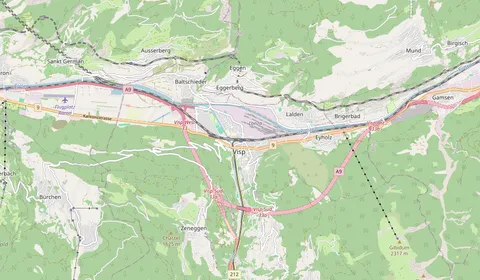
Train routes to and from Visp
Find places to stay in Visp

Frequently asked questions
Should I choose the fastest train to Visp?
Choose it only if its arrival and connection margin work for the whole trip. Compare the final transfer and the later ticket conditions before you pay.
What should I check before a connection at Visp?
Check the exact stations, travel date, connection time and the conditions of the later ticket. Allow more time when the legs are separate or an earlier delay would cause a problem.
Can I rely on a rail pass for every train on my trip?
Use the pass as part of the plan, then check the conditions for the exact train you intend to take. Do this before travel day, not while making the connection.
How should I plan the final transfer after arriving in Visp?
Save the final address, compare the arrival time with the onward route and keep a late-arrival fallback. Treat this as a separate trip leg when you choose the train.
What should I keep available on the travel day?
Keep the confirmed itinerary, ticket conditions and final address together. Check the details for the fare you hold if the plan changes.