Ouigo
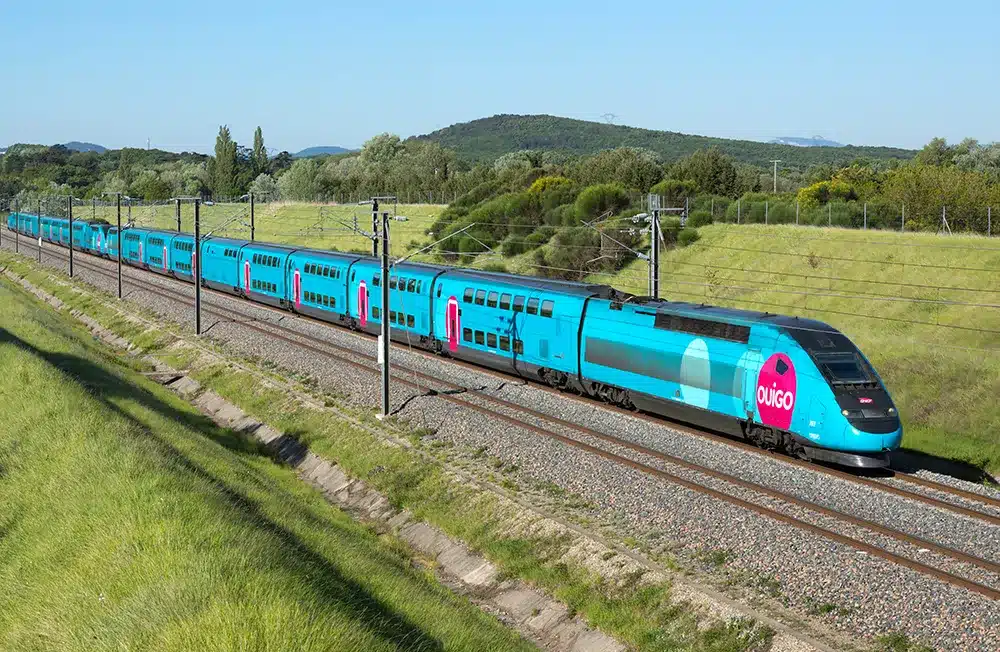
Ouigo is SNCF's low-cost high-speed brand, serving over 60 destinations in France and routes in Spain; basic fares include one hand bag and one cabin bag.
- Country
- France
- Official website
- Official website
- Train tickets
- 2
Ouigo is SNCF's low-cost, high-speed brand, covering more than 60 destinations in France, with a separate Ouigo España arm centred on Madrid to Barcelona.
What Ouigo is
Ouigo is SNCF's low-cost, high-speed train brand. SNCF, France's national railway company, launched it in 2013 to sell TGV seats at budget-airline prices: one class of seating, minimal catering, strict baggage limits. It worked, and in May 2021 SNCF took the same model into Spain through its own subsidiary, Ouigo España, which ran the country's first open-access high-speed service, on the Madrid to Barcelona line. Renfe, Spain's state railway, is a competitor here, not a partner. Its own answer to Ouigo is a separate low-cost brand called Avlo.
Where Ouigo runs
In France, Ouigo covers more than 60 destinations, including Paris, Lyon, Marseille, Bordeaux, Nantes, Strasbourg, Lille and Nice. Some of those trains use city-centre stations, others use out-of-town ones such as Marne-la-Vallée near Paris or Lyon Saint-Exupéry. Check the exact station before you book, not just the city name. In Spain, Ouigo España's flagship route is Madrid to Barcelona, alongside Valencia, Zaragoza, Alicante, Albacete, Tarragona, Cuenca, Valladolid and Segovia.
Booking and tickets
Every ticket is sold online, at ouigo.com or in the app, never at a station counter or by phone. French bookings open up to nine months ahead. The ticket itself does not arrive until three or four days before departure, by email and in the app, so you may not know your seat number until then unless you paid to choose one.
Baggage and fares
A basic ticket includes one hand bag and one cabin bag. Anything larger costs €5 extra, or comes bundled into the €9 Ouigo Plus option along with a seat choice and the onboard entertainment platform. A pet in its own carrier costs €10. Fares are dynamic, advertised from €16 in France and from around €9 to €16 in Spain, but they climb as the train fills. Book as soon as your dates are fixed rather than waiting.
Interrail and Eurail pass holders
Interrail Pass and Eurail Pass holders became able to use Ouigo in France from July 2026, including the low-cost Ouigo Classique service between Paris and Brussels. A paid seat reservation is still compulsory on top of the pass, and it is booked through the Interrail or Eurail reservation self-service system rather than directly with Ouigo. Reservations cost around €10 while a limited quota lasts, then around €15 once that quota runs out. That change has not reached Ouigo España: an Interrail Pass or Eurail Pass is not accepted on the Spanish side, so budget for a normal ticket there rather than assuming pass coverage carries over.
Before you board
Get to the station at least 30 minutes before departure. Boarding closes five minutes before the train leaves, and staff do check baggage size at the gate, so an oversized bag without a paid option can mean being turned away.
Where to book
Train tickets
- Check times & prices
Omio
Omio connects you with over 1,000 transport providers - trains, buses, flights, and more - to simplify your travel planning.
Trainline
Trainline sells rail and coach tickets worldwide on behalf of major UK and European transport companies.


Frequently asked questions
Who created Ouigo and when did it launch?
Ouigo is the budget-friendly high-speed train brand of SNCF, France's national railway company. It launched in France in 2013, and SNCF later brought the same low-cost model to Spain through its own subsidiary, Ouigo España.
How can Ouigo tickets be purchased?
Ouigo tickets can only be purchased online, either via their official website or mobile app. They are not available at station counters or through traditional travel agents.
What are Ouigo's refund and change policies?
Ouigo tickets are primarily non-refundable and non-exchangeable, particularly at the lowest price points. This is a core part of their low-cost model.
What baggage is included in a basic Ouigo ticket?
A basic Ouigo ticket typically includes one piece of hand luggage (like a backpack) and one cabin bag. Additional or oversized items must be declared and paid for during the booking process, as fees are usually much higher if paid at the station.
How early must passengers arrive at the station before a Ouigo departure?
Passengers must usually arrive at the station at least 30 minutes before departure for baggage and ticket checks. Unlike regular train travel, the gates close before the departure time, so arriving late means missing the train.
More operators in France
Train service
- Check times & prices
SNCF operates France's TGV and regional trains. SNCF Connect books domestic and many international journeys, with fares ranging from flexible to non-refundable.
Official website - Check times & prices
TGV Lyria links Paris with Geneva, Lausanne, Basel and Zurich in 3 to 4 hours. Fares from €29 or CHF 28, folding bikes only.
Official website - Check times & prices
ZOU! Intermétropole is the Marseille to Nice train branded ZOU!, run by Transdev since 2025 on Région Sud's public fares.
Official website