
Budapest has three long-distance railway stations. Keleti handles most international trains to Vienna, Munich, Zurich, and beyond. Nyugati covers trains to Prague, Bratislava, and the overnight sleeper to Berlin and Warsaw. Déli is mostly domestic, serving Lake Balaton and south-west Hungary.
The national operator, MÁV-Start, runs services across all three. When you book through MÁV, the system assigns a departure station based on your specific service and date. Do not assume Keleti. Look at the station name on your actual booking before you travel, because getting on the wrong metro line is a frustrating mistake to fix with luggage in hand.
None of the three has a direct rail link to Budapest airport. That surprises a lot of first-time visitors. The public transport option is a direct bus, described in the airport section below.
Budapest-Keleti: the main international station
For most international journeys, Keleti is your station. ÖBB Railjet trains to Vienna, Munich, Salzburg, Graz, Innsbruck, and Zurich all depart from here. The EuroNight sleeper to Zurich and Munich also leaves from Keleti. EC trains to Bucharest also use it. If your booking does not name a station and you are heading west or south, Keleti is the right assumption.
The station was built between 1881 and 1884 and is one of the more striking railway buildings in central Europe. The main trainshed has a large iron-and-glass roof. The facade carries statues of James Watt and George Stephenson. Platforms 6 to 9 sit inside the trainshed and are the ones you will use for most long-distance trains. Railjet trains to Vienna typically use platform 9. The EuroNight usually departs from platform 6 or 7. Always check the departure board; platforms can change on the day.
The lower level was modernised in 2023. Toilets, luggage lockers, and the MÁV customer centre are all down there. There are no ticket barriers. Ticket inspection happens on board.
A first-class premium lounge sits on platform 9 for first-class ticket holders and qualifying rail pass holders. If you need to buy a ticket or reservation, the MÁV customer centre on the lower level is the most convenient place to do it.
The most common mistake at Keleti is turning up there for a Prague or Bratislava train. Those services moved to Nyugati in December 2017 and they are not coming back. Check your station.
Getting to Budapest-Keleti
The M2 Metro (red line) stops at Keleti pu., directly below the station. From Deák Ferenc tér in the city centre, it is about five minutes. Steps and an escalator lead up from the metro to the platforms.
The 100E Airport Express bus, operated by BKK, stops near the station and connects to Deák Ferenc tér and Kálvin tér, with onward metro connections. See the airport section below.
Budapest-Nyugati: Prague, Bratislava and the overnight sleeper
Nyugati is the station for Prague and Bratislava. EC trains to both cities moved from Keleti to Nyugati in December 2017. The overnight sleeper to Berlin, Prague, and Warsaw also departs from Nyugati. If your itinerary includes any of those destinations, head to Nyugati.
Going to Keleti for a Prague or Berlin train is one of the most common errors travellers make in Budapest. Keleti is the bigger station, it is the one people have heard of, and it handles most international services. But it does not handle these ones.
The station building dates from 1877 and was constructed by the Gustave Eiffel company. The main trainshed on platforms 10 to 13 is a serious piece of iron architecture. International trains may use those platforms or platforms 1 to 9 on the north side. Check the departure board either way. There are no ticket barriers. There is also no first-class lounge.
Nyugati has 17 platforms arranged as a terminus. If you need to transfer from Keleti to Nyugati, allow 15 to 20 minutes. Take the M2 south to Deák Ferenc tér, change to the M3 (blue line), and travel one stop north to Nyugati pu. Trams 4 and 6 also stop directly in front of the station if you are already on the Ring Road.
Getting to Budapest-Nyugati
The M3 Metro (blue line) stops at Nyugati pu. outside the main entrance. Trams 4 and 6 run along the Ring Road in front of the station. Both connections are quick from most parts of central Pest.
Budapest-Déli: domestic trains and Lake Balaton
Déli is on the Buda side of the Danube. Most international travellers will not need it. The station serves domestic routes to Lake Balaton, Pecs, Szekesfehervar, and south-western Hungary. In the 2026 timetable, Déli carries few regular international services.
If your booking shows Budapest-Déli pu., you are almost certainly on a domestic train. Confirm the destination on your ticket rather than assuming a cross-border connection.
The M2 Metro (red line) serves Déli pu. It is a few stops west of Keleti on the same line. Déli is close to the Castle District, which can be convenient if you are staying in that part of Buda.
Budapest-Kelenföld: a practical stop for Buda travellers
Kelenföld is not a city-centre station, but it sits on the main international line toward Austria. Many long-distance trains, including Railjet services to Vienna, stop at Budapest-Kelenföld before leaving the city. For travellers with hotels in southern Buda, boarding or alighting at Kelenföld can save a cross-city metro journey.
Not all international trains stop here. Check your specific service at mavcsoport.hu to confirm whether your train calls at Kelenföld.
The M4 Metro (green line) serves Kelenföldi pu. and connects it to the rest of the city.
Getting to Budapest airport by public transport
Budapest Ferenc Liszt International Airport (BUD) has no rail link in 2026. No metro, no airport express train, no direct train connection from any station. The public transport option is the 100E Airport Express bus.
The 100E runs directly between the airport and Deák Ferenc tér in the city centre, stopping at Kálvin tér along the way. It is operated by BKK. As of June 2026, the airport shuttle bus single ticket costs HUF 2,500, bought on the bus via bankcard through the Budapest Pay&GO system, or at BKK machines. BKK states the journey time to the city centre is 40 minutes. In practice, allow more time during rush hours. The service runs around the clock, seven days a week.
From Deák Ferenc tér you can connect to the M2 (east, toward Keleti) or M3 (north, toward Nyugati). Check the current fare at bkk.hu before you travel, as prices can change.
Reservations on international trains from Budapest
Reservation rules vary by train. Getting them wrong costs money and can leave you without a seat or a bed.
Nightjet is the most important case. ÖBB Nightjet trains require a compulsory reservation for every passenger, whether or not you hold a rail pass. An Interrail or Eurail Pass covers the journey fare. It does not cover the accommodation reservation. You must book a seat, couchette, or sleeper separately, and you should do it well in advance if you want a couchette or private compartment. Those categories fill before the seat allocation on popular routes. Do not board a Nightjet without a reservation.
Railjet trains to Vienna and beyond are not compulsory, but a reservation is strongly recommended. Unreserved Railjet seats can be hard to find on busy Fridays and around public holidays. ÖBB charges pass-holder reservation fees in EUR. Book at oebb.at.
EC trains to Prague and Bratislava from Nyugati: reservation is recommended. Check the specific service before you travel, as rules can differ by operator.
MÁV InterCity domestic trains require the IC supplement, which acts as a compulsory reservation. Even with a pass, you need the IC supplement from MÁV-Start. Buy it at mavcsoport.hu or at the station.
| Train type | Route | Reservation | Book via |
|---|---|---|---|
| Railjet | Budapest to Vienna, Munich, Zurich | Strongly recommended | oebb.at |
| Nightjet | Budapest overnight to Zurich, Munich | Compulsory | oebb.at |
| EuroCity | Budapest-Nyugati to Prague, Bratislava | Recommended | oebb.at or mavcsoport.hu |
| EuroNight | Various overnight routes | Compulsory | Operator site |
| MÁV IC | Domestic InterCity | Compulsory IC supplement | mavcsoport.hu |
Interrail and Eurail passes are valid on MÁV-Start services including international trains operated by MÁV. Verify the reservation requirement for your specific train and travel date. Rules can vary between individual services even on the same corridor.
Reading the departure boards
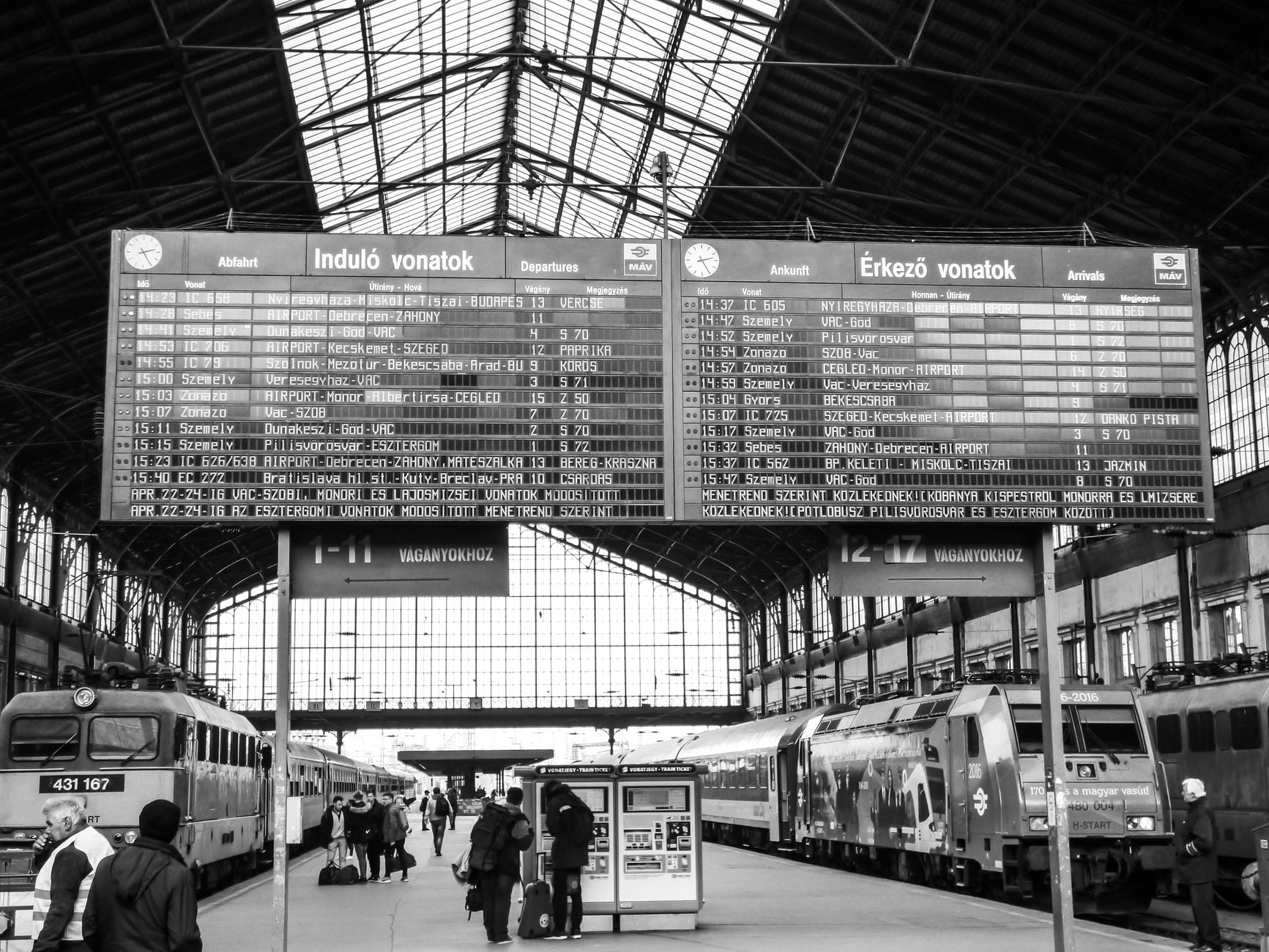
Budapest station boards display in Hungarian, cycling through English as well. Three words are worth knowing before you arrive.
Érkezés means arrivals. Indulás means departures. Vágány means platform.
If the board is on the Hungarian cycle when you look up, find your train by number or by the destination city name. Both stay legible regardless of the board language.
Frequently asked questions
What are the three main train stations in Budapest?
Budapest has three long-distance railway stations: Budapest-Keleti (East), Budapest-Nyugati (West), and Budapest-Déli (South). Keleti is the busiest and handles most international trains. Nyugati serves Prague, Bratislava, and the Berlin/Warsaw overnight sleeper. Déli mainly handles domestic routes to Lake Balaton.
Which Budapest train station do I need for Vienna?
For Vienna, your train departs from Budapest-Keleti. ÖBB Railjet services to Vienna and onward to Salzburg, Munich, Graz, Innsbruck, and Zurich all use Keleti. A seat reservation is strongly recommended on Railjet, especially on busy travel days.
Which Budapest station do I use for Prague?
Trains to Prague depart from Budapest-Nyugati, not Keleti. EuroCity services to Prague and Bratislava moved to Nyugati in December 2017. Check that your ticket says Budapest-Nyugati pu. before you travel.
Is there a train to Budapest airport?
No. Budapest Ferenc Liszt International Airport (BUD) has no rail link in 2026. The public transport connection is the 100E Airport Express bus, operated by BKK. It runs between the airport and Deák Ferenc tér in the city centre, with a stop at Kálvin tér. As of June 2026, the airport shuttle bus single ticket costs HUF 2,500. Check the current fare at bkk.hu.
Do I need a reservation on the Railjet from Budapest to Vienna?
A reservation is not compulsory on Railjet, but it is strongly recommended. Unreserved seats can be difficult to find on busy days, particularly on Friday evenings and around public holidays. ÖBB charges pass-holder reservation fees in EUR; book at oebb.at.
What is Budapest-Kelenföld station and do I need to use it?
Budapest-Kelenföld is a rail interchange in western Buda, on the main international line toward Austria. Many international trains, including Railjet services to Vienna, stop at Kelenföld as well as Keleti. Most travellers do not need it, but if your hotel is in southern Buda, it may be more practical than travelling to Keleti. Check your specific train at mavcsoport.hu to confirm whether it stops at Kelenföld.
Can I use an Interrail or Eurail Pass on trains from Budapest?
Yes. Interrail and Eurail passes are valid on MÁV-Start services, including international trains. However, the pass covers only the journey fare. On Nightjet overnight trains, a separate accommodation reservation is compulsory. On Railjet, a reservation is strongly recommended. On MÁV domestic InterCity trains, the IC supplement is compulsory even with a pass.
How do I transfer between Budapest-Keleti and Budapest-Nyugati?
Take the M2 Metro (red line) from Keleti pu. south to Deák Ferenc tér, then change to the M3 (blue line) and travel one stop north to Nyugati pu. Allow 15 to 20 minutes. Trams 4 and 6 also stop directly outside Nyugati if you are already on the Pest Ring Road.