
Train service

OBB
ÖBB is Austria’s national rail operator, known for its Railjet trains and Europe’s largest night train network, Nightjet.
Check times & pricesOfficial website Check times & prices
Westbahn
WESTbahn is a private Austrian train company offering fast, low-cost travel on modern double-decker trains between Vienna, Salzburg, and Munich.
Check times & pricesOfficial website
CFF
CFF is Switzerland’s national rail operator, known for punctual, fully electrified train services across the country and beyond.
Check times & pricesOfficial website
Deutsche Bahn
Deutsche Bahn (DB) is Germany’s national railway company, operating long-distance, regional, and international train services across Europe.
Check times & pricesOfficial websiteTrain tickets

Omio
Omio connects you with over 1,000 transport providers - trains, buses, flights, and more - to simplify your travel planning.

Trainline
Trainline sells rail and coach tickets worldwide on behalf of major UK and European transport companies.

Raileurope
Rail Europe is a leading travel tech company specializing in European train bookings for over 15,000 travel professionals worldwide.
Vienna is near the centre of Europe’s rail network, so arriving by train is straightforward from almost any direction. Most long-distance trains use Wien Hauptbahnhof, the main station, which handles over 1,000 trains a day and connects directly to the city’s U-Bahn. ÖBB runs the bulk of services, including the high-speed Railjet and the Nightjet overnight network. Vienna is the largest night train hub in the EU.
Direct trains reach Vienna from Munich in around 4 hours, from Budapest in as little as 2 hours 15 minutes, from Prague in around 4 hours, and from Berlin in around 8 hours. Nightjet overnight services run from Amsterdam, Brussels, Paris, Milan, Venice, and Zurich, among other destinations.
ÖBB Sparschiene advance fares start from €9.90 for domestic routes when booked early. Nightjet fares start from around €29.90 for a seat.
Train stations in Vienna
Vienna has three stations that matter for long-distance travel. Most trains use Wien Hauptbahnhof, but western routes and some international services use Wien Westbahnhof or Wien Meidling.
Wien Hauptbahnhof
Wien Hauptbahnhof is Vienna’s main arrival point for long-distance trains. It opened in December 2015 at Favoritenstraße 51 in the 10th district, south of the city centre. Almost every mainline service arrives and departs here, including all Railjet and Nightjet trains. The station is fully accessible and has a ticket office, an ÖBB first-class lounge, luggage storage, and a range of shops and restaurants including an Interspar Pronto supermarket. The U1 subway or Tram D takes you from the station to the city centre in around 10 to 15 minutes.
Wien Meidling
Wien Meidling at Eichenstraße 25 in the 12th district is a secondary station for long-distance trains and an intermediate stop on many services that continue to or from Hauptbahnhof. It has an underground concourse, a ticket office, an ÖBB lounge, and guidance systems for visually impaired travellers. The U6 subway runs directly from here.
Wien Westbahnhof
Wien Westbahnhof at Europaplatz 2 in the 15th district handles trains from western Austria and some international services. The station is integrated into BahnhofCity, a shopping mall with dining options. The U3 and U6 subway lines serve the station, and the Vienna AirportLines bus to Vienna Airport departs from Europaplatz.
“The new Main Station has turned Vienna into an international railway hub.” – vienna.info
| Station | Key features | Transit connections |
|---|---|---|
| Wien Hauptbahnhof | First-class lounge, supermarket, dining | U1, Tram D |
| Wien Meidling | Compact concourse, ÖBB lounge | U6 |
| Wien Westbahnhof | Shopping mall, dining, airport bus | U3, U6 |
Train companies and routes
ÖBB services
ÖBB (Austrian Federal Railways) runs the largest share of trains to and from Vienna. Services operate mainly through Wien Hauptbahnhof and Wien Meidling, and ÖBB is consistently among Europe’s most punctual train operators. Railjet trains have a restaurant car with at-seat service in first and business class, free Wi-Fi, and a power socket at every seat. Business class requires a mandatory seat reservation.
ÖBB’s Nightjet network connects Vienna to cities across Europe including Paris, Amsterdam, Brussels, Rome, Venice, Milan, and Zurich. Passengers choose between standard seating, a couchette (shared bunk), or a private sleeper compartment. Book Nightjet early if you want a sleeper or couchette, because these categories sell out well before seats.
Westbahn
Westbahn runs affordable domestic trains between Vienna and Bregenz, departing from Wien Westbahnhof and Wien Hütteldorf.
| Feature | Detail |
|---|---|
| Ticketing | Flexible tickets available onboard |
| Child fares | Under 6 travel free; ages 6-14 pay €3 with an adult |
| Onboard | Free WiFi, power outlets, vending machines |
| Route | Vienna to western Austria, stopping at key intermediate stations |
Other train companies
Deutsche Bahn (DB) operates multiple daily connections from cities across Germany. Schweizerische Bundesbahnen (SBB) runs direct trains from Zurich. RegioJet offers connections from Bratislava and Budapest. Fares and timetables are shown at regiojet.com, and prices vary by date and class.
Tickets can be booked via ÖBB’s website or app, or through resellers such as Trainline and Rail Europe. ÖBB accepts Eurail and Interrail passes, but each train company has its own ticketing system and reservation rules, so check before you travel.
Train types and classes
High-speed and intercity trains
ÖBB’s Railjet is the main high-speed option, running at up to 230 km/h and serving routes from Germany, Switzerland, and Hungary. ICE trains from Deutsche Bahn also run between major German cities and Vienna. EuroCity trains cover Vienna, Salzburg, and Innsbruck at reliable intercity speeds.
Regional trains stop at smaller stations across Austria and are the right choice for towns not served by Railjet. Journey times are longer, but fares are often lower.
Classes and onboard amenities
Most Vienna trains offer second and first class. Railjet trains add a Business class with premium seats, at-seat service, and a welcome drink. Reservation is compulsory for Business class and sensible in first class during busy periods.
Second class on Railjet is comfortable for any journey length. Railjet trains include free Wi-Fi, a power socket at every seat, a restaurant car, and a bar car. Air conditioning is standard.
The City Airport Train (CAT) runs non-stop between Wien Mitte and Vienna International Airport in 16 minutes, with departures every 30 minutes. A single ticket costs €14.90. Children under 15 travel free. If you hold a Wiener Linien annual pass or KlimaTicket, you qualify for a discounted CAT fare. Most ÖBB trains also accept guide dogs and small pets.
Train routes to Vienna
International connections
Direct trains reach Vienna from a wide range of countries.
From Germany, Railjet and ICE trains serve Munich in around 4 hours, with up to 16 daily departures across both operators. ICE services from Berlin take around 8 hours. Check current timetables before booking, as engineering works in 2026 have added some extra services between Vienna and Munich operated by ICE trainsets.
Direct trains also run from Budapest (around 2 hours 15 minutes to 2 hours 40 minutes depending on the service, with Railjet Xpress the fastest option), from Prague (around 4 hours by direct Railjet), and from Zurich (around 8 hours via the scenic Arlberg route). Bratislava is the shortest international connection at around 1 hour.
For overnight journeys, ÖBB Nightjet connects Vienna to a large network of European cities. Approximate journey times on main routes:
| Destination | Approximate journey time | Notes |
|---|---|---|
| Venice | Around 7 to 8 hours | |
| Milan | Around 11 to 12 hours | |
| Amsterdam | Around 14 to 15 hours | |
| Brussels | Around 15 to 16 hours | Selected days of the week |
Nightjet also runs to Paris, Hamburg, Rome, Zurich, and other destinations. Timetables vary by season. Check nightjet.com for current schedules.
Thanks to the Schengen Agreement, border crossings are generally straightforward on international routes. Carry a valid travel document because random ID checks can still occur onboard.
Austrian routes
Within Austria, Railjet and Railjet Xpress services form the core domestic network. Trains to Salzburg take around 2 hours 22 minutes and run roughly every 30 minutes throughout the day, making it the most frequent domestic ÖBB route. Trains to Graz and Innsbruck take around 2 hours 30 minutes and 4 hours respectively.
Vienna to Hallstatt is a popular day trip. Take a Railjet to Attnang-Puchheim or Salzburg and connect to a regional train, allowing around 3 to 4 hours each way.
| Service type | Vienna to Salzburg | Daily frequency |
|---|---|---|
| Railjet | Around 2h 22m | Frequent throughout the day |
| Railjet Xpress | Around 2h 22m | Frequent throughout the day |
| Nightjet | Around 2h 45m | Limited departures |
Travelling by train to Vienna can be faster than flying once airport transfer time is counted, particularly from Munich, Salzburg, or Budapest.
How to buy tickets
Where to book
ÖBB tickets can be bought at station ticket counters, ticket machines, online at oebb.at, or via the ÖBB app. Creating an ÖBB account gives you access to Sparschiene advance fares, which are only available online or via the app.
| Booking channel | Additional cost |
|---|---|
| Station ticket counters | No extra fee |
| Ticket machines | No extra fee |
| Onboard (long-distance) | €3 surcharge |
| ÖBB website or app | No extra fee |
| Travel centres at major stations | No extra fee |
Avoid buying onboard if you can. The €3 surcharge applies to long-distance tickets purchased from train attendants, and it buys you nothing extra.
For getting around Vienna itself, the WienMobil app combines public transit, bike-sharing, and taxi options in one place.
Ticket types and classes
| Class | What it includes |
|---|---|
| Standard (second class) | Comfortable seats, power sockets, access to restaurant and bar car |
| First class | More space, reclining seats, quiet zones |
| Business class | Premium seats, at-seat service, welcome drink, Wi-Fi. Reservation compulsory. |
ÖBB Sparschiene advance fares start from €9.90 for domestic routes and from €4.90 for some international routes. Tickets open for booking up to 6 months (180 days) before departure, online and via the app only. Book as early as possible for the lowest fares, particularly if you need a sleeper on a Nightjet.
“Our travel consultants will be glad to assist you. They can sell tickets, make seat reservations for you and provide you with any information you may need for your journey. Make the most of this personal service – throughout Austria at more than 50 travel centres located at ÖBB train stations.” – ÖBB
Seat reservations
Seat reservations are compulsory for Business class on Railjet trains. For Standard and First class, reservations are not required but are worth booking during busy periods such as public holidays and summer weekends. The ÖBB app also handles group bookings, bicycle transport, and tickets for dogs.
Getting to Vienna from the UK
There is no direct Eurostar service to Vienna. The most practical route from London is the Eurostar to Brussels (around 2 hours 15 minutes) or Paris, then a connecting Nightjet or daytime train onwards to Vienna.
From Brussels, a Nightjet to Vienna runs on selected days of the week and takes around 15 to 16 hours overnight. From Paris, the Nightjet to Vienna takes around 13 to 14 hours.
A daytime option is the Eurostar to Brussels or Paris, then a high-speed train through Germany or France to Vienna, though this requires at least one change and takes around 12 to 16 hours in total depending on connections.
Total London to Vienna journey time is typically 14 to 17 hours depending on route and connections. Booking the Eurostar and continental segments separately is usually the most flexible approach. ÖBB and Nightjet tickets can be bought at oebb.at or nightjet.com.
Station transport options
Public transit
Vienna’s train stations connect directly to the U-Bahn (underground), S-Bahn (local rail), trams, and buses. The network has five subway lines, 29 tram routes, and more than 130 bus routes. Vienna’s public transport runs without ticket barriers, but inspectors check tickets regularly, so validate your ticket before you travel.
A single ticket costs €3.20, or €3.00 when bought digitally via the app or a ticket machine. It is valid for one uninterrupted journey with any combination of U-Bahn, tram, and bus. A 24-hour pass costs €10.20, which is worth it for a full day of sightseeing. Vienna’s public transport also extends through the Verkehrsverbund Ost-Region (VOR) into parts of Lower Austria and Burgenland.
Taxis
Taxis are available at all major train stations. Vienna uses regulated taxi fares.
| Time of day | Base fare | Per km (first 4 km) | Per km (next 5 km) |
|---|---|---|---|
| Day | €3.80 | €1.42 | €1.08 |
| Night | €4.30 | €1.62 | €1.28 |
Waiting time is charged at €27.80 per hour. Fixed-price rides can be arranged through phone bookings or ride-hailing apps. Vienna taxis are licensed and metered.
Walking and cycling
Wien Hauptbahnhof and Wien Westbahnhof are within easy walking distance of hotels and trams. The WienMobil Rad bike-sharing programme has stations at Hauptbahnhof Süd, Floridsdorf S U, and Westbahnhof S U. For longer rentals or guided cycling tours, Pedal Power operates in central Vienna.
Sights near Vienna’s train stations
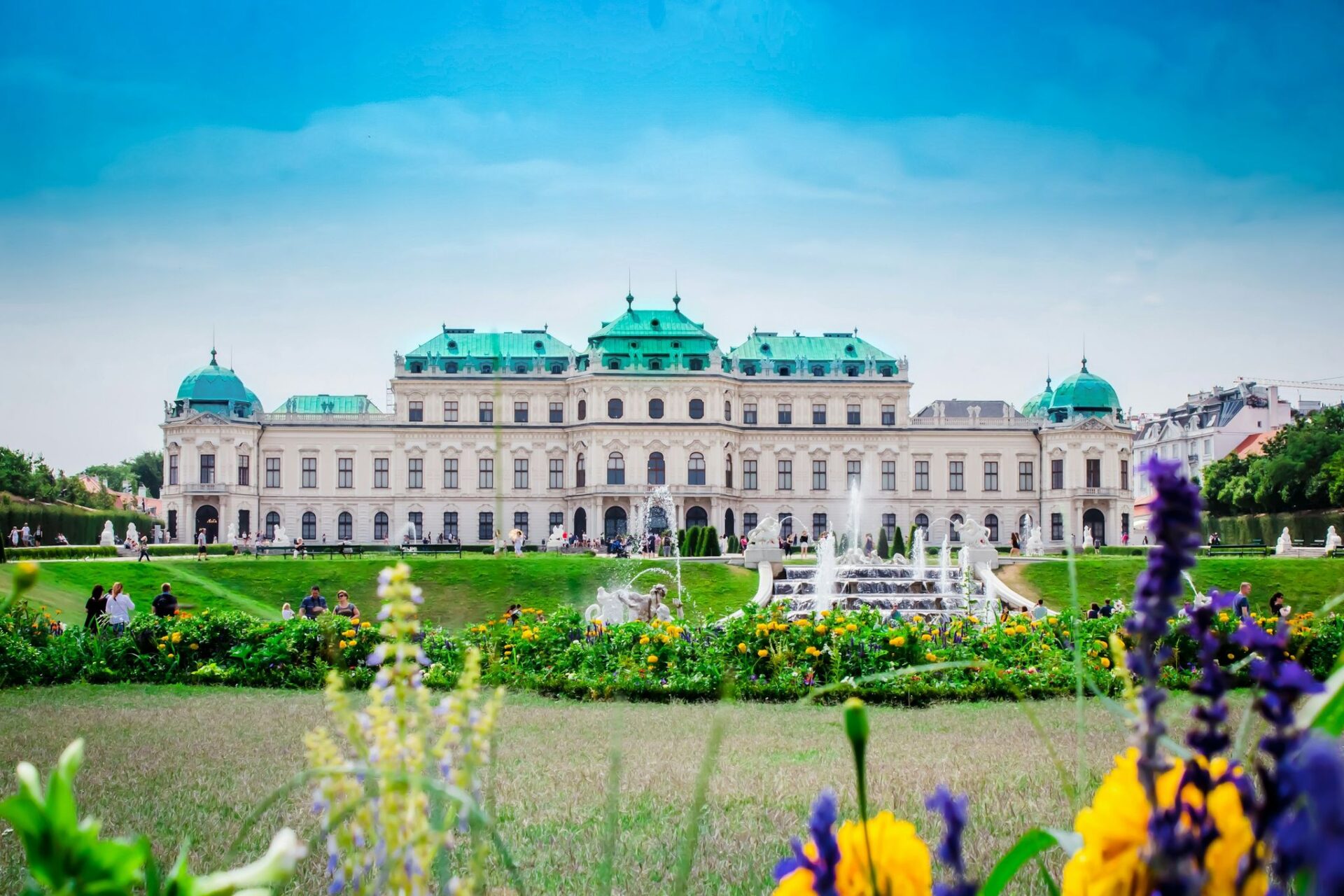
Wien Hauptbahnhof is well connected to Vienna’s main attractions. St. Stephen’s Cathedral is about 15 minutes away on the U1 to Stephansplatz. The Vienna State Opera is roughly 12 minutes away via U1 to Karlsplatz. Belvedere Palace is within walking distance of the station, around 15 to 20 minutes on foot.
Schönbrunn Palace is accessible from all three main stations: U1 to Karlsplatz then U4 from Hauptbahnhof (around 25 minutes), tram 60 from Westbahnhof (around 15 minutes), or U6 to Längenfeldgasse then U4 from Meidling (around 30 minutes).
Journey times are estimates based on normal conditions. A city transit pass makes it easy to combine stations and attractions in one day.
Travel by season
Winter (December to February)
Vienna winters are cold, with temperatures typically between -1 and 1°C and 15 to 20 cm of snowfall per month. December is the busiest period because of Vienna’s Christmas markets, which draw large crowds and fill trains from regional cities and neighbouring countries. Book train tickets well in advance if you are travelling in December.
Summer (June to August)
Summer temperatures in Vienna range from around 19 to 22°C in July and August. This period coincides with higher travel demand and, occasionally, engineering works on rail lines. The Donauinselfest in late June is one of the largest open-air events in Europe and adds to demand on trains into Vienna from nearby cities. Book early if your dates overlap with major events.
Timetable changes
European railways update timetables twice a year. The major revision takes effect at midnight on the second Saturday in December, with a minor adjustment in early June. Booking opens at the same time as the new timetable, so Sparschiene prices for post-December travel are not available until late June.
Planning tips
The ÖBB website and app both show live timetable information and disruptions. The SCOTTY mobile app is also useful for Austrian train planning. Engineering works can temporarily affect specific services, so check your route before travel, especially during summer.
Summary
Wien Hauptbahnhof handles the majority of trains to Vienna, with direct connections from major European cities and ÖBB Nightjet overnight services across the continent.
| From | Typical journey time | Starting fare | Main operator |
|---|---|---|---|
| Munich | Around 4 hours | From around €19 | Railjet, ICE |
| Prague | Around 4 hours | From around €15 | Railjet |
| Budapest | 2h 15m to 2h 40m | From around €14 | Railjet, Railjet Xpress |
| Berlin | Around 8 hours | From around €29 | ICE |
| Bratislava | Around 1 hour | Check at booking | RegioJet, ÖBB |
Advance Sparschiene fares start from €9.90 for domestic journeys and can be booked up to 6 months before departure. Nightjet sleeper trains start from around €29.90 for a seat. Book early if you want a private compartment, as these sell out on popular routes.
Vienna’s public transport network is extensive and easy to use from any of the three main stations. A single transit ticket costs €3.20 (€3.00 digital). The City Airport Train (CAT) connects Wien Mitte to Vienna International Airport in 16 minutes, with a one-way fare of €14.90.
Frequently asked questions
What are Vienna's main train stations?
For most visitors, Wien Hauptbahnhof is the right station. It opened in December 2015 and handles over 1,000 trains a day, including all Railjet and Nightjet services. There is a first-class lounge, luggage storage, and an Interspar supermarket on site; U1 and Tram D reach the city centre in around 10 minutes. Wien Meidling is a secondary stop on many of the same routes, with an ÖBB lounge and U6 access. Wien Westbahnhof serves western Austria and has a shopping mall and airport bus connections.
Which operator runs high-speed and overnight trains to Vienna?
ÖBB runs the most trains to Vienna. Its Railjet services are the main high-speed option; Nightjet handles overnight routes across Europe, with Wien Hauptbahnhof as the hub for both. Nightjet fares start from around €29.90 for a seat. Book sleeper and couchette places early, because they sell out before seats on popular routes.
Can I use an Interrail or Eurail pass to travel to Vienna?
Yes. ÖBB accepts Eurail and Interrail passes on Railjet and Nightjet services. Each operator has its own reservation rules, so check before you travel. On Nightjet, sleepers and couchettes usually require a pass-holder supplement on top of the base pass.
What onboard amenities are available on ÖBB Railjet trains to Vienna?
Railjet trains have free Wi-Fi, a power socket at every seat, a restaurant car, and a bar car. Air conditioning is standard. Business class adds at-seat meal service and a welcome drink, but a seat reservation is compulsory for that class.
Is there a direct train between Vienna city centre and Vienna International Airport?
Yes. The City Airport Train (CAT) runs directly between Wien Mitte and Vienna International Airport in 16 minutes, with a train every 30 minutes. A single ticket costs €14.90; children under 15 travel free. If you have a Wiener Linien annual pass or KlimaTicket, you pay a reduced fare.