
Marseille is, for practical purposes, a one-station city. The main station is Marseille-Saint-Charles, on a hill above Place des Marseillaises, and almost every traveller arriving by train will use it. A few other stops on the regional network sit inside the city limits, and one station near the airport carries the name “Marseille”. Confuse them in a booking flow and you can end up paying for a Marseille ticket that does not actually bring you to central Marseille.
This guide leads with the simple recommendation, then explains what to do at Saint-Charles, when (rarely) to pick a different stop, and how to reach the city, the airport, and the ferry or cruise port without wasting time.
Which Marseille train station you actually need
For almost every traveller, book Marseille-Saint-Charles. The station is also written Marseille Saint-Charles, Marseille St Charles, and Gare de Marseille-Saint-Charles, and they all refer to the same terminus. Every TGV inOui, Ouigo, TGV Lyria, Renfe AVE, Intercités and most relevant TER service to Marseille calls here.
Choose Marseille-Blancarde only if your specific TER train terminates there or you are changing for the regional line towards Aubagne, Toulon and Hyères. Choose Vitrolles Aéroport Marseille Provence only if you are travelling on the regional TER along the Avignon corridor and the timing genuinely suits your airport leg. The other Marseille stops (Arenc-Euroméditerranée, L’Estaque, Saint-Antoine, Picon-Busserine, La Pomme, La Barasse, Saint-Marcel, Sainte-Marthe) are local TER stations that a visitor should not book on purpose.
If a booking page shows only “Marseille”, open the train details and confirm the exact station name and arrival time before you pay.
Marseille’s train stations at a glance
Most travellers only need to recognise four station types: the main long-distance station, one secondary city station, the airport-adjacent TER station, and a group of local TER stops.
| Station | What it is | Choose it when | Avoid when |
|---|---|---|---|
| Marseille-Saint-Charles (Gare de Marseille-Saint-Charles) | The main station for Marseille; terminus of the Paris to Marseille and Marseille to Ventimiglia lines; on Square Narvik, 1st arrondissement | You want central Marseille, or any TGV, Ouigo, TGV Lyria, Renfe AVE, Intercités or summer Eurostar service | Almost never |
| Marseille-Blancarde | A secondary city station served only by TER PACA | Your specific TER terminates here, or you are changing for the Aubagne, Toulon or Hyères line | You want a central arrival; Blancarde is not the city centre and is not a high-speed station |
| Vitrolles Aéroport Marseille Provence | A TER station on the Avignon, Lyon and Narbonne axes, in the airport area but reached from the terminal by a separate connection | You are already on a TER along that corridor and the timing suits your flight | You expect to step off a train and into the airport terminal; it is not at the kerb |
| Other Marseille TER stops (Arenc-Euroméditerranée, L’Estaque, Saint-Antoine, Picon-Busserine, La Pomme, La Barasse, Saint-Marcel, Sainte-Marthe) | Small local stations for TER and suburban services | You live or stay nearby and a TER calls there | You are visiting Marseille; none of these are practical visitor arrival stations |
The rest of this guide focuses on Saint-Charles, with shorter sections on the airport link, the ferry and cruise port, and when to use Blancarde.
Marseille-Saint-Charles, the main station
Marseille-Saint-Charles is the southern terminus of the Paris to Marseille line and the western terminus of the line towards Ventimiglia in Italy. It opened on 8 January 1848 and sits on a small hill above Place des Marseillaises, with a grand staircase linking the station forecourt to the city below. Around 17.9 million passengers used it in 2024, making it the 27th busiest station in France.
Saint-Charles is a terminus, not a through station, so platforms behave differently from a Hbf-style hub. There are 14 dead-end platforms, lettered A to N on the main concourse, and trains roll in and stop. That means a few extra minutes when changing trains, because you walk forward off the platform, cross the concourse, and find your next platform letter from there. Plan a buffer if your connection looks tight on paper.
Services and operators at Saint-Charles
Saint-Charles hosts every major French long-distance service plus several international ones. In a booking flow you will normally see:
- TGV inOui from Paris-Gare-de-Lyon, Lille, Brussels via Lille, Strasbourg, Le Havre, Rennes, Nantes, Luxembourg and Nancy, plus the corridor that continues from Marseille to Toulon and Nice.
- A joint TGV and ICE service between Frankfurt and Marseille via Strasbourg, Mulhouse, Lyon, Avignon TGV and Aix-en-Provence TGV.
- Ouigo, the low-cost TGV brand, from Paris and Lyon.
- TGV Lyria from Geneva and Lausanne, with seasonal variation.
- Renfe AVE from Madrid via Zaragoza, Barcelona, Perpignan, Montpellier, Avignon TGV and Aix-en-Provence TGV.
- A seasonal Eurostar service between Marseille and Amsterdam via Brussels, normally running on summer Saturdays rather than year-round.
- Intercités on the Bordeaux to Toulouse to Narbonne to Marseille corridor.
- TER PACA towards Avignon, Aix-en-Provence, Briançon, Toulon, Hyères and along the Côte d’Azur, and TER Occitanie on the Narbonne, Perpignan and Portbou axis.
Paris to Marseille runs in around three hours on TGV via the LGV Méditerranée, which opened in 2001 and made the route a single working day for many travellers. Treat that as orientation, not a promise: check the journey time for your exact service when you book, because departures vary.
Getting out of the station and into the city
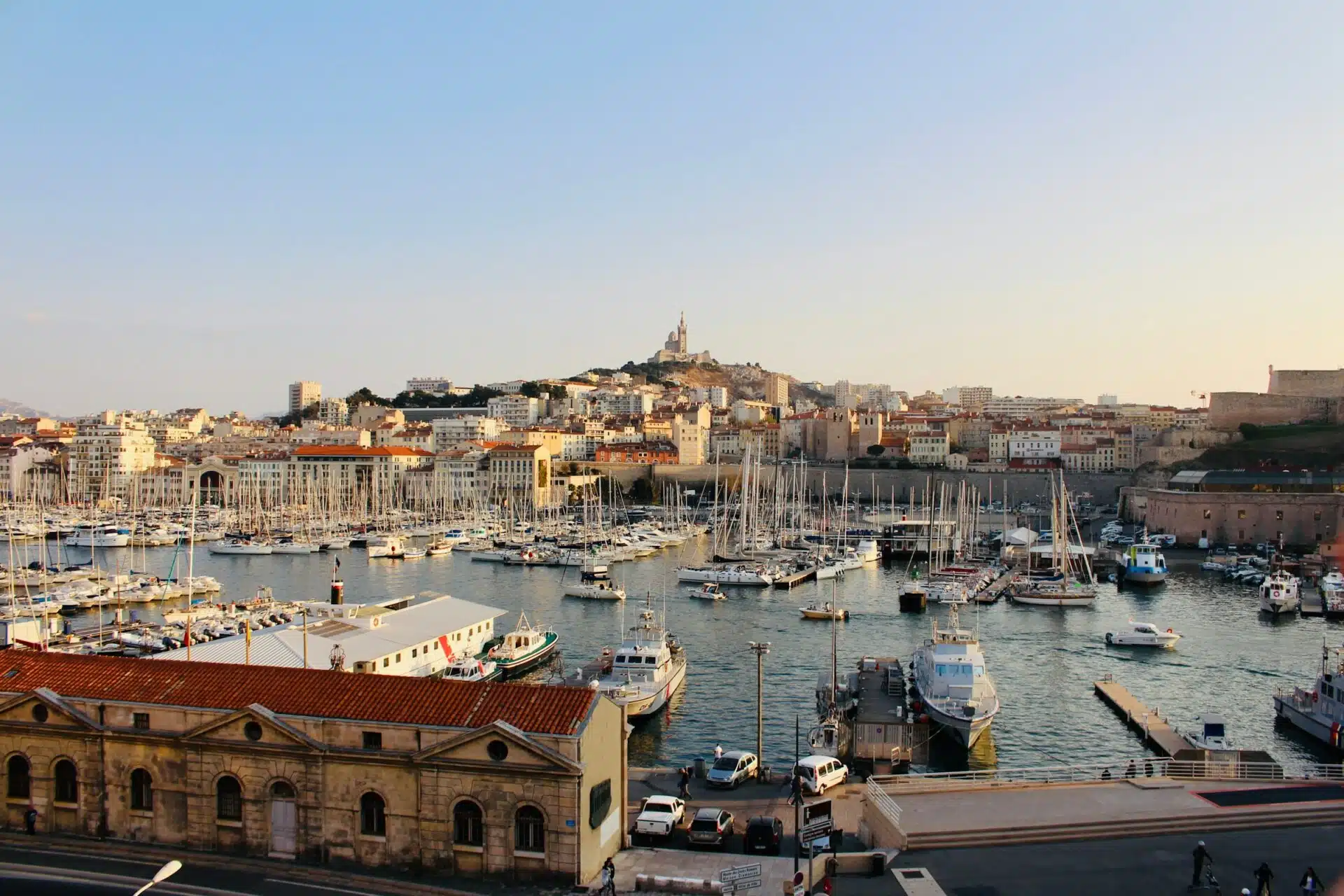
You have two clean ways out of Saint-Charles to central Marseille. The first is the grand staircase. Walk out of the concourse onto the terrace, take in the view over the city and the hill of Notre-Dame de la Garde, then go down the staircase to Place des Marseillaises. From there it is a flat walk down Boulevard d’Athènes and Boulevard Dugommier to La Canebière, with the Vieux Port at the end. The whole route is about 1.4 km and takes around 17 minutes.
The second is the metro. Inside the station, go down to the lower level and take metro line 1 in the La Fourragère direction. The Vieux-Port stop is two stops from Saint-Charles, via Colbert. With a heavy suitcase or a tight schedule, this is the easier choice. The same lower level also hosts metro line 2, which runs towards La Joliette and the cruise area.
Bus station, coaches and the airport shuttle
Marseille’s intercity coach station sits inside Saint-Charles itself, in the Honorat concourse. FlixBus and other intercity operators, regional coaches in the Provence-Alpes-Côte d’Azur network, and the Marseille Provence airport shuttle coach all use this bus station, not a separate building elsewhere in the city. If a booking refers to “Marseille coach station” or “Marseille bus station”, expect the same complex as the trains.
Left luggage and station services
Saint-Charles has a staffed left-luggage office run by Bag Mobile on level 0. To reach it from the main concourse, take the escalators or the lift down towards the metro and follow the signs. The station also has a ticket office, shops and food kiosks on the concourse, plus a regional ticket counter in the Honorat concourse opposite the bus station. Bag Mobile opening hours and prices can change, so check them before you rely on left luggage for a long day out.
Accessibility and assistance
Saint-Charles has PRM lifts and escalators between the concourse, the platforms and the metro level. SNCF runs an assistance service, Assist’enGare, for travellers with reduced mobility or who need help with luggage, and it works best when booked in advance for your specific train. If your journey involves changing trains at Saint-Charles, request assistance for both legs.
Rail passes and reservations at Saint-Charles
An Interrail or Eurail Pass is accepted at Saint-Charles, but the pass alone is not enough on most long-distance services. TGV inOui, Ouigo, TGV Lyria, Renfe AVE and the seasonal Eurostar all require a separate seat reservation in addition to the pass, and pass-holder places can sell out before standard fares on busy departures. TER services in Provence-Alpes-Côte d’Azur and Occitanie do not need a reservation, and daytime Intercités on the Bordeaux corridor are usually open-access, but the high-speed brands above are not. Book the reservation for your exact train; do not assume you can board.
Marseille-Blancarde and the city’s secondary stations
Marseille-Blancarde is the only other city station you might realistically end up at. It is a TER station east of the centre, used mainly by the TER PACA lines towards Aubagne, Toulon and Hyères, plus the local services towards Aix-en-Provence Ville and Pertuis. Book Blancarde only if your specific TER train starts or terminates there, or you are deliberately changing trains for the south-eastern line. Do not book a Blancarde arrival expecting a quick walk to the Vieux Port; for a central trip, you want Saint-Charles.
The other Marseille stops you may see in a search box (Arenc-Euroméditerranée, L’Estaque, Saint-Antoine, Picon-Busserine, La Pomme, La Barasse, Saint-Marcel, Sainte-Marthe) are small local TER stations. They are useful for residents and a handful of suburban journeys, not for a visitor planning a trip to Marseille.
Marseille airport and the Vitrolles station
The simplest way between Marseille Provence airport and Marseille-Saint-Charles is the direct airport shuttle coach, which uses the bus station inside Saint-Charles. It runs frequently through the day and lands you in the same complex as the trains. Check the live shuttle operator and timetable before relying on it, because schedules and fares can change.
Vitrolles Aéroport Marseille Provence is a separate TER station on the regional line between Marseille and the Avignon, Lyon and Narbonne corridors. Despite the name, it is not at the airport terminal: there is a public bus link between the station and the airport that you take in addition to your train. Use Vitrolles only when you are already on a TER along that corridor and the timing suits your flight, or when the airport coach genuinely does not fit your plan. For a one-off airport transfer, the shuttle to Saint-Charles is normally the cleaner answer.
Ferries and cruise port from Saint-Charles
For the ferry terminal at La Joliette, where the ships to North Africa and Corsica leave, take metro line 2 from Saint-Charles to La Joliette and walk through to the Gare Maritime. That is one practical metro ride and you should plan a few minutes for the walk through the terminal building.
The cruise port is a different problem. It is not walkable from Saint-Charles or from La Joliette, and there is no direct rail link. The usual route is metro line 2 to La Joliette, then bus 35T to the “Terminal Croisières” stop. From there it is a walk of roughly 800 m to 1.8 km to your berth, depending which cruise ship you are boarding. A free shuttle bus sometimes covers part of this, but it is not guaranteed. If you are arriving by train for a cruise, build the bus and the walk into your timing, and treat the cruise port leg as a separate connection, not an afterthought.
Three checks before you pay
Before booking any Marseille service, open the train details and confirm three things. First, the exact station name shown on the ticket: Saint-Charles is what you want for central Marseille; anything else is a deliberate choice for a TER or airport leg. Second, the operator, so you know whether it is TGV inOui, Ouigo, TGV Lyria, Renfe AVE, a summer Eurostar, Intercités or a TER. Third, if you are travelling on an Interrail or Eurail pass, that a seat reservation is included or booked separately for the high-speed services above. Get those three right and the rest of the trip is straightforward.
Frequently asked questions
What is the main train station in Marseille?
The main train station in Marseille is Marseille-Saint-Charles, also written Gare de Marseille-Saint-Charles or Marseille St Charles. It is a terminus on a hill above Place des Marseillaises and handles every TGV, Ouigo, TGV Lyria, Renfe AVE, Intercités, summer Eurostar and most relevant TER service to Marseille.
How many train stations does Marseille have?
Within the city limits, Marseille has around ten stations, but only Marseille-Saint-Charles really matters for visitors. Marseille-Blancarde is a secondary TER-only city station, and the rest (Arenc-Euroméditerranée, L'Estaque, Saint-Antoine, Picon-Busserine, La Pomme, La Barasse, Saint-Marcel, Sainte-Marthe) are small local stops. Vitrolles Aéroport Marseille Provence is a separate TER station near the airport, outside the city.
Is Marseille-Saint-Charles a terminus?
Yes, it is a terminus, with 14 dead-end platforms lettered A to N on the main concourse. Long-distance trains end their run at Saint-Charles, so when you change trains you walk forward off the platform, cross the concourse, and find your next platform letter from there. Build in a few extra minutes for tight connections.
How do I get from Marseille airport to Marseille-Saint-Charles?
The simplest option is the airport shuttle coach, which runs between Marseille Provence airport and the bus station inside Saint-Charles. If you are already on a regional TER along the Avignon corridor, the Vitrolles Aéroport Marseille Provence station is an alternative, but it is not at the airport terminal and needs a separate bus link.
How do I get from Marseille-Saint-Charles to the Vieux Port?
On foot, take the grand staircase down from the station, then walk along Boulevard d'Athènes, Boulevard Dugommier and La Canebière. The full walk is about 1.4 km and takes around 17 minutes. By metro, take line 1 in the La Fourragère direction; Vieux-Port is two stops from Saint-Charles.
Can I use an Interrail or Eurail Pass at Marseille-Saint-Charles?
Yes, but you still need a separate seat reservation for the high-speed services: TGV inOui, Ouigo, TGV Lyria, Renfe AVE and the seasonal Eurostar. TER trains in Provence-Alpes-Côte d'Azur and Occitanie do not need a reservation. Book the reservation in advance, especially in summer, because pass-holder places can sell out before standard fares.
Where is left luggage at Marseille-Saint-Charles?
Left luggage at Saint-Charles is run by Bag Mobile, on level 0 of the station. From the main concourse, take the escalators or lift down towards the metro and follow the signs. Opening hours and prices can change, so check the latest before you store a bag for the whole day.