
Cologne has more than one usable train station, and the choice matters. For almost every visitor the right station is Köln Hauptbahnhof (Köln Hbf), the city’s main hub right next to Cologne Cathedral. The east-bank station, Köln Messe/Deutz, is the right choice only for travellers heading to the trade-fair grounds, the Lanxess Arena, or a hotel on that side of the Rhine, and during engineering work when long-distance trains divert there. Köln/Bonn Airport has its own rail station too, mainly for the S-Bahn link into the city.
This guide tells you which station to book, when to choose differently, and what to check before you pay.
The three stations that matter, and one to know about
Most travellers only need to think about three Cologne stations:
- Köln Hbf: the central station, west bank of the Rhine, immediately next to the cathedral. Default for almost everyone.
- Köln Messe/Deutz: across the Rhine, next to Koelnmesse and the Lanxess Arena. Choose if your hotel or event is on the east bank, if your booked train calls here, or if Hbf is closed.
- Köln/Bonn Flughafen: the rail station under Terminal 2 at Köln/Bonn Airport. Use if you are flying.
There is also Köln-Ehrenfeld, a few minutes west of Hbf. It is not a normal traveller choice, but during major engineering work at Hbf some ICE and IC trains, particularly towards Aachen and Brussels, are sent here. Check your ticket if you see “Köln-Ehrenfeld” instead of “Köln Hbf”.
One quick warning before you book. International booking pages often show only “Cologne” or “Köln”. Open the train details and confirm the station code: KK is Köln Hbf, KKDZ is Köln Messe/Deutz. The two stations are around 15 to 20 minutes apart on foot across the Hohenzollern Bridge, and confusing them is the most common Cologne booking mistake.
Köln Hauptbahnhof: the central station for almost everyone
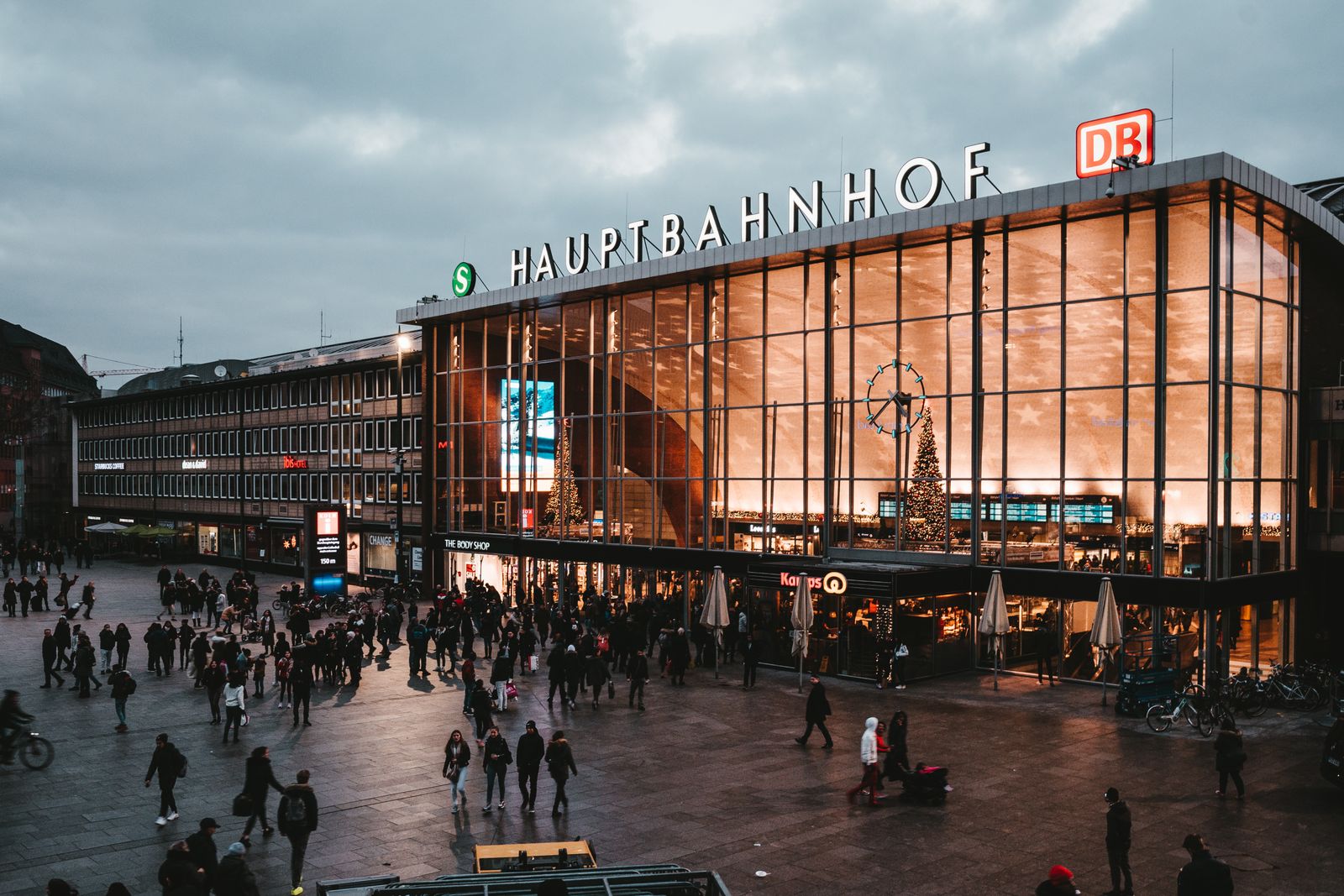
Köln Hbf is the obvious choice. The main exit faces the south side of Cologne Cathedral, so the most photographed building in Germany is on the doorstep. The cathedral steps are around a one-minute walk. The old town, the Rhine promenade, and the Hohenzollern Bridge are all within ten minutes on foot.
The station is one of the busiest long-distance hubs in Germany. Deutsche Bahn cites around 1,300 train movements a day at full service capacity. From a single platform deck you can board ICE, IC, EC, Eurostar (the post-merger high-speed brand to Brussels, Paris and Amsterdam), ÖBB Nightjet overnight trains, DB Regio RE and RB regional services, and the local S-Bahn. Flixtrain also calls here on selected long-distance routes.
Useful facilities at Köln Hbf include a DB Reisezentrum (the staffed ticket office for tickets, BahnCard purchases, refund and exchange help), a DB Lounge for first-class and BahnCard 100 customers, luggage lockers (Schließfächer) in the main concourse, a Bahnhofsmission for travellers in difficulty, a 3-S Centre for service and safety issues, a mobility service for assisted boarding, public WiFi, a bike garage, and a taxi rank at the south exit.
A practical note. The station has two main exits, north and south. The south exit is the cathedral side and is what most visitors want. The north exit drops you straight into the city centre and is sometimes faster for hotels north of the cathedral square.
Köln Messe/Deutz: when the east-bank station is the right call
Köln Messe/Deutz sits on the east bank of the Rhine, across the Hohenzollern Bridge from Hbf. The station is right next to Koelnmesse, the city’s main exhibition centre, and a short walk from the Lanxess Arena. If you are attending a trade fair or a concert there, Messe/Deutz is the right station and Hbf is the wrong one.
Some long-distance trains call at both Hbf and Messe/Deutz, and a few call only at Messe/Deutz. During engineering work at Hbf, most of the long-distance traffic diverts here. In November 2025, when Hbf closed for ten days for new signal-box and switch work, ICE and IC trains to Amsterdam, Berlin, Frankfurt, Bremen and Hamburg were all redirected to Messe/Deutz, and the pattern is likely to recur the next time Hbf needs major work.
Walking between Hbf and Messe/Deutz takes around 15 to 20 minutes on the Hohenzollern Bridge pedestrian walkway, which is one of the most pleasant station-to-station walks in Germany. The S-Bahn covers the same distance in a few minutes if you have luggage or short time before a connection.
When booking, check the station code on the train details page. The code KKDZ means Köln Messe/Deutz, not Köln Hbf. If your hotel is in the cathedral district, that is not the station you want.
Köln/Bonn Airport: the airport rail link
Köln/Bonn Airport (CGN) has its own train station, Köln/Bonn Flughafen, under Terminal 2. The S-Bahn lines S13 and S19 connect it to Köln Messe/Deutz and Köln Hbf in around 15 minutes. The S19 has run to the airport since December 2019, so older guides may show only S13.
A small number of long-distance ICE services also call at the airport station, mainly useful when you are connecting between Köln/Bonn and Frankfurt Airport’s long-distance station (Frankfurt Flughafen Fernbahnhof) without passing through either city centre. For most journeys into Cologne, the cheap, frequent S-Bahn is what you want.
One source of confusion is worth flagging. “Cologne” in the Ryanair sense sometimes means Frankfurt-Hahn, an airport around 130 km away with no rail station and no rail connection to Cologne. Check the airport code before you book a flight, not after.
Where Cologne trains actually take you
Most international visitors to Cologne arrive on a handful of routes. The fact floor below is orientation only; check the exact journey time and price for your date when you book.
| Route | Operator(s) | Typical journey time | Best Cologne station |
|---|---|---|---|
| Cologne to Brussels-Midi | Eurostar | around 1h 50m | Köln Hbf |
| Cologne to Paris-Nord | Eurostar | around 3h 15m | Köln Hbf |
| Cologne to Amsterdam Centraal | Eurostar / ICE International | around 2h 35m to 2h 50m | Köln Hbf |
| Cologne to London St Pancras | Eurostar via Brussels (change) | around 4h 45m to 5h with one change | Köln Hbf |
| Cologne to Frankfurt (Main) Hbf | ICE on the high-speed line | around 1 hour 2 minutes on the fastest services | Köln Hbf or Messe/Deutz |
| Cologne to Berlin Hbf | ICE | around 4h 15m to 4h 30m | Köln Hbf or Messe/Deutz |
| Cologne to Hamburg Hbf | ICE | around 4h | Köln Hbf or Messe/Deutz |
| Cologne to Vienna | Nightjet (ÖBB) | overnight, around 13h | Köln Hbf |
The Frankfurt corridor is the one that surprises people. The dedicated high-speed line between Köln and Frankfurt, opened in August 2002, runs trains at up to 300 km/h and brings city-centre to city-centre time down to around 62 minutes on the fastest ICE services, with most departures around 75 to 80 minutes. For Frankfurt Airport specifically, ICE trains call at Frankfurt Flughafen Fernbahnhof, the long-distance airport station, so a Cologne to Frankfurt Airport rail connection is faster and easier than most people expect.
Tickets, passes and reservations
If you are travelling with an Interrail or Eurail Pass, the rules at Cologne stations differ by train. Get this wrong and you will board the wrong way around.
- ICE, IC and EC within Germany. No compulsory reservation. You can usually board, find any unreserved seat, and travel on the pass alone. A seat reservation is available for a small extra fee and worth it on busy routes.
- Eurostar (Brussels, Paris, Amsterdam, London). Compulsory seat reservation for pass holders, plus a fixed pass-holder fee. Pass-holder quotas are limited and can sell out weeks ahead, especially in summer. Book the reservation as soon as the booking window opens for your date.
- ÖBB Nightjet overnight trains. Compulsory reservation. The pass covers the travel day, not the bed. Book the seat, couchette or sleeper category you actually want, because the cheaper berths sell out first.
- Flixtrain and other open-access operators. Not covered by Interrail or Eurail. Buy a separate ticket.
BahnCard discounts (BahnCard 25, 50 or 100) apply only on tickets booked through Deutsche Bahn channels: db.com, DB Navigator, the Reisezentrum at the station, or DB ticket machines. They do not stack with pass-holder reservations.
The single biggest mistake at Köln Hbf is treating Eurostar like ICE. Walking up to the platform without a reservation works for ICE; it does not work for Eurostar. Book the reservation before you go.
Engineering work and station closures
Cologne Hbf has had recurring engineering closures since the November 2025 signal-box failure, and Deutsche Bahn has flagged that further closures are likely while the work is finished. There is also a longer-running replacement-service period on the Hagen to Wuppertal to Cologne corridor running through 2026. None of this should stop you booking Cologne, but it does mean you should check live departures on the day of travel.
The DB Navigator app and db.com both show planned closures, replacement-bus services, and platform changes. When the Hbf is fully closed, long-distance trains usually divert in a recognisable pattern: international trains to Brussels and Aachen run from Köln-Ehrenfeld, while ICE and IC services to Amsterdam, Berlin, Frankfurt and Hamburg run from Köln Messe/Deutz, sometimes with a reduced schedule. Some Berlin services are routed via Düsseldorf instead.
The practical rule is simple. Check your train on the booking platform the day before, and again on the morning of travel. If your station has changed, you will see it in the train details before you leave the hotel.
Getting from the station to the cathedral and the old town
Walk. From Köln Hbf the main south exit faces the cathedral, around a one-minute walk. The Hohe Strasse shopping street, the old town (Altstadt), the Rhine promenade, and the Hohenzollern Bridge are all within ten minutes of the station on foot. There is rarely a reason to take public transport from Hbf to the centre.
From Köln Messe/Deutz the walk into the centre is around 15 to 20 minutes across the Hohenzollern Bridge. The pedestrian walkway runs along both sides of the bridge, with views back over the cathedral and the Rhine. With heavy luggage, take the S-Bahn one stop to Hbf.
The KVB tram and U-Bahn network is excellent for outer districts, but for the cathedral, museums and central restaurants from either station, your feet are faster than any ticket.
Luggage, food and waiting at Köln Hbf
For a few hours’ stopover, the station handles the basics well. DB Schließfächer (luggage lockers) are in the main concourse; small and large sizes are available, and they take card payment. They fill up around major events and trade fairs, so leave time to find one in busy weeks.
The DB Reisezentrum is the place to go for ticket questions, refunds, reservations and BahnCard purchases. The DB Lounge, on the upper level, is open to first-class long-distance ticket holders, BahnCard 100 holders, and ÖBB Business equivalents.
For food, the concourse has the usual mix of bakeries, coffee chains, fast food and a small supermarket. For better food you are better off walking five minutes into the old town. The Bahnhofsmission, near the main hall, helps travellers in difficulty without charge or registration.
Frequently asked questions
What is the main Cologne train station called?
The main station is Köln Hauptbahnhof, usually shortened to Köln Hbf and called Cologne Central Station in English. It is in the city centre on the west bank of the Rhine, right next to Cologne Cathedral. For almost every visitor to Cologne, this is the station to book.
Is there more than one train station in Cologne?
Yes. The three you may actually use are Köln Hbf (central, default for most), Köln Messe/Deutz (across the Rhine, useful for trade-fair traffic and during Hbf engineering work), and Köln/Bonn Flughafen (the rail station at the airport). Köln-Ehrenfeld also handles some long-distance diversions when Köln Hbf is closed.
Which train station is closest to Cologne Cathedral?
Köln Hbf. The south exit of the station faces the cathedral, around a one-minute walk away. No tram or U-Bahn is needed.
Is Köln Messe the same as Köln Hbf?
No. Köln Messe/Deutz is a separate station across the Rhine from Köln Hbf, about 15 to 20 minutes apart on foot. They are different stations with different station codes (KK for Hbf, KKDZ for Messe/Deutz). Booking the wrong one is the most common Cologne booking mistake.
Is there a train station at Cologne Airport?
Yes. The Köln/Bonn Flughafen station sits under Terminal 2 at Köln/Bonn Airport (CGN). S-Bahn lines S13 and S19 link it with Köln Hbf and Köln Messe/Deutz in around 15 minutes. A small number of long-distance ICE services also call at the airport station.
How far is Cologne Old Town from the train station?
The Altstadt (old town) starts a few minutes from Köln Hbf on foot. From the south exit, the cathedral, the Rhine promenade, the Hohe Strasse shopping street and the old-town squares are all within ten minutes' walk.
Are Köln and Cologne the same city?
Yes. Köln is the German name and Cologne is the English name for the same city in western Germany. Train tickets may show either form, depending on where the ticket is sold.