
Bruges keeps the station question simple. There is only one usable train station, and everyone arrives there. On Belgian Railways it is called Brugge. On most international booking pages it shows up as Bruges. They are the same place, at Stationsplein 5, about 1.5 km south of Markt. The interesting question is not which station to book. It is how to get from the station into the historic centre, and how to connect to the rest of Europe through Brussels.
Brugge is the only station you need
When a booking page shows the destination as Bruges, the station is Brugge. The Dutch name is Station Brugge and the French name is Gare de Bruges. All three refer to the same building. The station is run by SNCB/NMBS, the Belgian national rail operator, and sits at Stationsplein 5. There is no second usable main-line station in the city.
If you have read the official Visit Bruges tourist site and seen a reference to a station called Brugge Sint-Pieters, ignore it for booking purposes. That name does not match any standard SNCB station on a normal journey planner, and it is not where intercity trains from Brussels, Ghent, or the airport stop. Book to Brugge or Bruges, and you will arrive at the right place. The station code is FR if your ticket shows one.
The current station building has been in use since 1939, designed in the International Style by the brothers Josse and Maurice Van Kriekinge. It has five island platforms and twelve tracks. Not a small halt.
Where the station sits and getting to Markt
The station is about 1.5 km south of the historic centre. The walk to Markt, the main square, takes around 20 to 25 minutes through Oostmeers and ’t Zand. With light bags and a clear afternoon, walking is genuinely pleasant. With a wheeled case on cobblestones, it is a slog.
If you have luggage, take the bus. De Lijn lines 1 and 2 leave from the bus station directly in front of the train station and stop at Dijver, just south of the Grote Markt. Tickets come from the driver or the De Lijn vending machines on the platform. There is also a city-run shuttle bus that runs in a loop into the historic centre from a stop to the right of the bus station, calling at Wollestraat by Markt. Confirm the current fare on the day, as it has changed over the years.
Taxis wait outside the main entrance. They are sensible for late arrivals, heavy bags, or hotels out near the canal ring.
Inside the station
Brugge station is simpler than its size suggests. A single wide underpass runs beneath the platforms, with the ticket office at the city-centre end. Escalators, stairs, and lifts on every platform lead down to that passage. If you are unsure which way to leave, follow the signs out to Stationsplein. You will arrive at the bus station, the taxi rank, and the shuttle stop together.
The ticket office opens 06:15 to 20:00 on weekdays and 07:15 to 20:00 at weekends. The main hall opens from about 03:30 in the morning until just after 02:00 the next night, so an early or late train is workable. There are luggage lockers and a small set of shops in the underpass. Behind the station, an underground car park holds about 800 cars and 1,000 bikes, completed in 2010.
If you need mobility assistance, request it through SNCB before you travel. Lifts and an adapted ticket counter are available.
International travel via Brussels-Midi
There is no Eurostar to Bruges. There is no TGV and no ICE either. The daily Thalys high-speed service from Bruges to Paris ran from 1998 until 31 March 2015, and it was not replaced. If your trip starts in London, Paris, Amsterdam, or Cologne, you change at Brussels-Midi. SNCB also calls it Brussel-Zuid in Dutch and Bruxelles-Midi in French.
The handover is straightforward. International trains arrive at Brussels-Midi, and a Belgian intercity train continues to Bruges in about one hour. SNCB runs roughly three IC trains an hour on this route, so a missed connection is rarely a disaster. Allow at least 30 minutes between an Eurostar arrival and an IC departure when you book, especially with a checked-in case or on a busy summer weekend.
Useful end-to-end times from the major gateways:
- London St Pancras to Bruges, around 3 hours 15 minutes via Brussels-Midi.
- Paris-Nord to Bruges, around 2 hours 30 minutes.
- Amsterdam Centraal to Bruges, around 2 hours 53 minutes via Eurostar and IC, or around 3 hours 35 minutes on NS via Antwerp and Ghent.
- Lille-Flandres to Bruges, around 1 hour 30 minutes, direct via Kortrijk on French and Belgian rail, with no need to detour through Brussels.
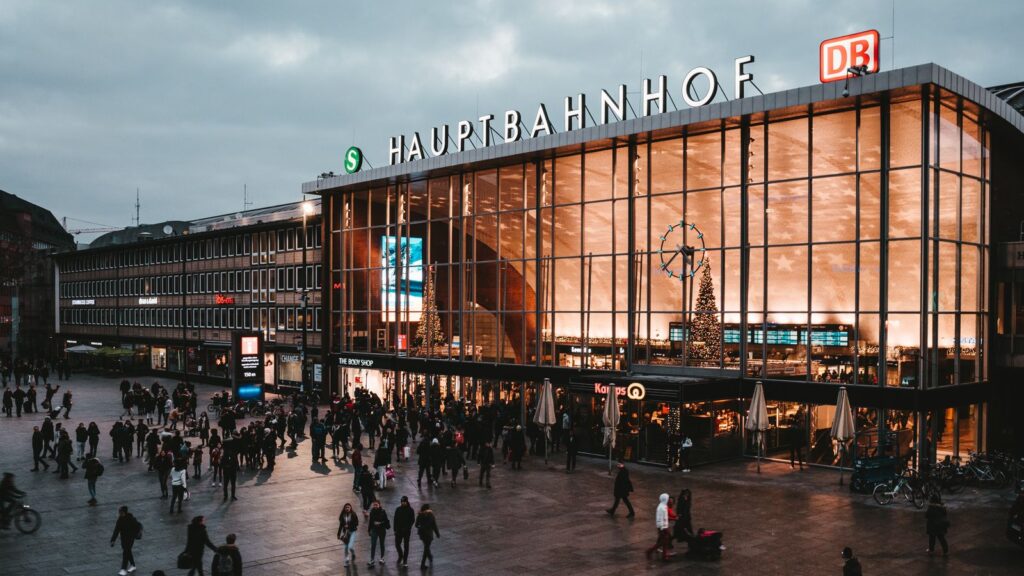
- Cologne Hauptbahnhof to Bruges, around 3 hours via Brussels-Midi.
For most travellers, Brussels-Midi is the connecting station. Lille is the exception worth knowing.
From Brussels Airport (Zaventem) to Bruges
Brussels Airport sits at Zaventem, north-east of the capital. On weekdays you can usually reach Bruges in about 1 hour 30 minutes on an hourly direct intercity that runs via Ghent. A second daily direct service via Kortrijk takes about 2 hours 30 minutes, which is fine if your flight lands at the right moment but rarely worth waiting for.
Weekends are different. The direct services run less often, and changing at Brussels-Midi is often quicker than waiting at the airport. Check the timetable on belgiantrain.be on the day. If the next direct option is more than 30 minutes away, the change at Midi will usually beat it.
Buy the airport ticket at a vending machine in Brussels Airport station, or as part of a single ticket from belgiantrain.be that includes the airport surcharge. The surcharge funds the underground tunnel into the airport station and is normal.
Onward trains from Bruges
Bruges is a useful base for the Belgian coast and the rest of Flanders. The most practical onward connections from the same Brugge platforms are:
- Ghent (Gent-Sint-Pieters), 2 to 4 trains per hour, about 25 minutes.
- Antwerp Central, around hourly, about 1 hour 30 minutes.
- Leuven, one or two trains an hour, about 1 hour 30 minutes.
- Kortrijk, hourly, about 1 hour, with onward connections to Lille-Flandres in France.
- The Belgian coast: Ostend, Blankenberge, and Knokke are all hourly or better, with journey times under 25 minutes.
Most trains from Bruges run in one of two directions: inland towards Ghent and Brussels, or out to the coast towards Knokke, Blankenberge, or Ostend. Read the destination on the platform display before you board. The same platform can host a coast train and a Brussels train within a few minutes of each other.
Tickets, passes, and what to book
For trips inside Belgium, buy at belgiantrain.be, at the Stationsplein ticket office, or at a vending machine in the underpass. Belgian intercity trains do not require a seat reservation. A flexible single lets you board any train on the day; a date-specific ticket binds you to a booked one.
There is no tourist smartcard for SNCB intercity tickets. The local MOBIB card mostly works for Belgian residents and is not a useful Oyster-style option for visitors.
Interrail Pass and Eurail Pass holders are covered for SNCB intercity and local trains, with no reservation needed on the Belgian side. The international leg is different. Eurostar requires a separate pass-holder reservation, bought through Eurostar or a reseller. Numbers are limited at peak times, particularly summer weekends and the run-up to Christmas markets, so book the international leg as soon as your dates are firm.
A note on the old Bruges stations
Today’s station is the third Bruges main station. The railway first arrived in 1838, with a small original station on ’t Zand inside the medieval walls. A new building by Auguste Payen opened on the same square in 1844, was demolished and rebuilt in Ronse in 1879, and replaced with a larger Joseph Schadde station on ’t Zand in 1886. Both earlier stations are gone. The 1886 building stood derelict through the Second World War and was demolished in 1948.
If an older guide refers to a “Brugge Centraal” or to a station on ’t Zand, it is talking about history. There is only one working station today: Brugge, at Stationsplein 5.
Frequently asked questions
How many train stations are there in Bruges?
There is one train station that travellers use, called Brugge on Belgian Railways and Bruges on most international booking pages. Both names point to the same station at Stationsplein 5, about 1.5 km south of Markt. Older guides and the official tourist site sometimes mention a Brugge Sint-Pieters station, but that name does not match a working SNCB intercity stop and is not where trains from Brussels, Ghent, or the airport call.
What is the main train station in Bruges called?
Belgian Railways calls it Brugge. International booking pages usually show it as Bruges. The Dutch name on the building is Station Brugge and the French equivalent is Gare de Bruges. All four names refer to the same station, at Stationsplein 5 in the south of the city.
Is there a Eurostar to Bruges?
No. Eurostar does not run direct trains to Bruges, and neither does TGV or ICE. From London, Paris, Amsterdam, or Cologne, take the international train to Brussels-Midi (also called Brussel-Zuid in Dutch and Bruxelles-Midi in French), then change there for a Belgian intercity train that reaches Bruges in about one hour. The old daily Thalys from Bruges to Paris ended on 31 March 2015 and was not replaced.
How do I get from Bruges train station to the city centre?
The walk to Markt is about 20 to 25 minutes through Oostmeers and 't Zand. With luggage, take De Lijn bus 1 or 2 from the bus station directly in front of the train station to the Dijver stop, just south of the Grote Markt. There is also a city-run shuttle bus that calls at Wollestraat by Markt, leaving from a stop to the right of the bus station. Confirm the current shuttle fare on the day, as the price has changed over the years. Taxis wait outside the main entrance.
How long does it take to get from Brussels to Bruges by train?
About one hour. SNCB runs roughly three intercity trains an hour from Brussels-Midi to Bruges, with no seat reservation required. Most of those trains continue to Knokke, Blankenberge, or Ostend on the Belgian coast, so confirm the destination on the platform display before you board.
Can I take a train from Brussels Airport to Bruges?
Yes. On weekdays there is an hourly direct intercity from Brussels Airport (Zaventem) to Bruges via Ghent, taking about 1 hour 30 minutes. A second daily direct service via Kortrijk takes around 2 hours 30 minutes. At weekends the direct services run less often and changing at Brussels-Midi is usually quicker. Check the timetable on belgiantrain.be on the day. The ticket includes the airport-station surcharge for the underground tunnel into the terminal.
Do I need a seat reservation for trains in Belgium?
No. SNCB intercity trains do not require a seat reservation. A flexible single ticket lets you board any train on the day, and a date-specific ticket binds you to a particular service. Reservations are only required for the international Eurostar leg from London, Paris, or Amsterdam, which is bought separately.
Is an Interrail Pass valid in Belgium and on the way to Bruges?
Yes, an Interrail Pass and a Eurail Pass are valid on SNCB intercity and local trains, with no reservation needed once you are inside Belgium. The international leg is different. If you are travelling on Eurostar from London, Paris, or Amsterdam to Brussels-Midi, you need a separate pass-holder reservation on Eurostar. Numbers are limited, especially on summer weekends and in the run-up to the Christmas markets, so book the international leg as soon as your dates are firm.