
Basel has three usable mainline stations spread across three jurisdictions: Swiss, German, and French. Most visitors only need to know one. Basel SBB is the main hub, and almost every long-distance and international service starts, ends, or stops here.
The other two matter for specific cases. Basel Badischer Bahnhof, abbreviated Basel Bad, is the German-operated station on the right (north) bank of the Rhine. Basel SNCF is not a separate building. It is the western set of platforms inside Basel SBB itself, reached through a border crossing within the station.
Switzerland’s national rail operator is SBB, written CFF in French and FFS in Italian. Same company, three languages. You will see all three names on tickets, timetables, and station signs.
Open the train details before you pay and confirm the station name. Booking pages often show only “Basel”, but Basel SBB and Basel Bad are different platforms in different parts of the city.
Basel SBB: the main hub for almost every journey
For nearly every visitor, book Basel SBB. About 1,000 trains a day depart from here, roughly one every 90 seconds. The current neo-baroque building opened in 1907, designed by Emil Faesch and Emmanuel La Roche, on a site first used in 1854. It is Europe’s busiest international border station and a Swiss heritage site of national significance.
The station is owned by SBB CFF FFS and partly operated by France’s SNCF. TGV Lyria services to Paris, ICE trains to Germany, EuroCity trains to Milan via the Gotthard, Nightjet sleepers, and most domestic services to Zurich, Bern, Lucerne, Lausanne, Geneva, Interlaken, and Lugano use Basel SBB.
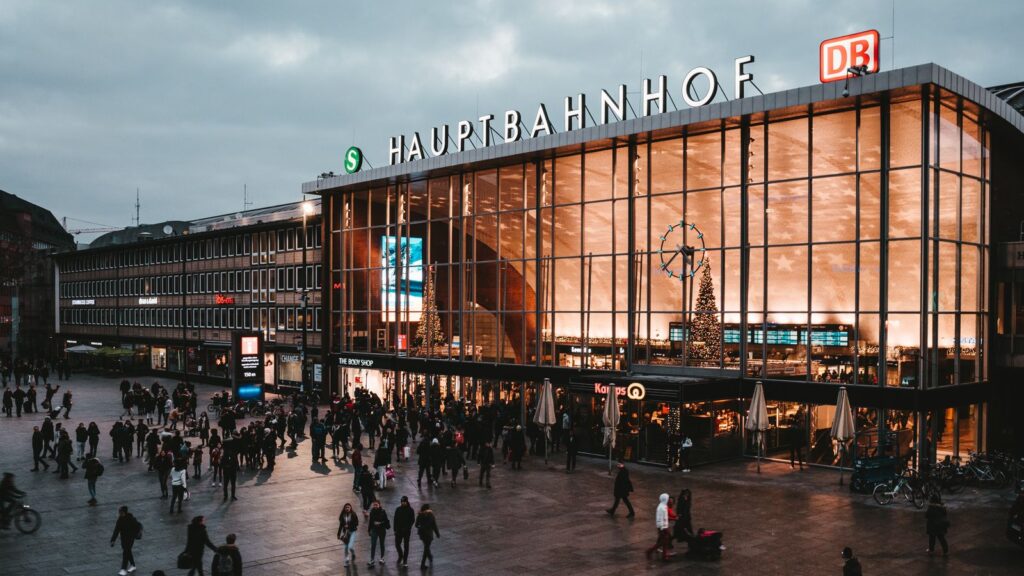
Note the name. Basel does not call its main station Hauptbahnhof, and there is no “Basel HB” in SBB systems. Locally and on signs, it is Bahnhof Basel SBB, often shortened to Bahnhof SBB.
The ticket hall sits under a timber-lined steel-arch structure with 1920s murals advertising Swiss destinations. There are no ticket barriers at platform level, so luggage and pushchairs move freely. Check the Gleis (platform number) on the departure board shortly before your train.
Basel SBB platforms and the SNCF wing (tracks 30 to 35)
Basel SBB has a large set of ground-level tracks under the 1905 train shed, plus newer tracks added on the south side. The important thing to know is what happens on the western end.
Tracks 30 to 35 are the Basel SNCF platforms, attached to the west wing of Basel SBB. SBB online timetables sometimes call them Basel SBB Gl. 30 to 35; other booking systems show them as Basel SNCF. Reach the platforms through the border crossing inside the station, or use the separate entrance on Centralbahnstrasse west of Centralbahnplatz.
Track 4 even continues physically into SNCF track 30. The overhead catenary switches from the Swiss 15 kV 16.7 Hz AC system to the French 25 kV 50 Hz AC system at that point, which is how international through-services pass between the two networks.
If your booking shows a platform starting with 3, you are on the SNCF side. Allow an extra five minutes to walk there from the main hall with luggage.
Basel Badischer Bahnhof: the German station on the right bank
Choose Basel Bad if your DB long-distance train terminates here or only stops here, or if your hotel is in Kleinbasel on the right bank of the Rhine. Otherwise, book Basel SBB.
Basel Bad is the city’s second-largest station and sits 2 km north of Basel SBB across the Rhine. It is operated by Deutsche Bahn (DB Netz and DB Station&Service) and the clocks bear the DB logo. Although the building stands on Swiss soil, its platforms and the passenger tunnel sit in a German customs enclave under an 1852 treaty. Customs checks are done in the tunnel between the platforms and the station hall.
Switzerland has been in Schengen since 2008, so there is no passport check. Customs officers may still stop you. The Swiss franc is the official currency in the station hall shops, and euros are accepted for train tickets.
Long-distance services include DB trains to Freiburg, Karlsruhe, Mannheim, Frankfurt, Hamburg, Berlin, and Amsterdam, plus the tri-national Regio S-Bahn Basel. To connect from Basel SBB, take tram 1, 2, 8, or 6 to Messeplatz or Bad Bahnhof in 10 to 15 minutes, or bus 30.
The booking warning here is real. Some northbound DB services stop at both Basel SBB and Basel Bad; others only at Basel Bad. Open the train details before you pay and check which station your train calls at.
International trains from Basel
Most international long-distance services leave from Basel SBB. The exception is some DB long-distance trains that only call at Basel Bad. Open the timetable for your specific train before walking to either station.
TGV Lyria to Paris. Direct TGV Lyria trains run every two hours under the December 2025 timetable, taking around 3 hours to Paris Gare de Lyon. Reservation is compulsory on every departure, including for Interrail and Eurail pass holders. Check the current pass-holder fee at eurail.com or interrail.eu, as it can change by year and class.
ICE to Germany. DB Intercity-Express trains run from Basel SBB every two hours to Cologne, with through services to Berlin Ostbahnhof and a daily Hamburg-Altona to Chur ICE. A seat reservation is strongly recommended. Some Frankfurt-bound ICEs call at both Basel SBB and Basel Bad. Most northbound ICE and EC services to Hamburg, Frankfurt, and Amsterdam pass through Basel Bad as well, and a few terminate there.
EuroCity to Milan. Four daily EuroCity continuations link Basel SBB to Milano Centrale via Brig and the Gotthard route. Reservation is generally optional on the EC stretch, but may be required if the train links into a Frecciarossa or Frecciargento beyond Milan.
Nightjet overnight trains. Nightjet sleepers run from Basel and Zurich to Hamburg, Berlin and Prague, and to Amsterdam. Reservation is compulsory for every accommodation type, whether seat, couchette, or sleeper. The Interrail or Eurail pass covers the travel day; a separate reservation for your bed or seat is required on top. Book early. Sleeper and couchette places sell out weeks ahead on popular departures.
EuroAirport (BSL, MLH, EAP) and getting there from Basel
There is no direct train to EuroAirport. A dedicated rail link has been planned for years and the earliest operating date is currently 2035. Take BVB bus 50 from Basel SBB instead.
Bus 50 leaves from Centralbahnstrasse outside Basel SBB. It runs every 7 to 8 minutes on weekdays and every 10 minutes during the day at weekends. The trip to EuroAirport takes about 20 minutes.
The airport has three IATA codes for one set of runways: BSL is the Swiss code, MLH is the French code, and EAP is the combined Metropolitan Area Basel code. The terminal is split into a Swiss exit and a French exit. Plan which exit your hotel reaches more easily before you fly.
The closest railway station to the terminal is Saint-Louis-la-Chaussée, about 900 m north on the French side. A Saint-Louis DistriBus 11 shuttle covers the gap in about 10 minutes. Useful if you are arriving by SNCF TER from Mulhouse. For travellers coming from central Basel, bus 50 from Basel SBB is faster and simpler.
Tickets, passes and reservations
The right ticket or pass depends on how many journeys you are making and whether they cross an international border.
Point-to-point SBB tickets are usually the most cost-effective for one or two journeys. Supersaver tickets bought in advance at SBB.ch are much cheaper than walk-up fares. Prices vary by date, train, and how early you book.
The Swiss Travel Pass gives unlimited travel on SBB trains, S-Bahn, many private mountain railways, buses, and lake boats. No domestic reservation fees apply. It suits visitors making multiple journeys across Switzerland over several days. Buy at swisstravelsystem.ch.
The Half-Fare Travelcard gives 50% off most SBB and public transport. Confirm the current monthly and annual price at SBB.ch before buying, as fares are reviewed periodically.
Interrail and Eurail passes are valid on SBB domestic trains, but the reservation fees on international trains are real additional costs. TGV Lyria reservations are compulsory and Nightjet requires a reservation for every accommodation type. ICE reservations are strongly recommended on long international runs. For a single Basel to Paris journey, a Supersaver fare often beats the pass plus a compulsory reservation fee. Compare before you commit.
Facilities and getting around Basel from the station
Basel SBB has the practical kit a visitor expects. Luggage check-in and hand luggage storage are in the basement, accessed by escalators from the ticket hall. The Passerelle, a 185 m walkway above the platforms opened in 2003, links the ticket hall to the Gundeldingen district at the rear with shops along the way. The SBB Travel Centre handles tickets and pass questions. A Migros sits in the former first/second class restaurant on the north-west wing.
Trams leave from Centralbahnplatz immediately outside the main exit. Useful lines for visitors include tram 8 to Weil am Rhein over the German border, tram 10 (the longest tram line in Europe) to Dornach Bahnhof and over the French border to Rodersdorf, tram 11 to Saint-Louis Grenze on the French border, and tram 2 to Riehen via Bad Bahnhof. The Old Town (Marktplatz, Münster, Mittlere Brücke) is one or two stops away on tram 8 or 11, or roughly 15 to 20 minutes on foot via Aeschenplatz.
At Basel Bad, trams 2 and 6 head into the city and bus 30 connects to Basel SBB via UKBB. From the right bank, the Mittlere Brücke is a short walk and crosses into the Old Town.
Most travellers do not need a taxi from either station. Trams run frequently from early morning until past midnight, and the city is small enough that even the longest cross-river trip takes about 20 minutes.
Frequently asked questions
How many train stations are there in Basel?
Basel has three usable mainline stations: Basel SBB (the main hub, run by SBB), Basel Badischer Bahnhof or Basel Bad (the German-operated station on the right bank of the Rhine), and Basel SNCF (the French side, which is physically the western platforms of Basel SBB itself, on tracks 30 to 35). Nearly all visitors only need Basel SBB.
What is the difference between Basel Bad and Basel SBB?
Basel SBB is the central Swiss station, owned by SBB and used by almost every long-distance and international train, including TGV Lyria to Paris, EuroCity to Milan, most ICE trains, and Nightjet sleepers. Basel Bad is operated by Deutsche Bahn and sits 2 km north across the Rhine. Its platforms are in a German customs enclave under an 1852 treaty, and it handles DB long-distance trains to Freiburg, Karlsruhe, Mannheim, Frankfurt, Hamburg, Berlin, and Amsterdam, plus the Regio S-Bahn. Choose Basel Bad only if your specific train terminates or only stops there, or if your hotel is on the right bank.
Which is the main train station in Basel?
Basel SBB (Bahnhof Basel SBB) is the main station. It is the central railway station in Basel and Europe's busiest international border station, with about 1,000 trains a day. Note that Basel does not use "Hauptbahnhof" or "HB" for its main station; locally it is just Bahnhof SBB.
Where do trains go from Basel SBB?
From Basel SBB, you can reach Zurich, Bern, Lucerne, Lausanne, Geneva, Interlaken, and Lugano on domestic SBB services; Paris by direct TGV Lyria every two hours; Milano Centrale by EuroCity via the Gotthard route (four daily continuations from Brig); Cologne, Frankfurt, Hamburg, and Berlin by ICE; Amsterdam by ICE International; and Hamburg, Berlin, Prague, and Amsterdam by Nightjet sleeper. Strasbourg and Mulhouse are reached by half-hourly TER from the SNCF platforms (tracks 30 to 35).
What does SBB stand for?
SBB stands for Schweizerische Bundesbahnen, the German name for Swiss Federal Railways. The same operator is called CFF in French (Chemins de fer fédéraux suisses) and FFS in Italian (Ferrovie federali svizzere). You will see all three abbreviations on tickets, station signs, and the SBB Mobile app.
How do I get from EuroAirport (BSL) to Basel SBB?
Take BVB bus 50 from the Swiss exit of the airport. It runs to Basel SBB on Centralbahnstrasse every 7 to 8 minutes on weekdays and every 10 minutes during the day at weekends, with a journey of about 20 minutes. There is no direct rail link to EuroAirport; a dedicated rail line has been planned for years and the earliest expected operating date is 2035.
Do I need a reservation on trains from Basel?
On most SBB domestic InterCity, InterRegio, and S-Bahn services, no reservation is required. A reservation is compulsory on TGV Lyria trains to Paris and on Nightjet overnight trains (including seat, couchette, and sleeper). A seat reservation is strongly recommended on ICE trains to Germany. If you are using an Interrail or Eurail Pass, the reservation fees on international trains are paid separately and are not included in the pass.
Is the Swiss Travel Pass worth it for visitors to Basel?
The Swiss Travel Pass is most cost-effective if you are making several train, bus, and boat journeys across Switzerland over several days. For a visit centred on Basel itself with one or two longer trips, a point-to-point SBB Supersaver ticket or the Half-Fare Travelcard often works out cheaper. Compare your planned journeys at SBB.ch before buying any pass.