
Rome’s main station is Termini. That is where most trains arrive, where both metro lines intersect, and where the airport express departs. But some high-speed Frecciarossa and Italo services stop at Tiburtina instead, and from late 2024, the Nightjet sleepers to Munich, Salzburg, and Vienna switched from Termini to Tiburtina too. Check the exact station name on your ticket before you book. Check it again before you travel.
Rome’s train stations at a glance
On booking sites and boards, the city is “Roma”. The station name tells you which part of Rome you actually need.
| Station | Where it is | Metro | Mainly used by | Best for |
|---|---|---|---|---|
| Roma Termini | City centre | Lines A and B | Most high-speed, intercity, and regional trains; Leonardo Express to Fiumicino | Almost every visit to Rome |
| Roma Tiburtina | Northeast | Line B only | Some Frecce and Italo high-speed; Nightjet sleepers; some regional | When your ticket says Tiburtina |
| Roma Ostiense | Southwest | Piramide (Line B) | FL1 regional trains to Fiumicino Airport | Cheaper airport option; FL1 line |
| Roma Trastevere | West bank | – | FL1 regional trains to Fiumicino Airport | Cheaper airport option; FL1 line |
For almost every visit, Roma Termini is the station you want. The others matter when your specific service uses them.
Roma Termini, the station most trains use
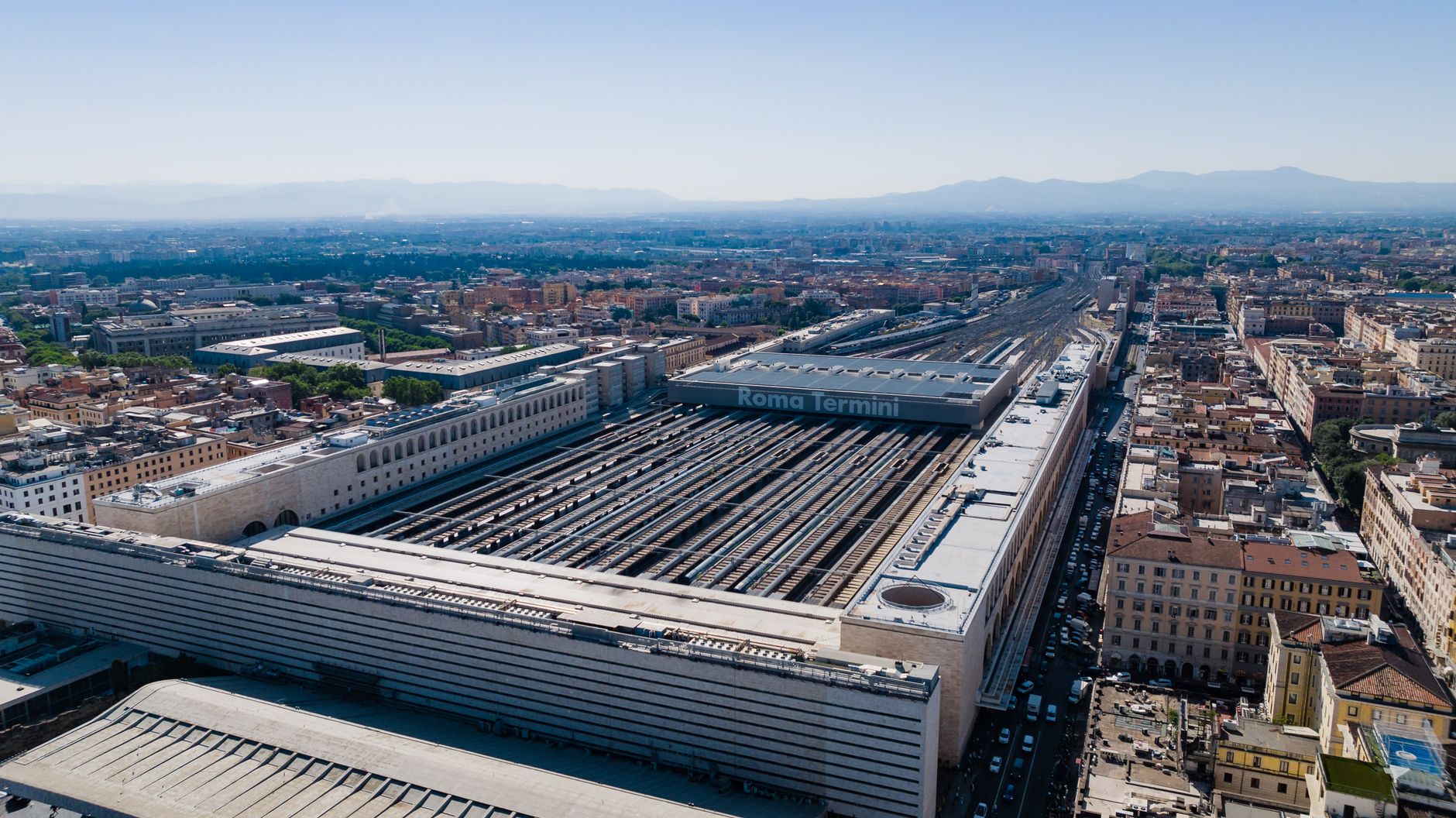
Termini is Rome’s central hub. The name has nothing to do with it being a terminus, it comes from the Terme di Diocletiano, the ancient Roman baths nearby. There has been a station here since 1863. The current building opened in December 1950, a clean example of Italian postwar modernism.
More than 30 platforms, and both metro lines. That combination makes Termini the best-connected station in Rome. Metro Line A links it to the Vatican and the Spanish Steps. Line B runs to the Colosseum, Circo Massimo, and, four stops northeast, Roma Tiburtina.
A few practical details: left luggage (KiPoint, also called KiBag) is on platform 24. Walk the full length of the platform to find it. The Leonardo Express to Fiumicino Airport departs from platforms 23 and 24. Trenitalia’s Freccialounge is on the main concourse for Executive and Business Salottino passengers. Italo has its Club lounge on the first floor above the atrium.
Roma Tiburtina, the station that catches travellers out
Tiburtina was rebuilt and reopened in 2011 for the high-speed Alta Velocità line. It is a calm, modern station. The problem is location: northeast of the centre, considerably further from the historic sights than Termini. The Roman Forum is a 22-minute walk from Termini. From Tiburtina, it is over an hour.
To get from Tiburtina into the centre, take Metro Line B from the station below the platforms toward Termini. Around four stops, roughly 30 minutes platform to platform. Allow for that when you plan.
Both Trenitalia Frecce (Frecciarossa and Frecciargento) and Italo stop at Tiburtina on some departures. Some services call at both Tiburtina and Termini; others stop only at Tiburtina. From late 2024, the Nightjet sleepers to Munich, Salzburg, and Vienna use Tiburtina, not Termini. That switch matters. If you have a night train booked and you head to Termini by default, you will miss it. Check the station name on the ticket.
Getting to Fiumicino Airport: Leonardo Express or the FL1
Two trains connect Rome to Fiumicino Airport (FCO). They serve different purposes.
The Leonardo Express is non-stop. It runs from Roma Termini to Fiumicino in around 32 minutes, every 15 minutes. Fares were around €14 to €18 per person as of June 2026, check live prices before booking, as the amount varies by booking channel and whether you buy in advance. Tickets depart from platforms 23 and 24 at Termini. For most visitors staying near the centre, this is the straightforward option.
The FL1 regional train is slower and stops along the way. It links Fiumicino with Roma Trastevere, Roma Ostiense, and Roma Tiburtina. Fares were around €8 as of June 2026. The FL1 does not serve Termini directly, if you want Termini, you need either the Leonardo Express or a change. But if your hotel is near Trastevere or Ostiense, the FL1 is a better match and cheaper. It runs every 15 minutes on weekdays and around every 30 minutes at weekends.
Choose the Leonardo Express for Termini, speed, and simplicity. Choose the FL1 if you are staying near one of its stops, or if the price difference matters to you.
Which station name to check before you pay
Booking pages usually show only “Rome” or “Roma”. Before you confirm payment, open the train details and find the station name. You will see Roma Termini, Roma Tiburtina, Roma Ostiense, or Roma Trastevere. These are four different parts of the city.
The mistake that costs people happens on departure. They go to Termini, the obvious choice, only to find their train leaves from Tiburtina. Metro Line B fixes the problem if you have time. Around 30 minutes from Termini to Tiburtina. Not a disaster, but it becomes one when you are cutting it fine. Check the station when you book, not when you arrive.
Ticket validation and seat reservations: two rules to know
These are separate rules. Do not conflate them.
Ticket validation applies to regional Trenitalia paper tickets without a fixed departure time. Before you board, stamp the ticket in the yellow or green obliteratrice machine at the platform entrance. Online tickets bought for a specific departure time are pre-validated and need no stamping. Inspectors check, and an unstamped paper ticket draws a fine of €50 or more. The rule is: if you have a paper regional ticket with no fixed time on it, stamp it before you step on the train.
Seat reservations are mandatory on all Frecciarossa, Frecciargento, and Italo services. Mandatory means required, an Interrail or Eurail Pass covers the journey, but the reservation is a separate fee on top of the pass. No reservation, no seat, and no valid basis to be on the train. Book the reservation before you travel, either directly from Trenitalia or Italo. Names like ItaliaRail, Trainline, and Rail Europe are resellers, not train operators, they sell Trenitalia and Italo seats, sometimes with a booking fee on top. Buying direct is usually the cleaner route.
Operators at Rome’s stations
Trenitalia is Italy’s national rail operator. Its premium long-distance services run as Le Frecce: Frecciarossa (fastest), Frecciargento, and Frecciabianca. Italo is a separate private high-speed operator. Both Trenitalia Frecce and Italo serve Roma Termini and Roma Tiburtina, so checking the station name on your ticket applies whichever operator you are travelling with.
For shorter regional journeys, a day trip, a town nearby, or a connection using the FL1, you will be on Trenitalia regional trains. These do not require a seat reservation, and tickets can usually be bought on the day. Just remember: if the ticket is a paper one without a fixed departure time, validate it before you board.
Frequently asked questions
How many train stations does Rome have?
Rome has several stations, but four matter most to travellers: Roma Termini (the main hub), Roma Tiburtina (the second high-speed stop), Roma Ostiense, and Roma Trastevere. Ostiense and Trastevere are primarily relevant if you are using the FL1 regional train to Fiumicino Airport.
What is the main train station in Rome?
Roma Termini. It is the central hub for most long-distance, high-speed, and regional trains, and the departure point for the Leonardo Express to Fiumicino Airport. Both Metro Lines A and B serve it.
Is Roma Termini a railway terminus?
No. Despite the name, Termini is not a terminus in the railway sense. The name comes from the Terme di Diocletiano, the ancient Roman baths nearby. Trains pass through Termini in both directions.
Do all high-speed trains stop at Roma Termini?
No. Both Trenitalia Frecce (Frecciarossa, Frecciargento) and Italo stop at Roma Tiburtina on some departures. Some services call at Tiburtina instead of Termini, not in addition to it. Always check the exact station name on your ticket before you book.
How do I get from Rome to Fiumicino Airport by train?
Two options. The Leonardo Express is non-stop from Roma Termini to Fiumicino in around 32 minutes, running every 15 minutes. The FL1 regional train is slower and cheaper (around €8 as of June 2026), stopping at Trastevere, Ostiense, and Tiburtina but not Termini directly. Choose based on where you are staying and how much time you have.
Do I need to validate my train ticket in Italy?
It depends on the ticket. Regional paper tickets without a fixed departure time must be stamped in the obliteratrice machines at the platform before you board. Online tickets for a specific departure time are pre-validated and need no stamping. If you board with an unstamped paper regional ticket, you risk a fine of €50 or more.
Do I need a seat reservation if I have an Interrail or Eurail Pass?
Yes. Seat reservations are mandatory on all Frecciarossa, Frecciargento, and Italo services, even for pass holders. The pass covers the journey but the reservation is a separate fee. Book the reservation directly from Trenitalia or Italo before you travel.
Which Rome station do night trains use?
From late 2024, the ÖBB Nightjet sleepers to Munich, Salzburg, and Vienna use Roma Tiburtina, not Roma Termini. If you have a Nightjet booking, check your ticket for the station name, do not assume it is Termini.