
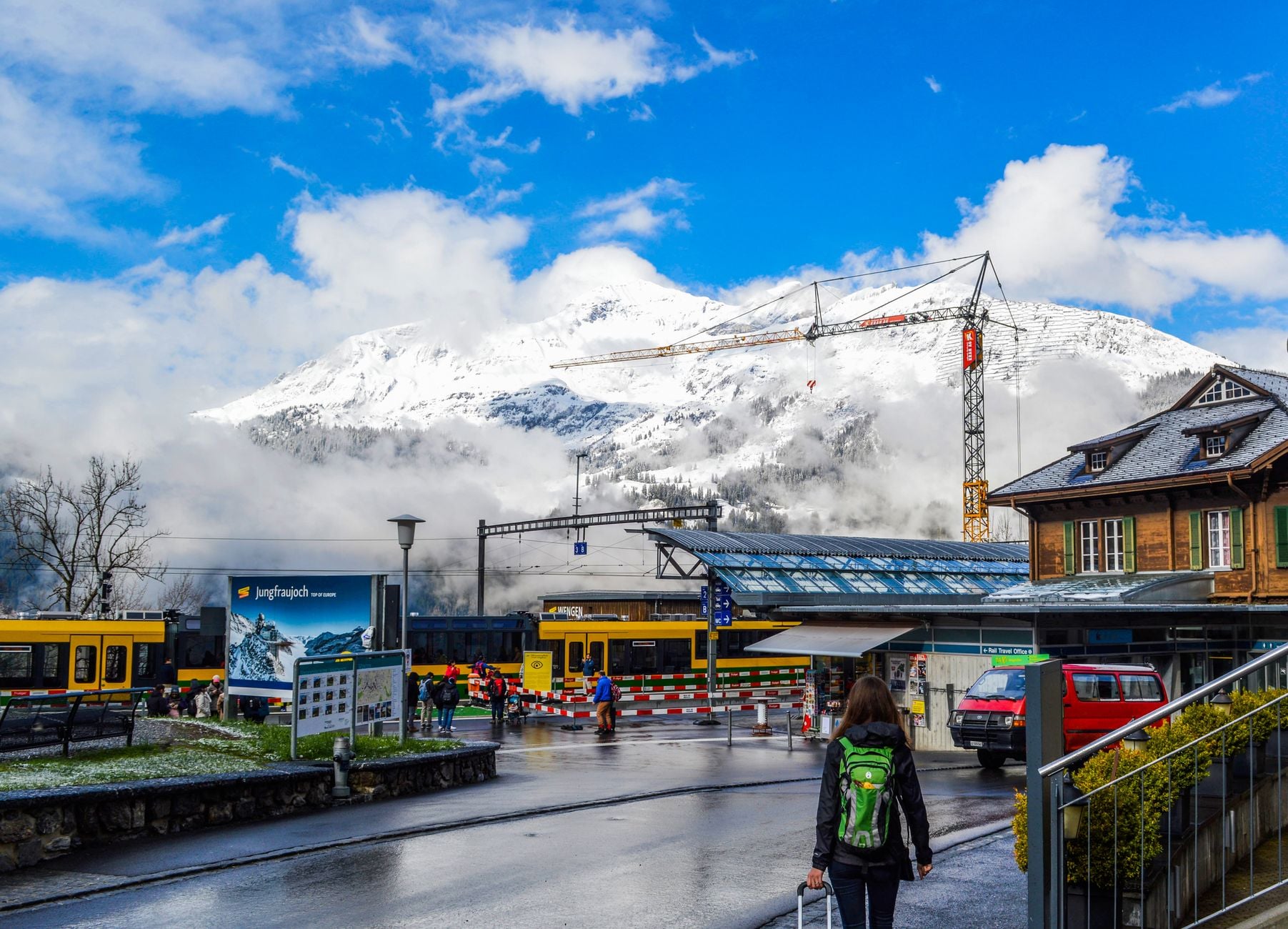
If your booking screen just says “Interlaken” and you have not opened the train details, you may be about to book the wrong station. Interlaken has two main passenger stations on the same SBB long-distance line, and only one of them connects to the mountain railways into the Jungfrau region. This guide explains which Interlaken station you actually need, what each one connects to, and what to check before you pay.
Which Interlaken train station you actually need
Interlaken has two main stations: Interlaken Ost and Interlaken West. Both are on the same long-distance line from Bern, Basel and Zurich via Spiez, so every long-distance train calls at both. The choice matters because of what happens next.
Pick Interlaken Ost if you are heading to Lauterbrunnen, Grindelwald or the wider Jungfrau region, if you are continuing on the GoldenPass Express or the Brünig line to Lucerne, or if you are boarding a Lake Brienz boat. Pick Interlaken West if your hotel is on the central Höheweg or Bahnhofstrasse axis, or if you are continuing onto a Lake Thun boat. Booking the wrong one is not a disaster, since local trains between Ost and West run every few minutes, but it can mean an extra change with luggage.
How many train stations are there in Interlaken?
Two main passenger stations: Interlaken Ost on the east side of town and Interlaken West on the west side, with about a 20-minute walk along Bahnhofstrasse and the Höheweg between them. There is no third “Interlaken Hauptbahnhof” or “Interlaken Central”; older guides that mention “Interlaken Zollhaus” are referring to the original name of Ost, which switched to Interlaken Ost in 1890.
Treat Interlaken as a two-station city when you book. The single biggest mistake is assuming there is only one Interlaken station, then ending up at the one furthest from your hotel or, worse, the one without the onward train you need.
Interlaken Ost: the operational hub for the Bernese Oberland
Interlaken Ost sits on the eastern side of town at Untere Bönigstrasse, beside the Aare river and next to the Lake Brienz quay. The station building is at 567 metres elevation and the Harder Kulm funicular base is a few minutes on foot. Five operators serve it: Swiss Federal Railways (SBB), BLS AG, Deutsche Bahn (ICE), Zentralbahn, and Berner Oberland-Bahnen (BOB), and three different lines meet here.
The layout is unusual. Eight platforms across three island platforms serve nine tracks, all of which are terminus tracks because mixed gauge and electrification mean nothing runs through. Looking inward from the station building, the first three platform tracks belong to the BOB metre-gauge trains to Lauterbrunnen and Grindelwald, the next two to the Zentralbahn metre-gauge Brünig line to Brienz, Meiringen and Lucerne, and the final three to standard-gauge SBB, BLS and DB long-distance trains to Spiez, Bern and beyond.
Choose Ost if any onward train you need leaves from Ost. The Brünig line and the Bernese Oberland Railway physically cannot reach Interlaken West. The GoldenPass Express to Montreux also begins and ends at Interlaken Ost. Lake Brienz BLS ferries dock at a quay reached via a navigable reach of the Aare, just outside the station.
Practical detail makes Ost the easier station to wait at. There are 200 parking spaces, step-free access throughout, ticket counters and SBB ticket machines alongside BOB ticket machines, luggage lockers, and PostBus and STI bus connections from outside the door. The check to do before you book: confirm that your onward train shows Interlaken Ost as the boarding station, especially for GoldenPass Express and any BOB service.
Interlaken West: the central station for many hotels
Interlaken West stands on the western side of town at Bahnhofstrasse 28, between Lake Thun and the central shopping street. Elevation is 563 metres. The station is on the Thunersee line, standard gauge, electrified at 15 kV AC. BLS AG owns the station and the line, and SBB and Deutsche Bahn run services into it. Two side platforms serve two through tracks; the layout is small and easy to navigate.
Every eastbound long-distance train that calls at Interlaken West continues to Interlaken Ost, so you do not lose anything in long-distance access by choosing West. Trains from Basel, Bern, Spiez, Berlin and Hamburg all stop here. What you do not get from West is any onward narrow-gauge connection: the BOB, the Brünig line and the GoldenPass Express all start from Ost.
Choose West if your hotel is on the Bahnhofstrasse or western Höheweg axis, or if you are continuing onto a Lake Thun boat. The BLS ferry quay on Lake Thun is reached from the station via the 2.75-kilometre Interlaken ship canal. The station has 61 parking spaces, step-free access, ticket counters and machines, and PostBus and STI bus connections. The check to do before you book: if your itinerary later requires a BOB, Brünig or GoldenPass Express train, plan an explicit transfer at Interlaken Ost rather than expecting to board at West.
Interlaken Ost vs Interlaken West at a glance
Most travellers only need to compare the two on six points.
| Station | Operators and lines | Long-distance trains | Narrow gauge and GoldenPass | Lake boat | Walk to central Höheweg |
|---|---|---|---|---|---|
| Interlaken Ost | SBB, BLS, DB, Zentralbahn (Brünig line), Berner Oberland-Bahnen (BOB); three lines meet here | Hourly IC/ICE/EuroCity to Basel via Bern and Spiez; IC every two hours to Romanshorn; RegioExpress every two hours to Spiez | Yes: BOB half-hourly to Lauterbrunnen and Grindelwald; Brünig line half-hourly to Meiringen and hourly to Lucerne; GoldenPass Express four daily round-trips to Montreux | Lake Brienz BLS ferries from the adjacent quay | About 15 minutes |
| Interlaken West | BLS (owner), SBB, DB; one line (Thunersee line) | Same hourly long-distance services from Basel, Bern and Spiez, all of which continue to Ost | None; transfer at Ost for BOB, Brünig and GoldenPass Express | Lake Thun BLS ferries via the Interlaken ship canal | About 5 minutes |
The frequencies in this table reflect the December 2024 and December 2025 timetable changes documented on Wikipedia; check the current SBB timetable for your travel date.
Arriving in Interlaken by train: routes and changes
From Bern, take an hourly InterCity south via Spiez direct to Interlaken West and Interlaken Ost. From Basel, the same hourly IC/ICE/EuroCity service runs via Bern and Spiez; the EuroCity from Basel to Interlaken Ost takes around 1 hour 58 minutes. From Zurich, there is no through long-distance service, so plan a change at Bern or Spiez and add roughly an hour overall.
From Lucerne, take the hourly Panorama Express on the metre-gauge Brünig line via Brienz to Interlaken Ost. From Montreux, take one of the four daily GoldenPass Express round-trips direct to Interlaken Ost, or use the older non-Express service with a change at Zweisimmen.
From Germany, the long-distance through-service is thinner than many travellers assume. Wikipedia notes that two ICE services from Interlaken Ost continue to Berlin Ostbahnhof or Dortmund Hbf, and a single ICE continues to Hamburg-Altona; the rest of the ICE pattern is hourly to Basel SBB with onward changes for Frankfurt and other cities. Treat the daily Berlin and Hamburg ICEs as occasional, not as a frequent option, and confirm the exact train on the SBB timetable for your travel date before you book.
Onward mountain trains from Interlaken Ost
The Berner Oberland-Bahnen (BOB) runs half-hourly metre-gauge Regio services from Interlaken Ost up the Lütschinen valley. Trains operate combined as far as Zweilütschinen and then split, with one half continuing to Lauterbrunnen and the other to Grindelwald. From Lauterbrunnen the Wengernalpbahn (WAB) cog railway carries on to Wengen, Kleine Scheidegg and Grindelwald; the total Interlaken Ost to Wengen journey is around 46 minutes including the change.
The Zentralbahn Brünig line runs half-hourly Regio services from Interlaken Ost to Meiringen and hourly to Lucerne via Brienz, plus the Panorama Express on the same line. The GoldenPass Express, the change-free Montreux service, runs four daily round-trips from Interlaken Ost in each direction and requires a paid seat reservation regardless of pass type.
Plan the changes at Interlaken Ost rather than fighting them. Allow 10 to 15 minutes between standard-gauge platforms and BOB platforms if you have heavy luggage, since the BOB tracks sit at the inside of the station and the standard-gauge SBB and BLS tracks at the outside. Do not try to start any of these trips from Interlaken West; the metre-gauge lines do not physically reach it.
Rail passes, reservations and tickets at Interlaken stations
The Swiss Travel Pass covers all SBB and BLS trains to and between Interlaken Ost and Interlaken West, the BOB to Lauterbrunnen and Grindelwald, and the lake boats on Thun and Brienz. The onward Jungfrau Railway segment beyond Lauterbrunnen and Grindelwald is normally discount-only with the pass, not free. The Half Fare Travelcard gives half-price tickets on SBB, BLS, BOB and the lake boats; it is more useful for travellers already based in Switzerland.
Interrail Pass and Eurail Pass holders can use SBB and BLS standard services to either Interlaken station without an extra reservation. BOB regional trains to Lauterbrunnen and Grindelwald accept the pass walk-on. The exception is the GoldenPass Express, which requires a paid seat reservation regardless of pass type and which often fills early on summer and Christmas dates. Book the GoldenPass reservation before you travel, especially for the prestige class.
For pay-as-you-go tickets, SBB, BLS, Trainline and Omio all sell tickets to either Interlaken station. The check to do before you book: confirm whether your ticket includes the onward BOB leg to Lauterbrunnen or Grindelwald, or only the SBB leg to Interlaken Ost, since the two are often priced and booked separately even when sold as one journey. Do not assume the Lake Brienz boat is included on an Interrail or Eurail pass; it is not, unless you also hold a Swiss Travel Pass or a covered regional pass.
Getting between Interlaken Ost and Interlaken West
The walk between the two stations is about 20 minutes along Bahnhofstrasse and the Höheweg, mostly flat and well sign-posted. Local SBB and BLS trains run every few minutes between the two stations as part of the long-distance and RegioExpress pattern, so a regional train with luggage is usually the better choice than walking. Several town bus lines link the two stations via central Interlaken if you are coming from a hotel off the main axis.
The lake boats do not connect the two stations to each other. Lake Thun boats leave from the quay at Interlaken West via the ship canal, and Lake Brienz boats leave from the quay next to Interlaken Ost. If you arrive at the wrong station for your onward boat, take a regional train one stop rather than walking the wrong way along the lake.
Facilities, accessibility and parking at the two stations
Both stations have step-free access from the street to the platforms, ticket counters and SBB ticket machines, and PostBus and STI bus stops outside. Interlaken Ost also has dedicated BOB ticket machines on the BOB platforms and the larger luggage facilities, including SBB-branded luggage forwarding to other Swiss stations. Interlaken West is the smaller, simpler building and has fewer station services.
Parking is limited at both. Interlaken Ost has 200 spaces and Interlaken West has 61, and both can fill in peak season; book overnight parking ahead in summer rather than relying on day-of availability. Both stations are part of the SBB Bike network, with bike rental and bike parking on site.
Before you book any long-distance ticket to Interlaken, open the train details on the booking page and confirm whether the arrival is at Interlaken Ost or Interlaken West. Match that to your hotel and your onward train, not to the first “Interlaken” the booking screen suggests.
Frequently asked questions
How many train stations are there in Interlaken?
Two main passenger stations: Interlaken Ost on the east side of town and Interlaken West on the west side, about a 20-minute walk apart along Bahnhofstrasse and the Höheweg. Older guides that mention Interlaken Zollhaus are referring to the original name of Interlaken Ost, which changed in 1890. There is no separate Interlaken Hauptbahnhof or Interlaken Central.
Which train station is best for Interlaken?
It depends on your hotel and your onward train. Choose Interlaken Ost if you are heading to Lauterbrunnen, Grindelwald or the wider Jungfrau region, if you are taking the GoldenPass Express or the Brünig line to Lucerne, or if you are boarding a Lake Brienz boat. Choose Interlaken West if your hotel is on the central Höheweg or Bahnhofstrasse axis, or if you are continuing onto a Lake Thun boat.
What is the difference between Interlaken Ost and Interlaken West?
Interlaken Ost is the larger operational hub on the east side of town, with eight platforms across three island platforms and nine tracks. Five operators serve it, including the metre-gauge BOB to Lauterbrunnen and Grindelwald, the Zentralbahn Brünig line to Lucerne, and the GoldenPass Express to Montreux. Interlaken West is a small two-platform station on the western side, on the Thunersee line only. Both are served by every long-distance train from Basel, Bern and Spiez, so the difference is what comes next.
What is the name of the train station in Interlaken?
There are two main stations, both called simply Interlaken on signs and tickets, distinguished as Interlaken Ost and Interlaken West. Booking pages may show both or just Interlaken; open the train details to confirm which one your train uses before you pay.
Can I catch the train to Lauterbrunnen or Grindelwald from Interlaken West?
No. All Berner Oberland-Bahnen (BOB) services to Lauterbrunnen and Grindelwald start from Interlaken Ost only. The BOB is a metre-gauge line and physically cannot reach Interlaken West. If you arrive at West, take a local SBB or BLS train one stop to Ost and change there.
How far is it from Interlaken Ost to Interlaken West?
About 20 minutes on foot along Bahnhofstrasse and the Höheweg, mostly flat and well sign-posted. Local SBB and BLS trains also run between the two stations every few minutes as part of the long-distance and RegioExpress pattern, which is usually the better choice if you have luggage.
Do Interrail and Eurail passes work on the GoldenPass Express from Interlaken Ost?
The pass covers the journey, but the GoldenPass Express requires a paid seat reservation regardless of pass type. Book the reservation ahead, especially for summer and Christmas dates and for prestige class, because pass-holder seats often go before the regular fares. Swiss IC, IR and RegioExpress services to and from the two Interlaken stations and BOB regional trains to Lauterbrunnen and Grindelwald are walk-on with the pass.
Which Interlaken station should I book if I am taking the boat on Lake Thun or Lake Brienz?
Book Interlaken West for Lake Thun; the BLS ferry quay sits at the end of the 2.75-kilometre Interlaken ship canal from the station. Book Interlaken Ost for Lake Brienz; the BLS ferry quay there is reached via a navigable reach of the Aare river next to the station. Mixing them up means an unnecessary 20-minute walk across town.