
For almost every traveller arriving in or leaving Hamburg by train, the right answer is Hamburg Hauptbahnhof. It is the city’s main station, the most central, and the one with by far the broadest set of long-distance connections. Choose Hamburg-Altona only when you have a specific reason: a hotel in the west of the city, the Marschbahn to Sylt, or one of the long-distance ICE services that begins there.
This guide covers the four long-distance stations a visitor might realistically book in Hamburg, Germany: Hauptbahnhof (Hbf), Altona, Dammtor, and Harburg. Not Hamburg, NY. The S-Bahn, U-Bahn, and dozens of suburban halts matter for moving around inside the city, but they are not where you start a journey to Berlin, Copenhagen, or Munich.
One reusable habit. If a booking page only shows “Hamburg” with no station code, open the train details and confirm the exact station before you pay.
The four useful long-distance stations at a glance
- Hamburg Hauptbahnhof (Hbf): central, next to the Kunsthalle in Hamburg-Mitte. The default for almost every journey.
- Hamburg-Altona: west of the centre, in the Altona borough. Useful for the Marschbahn to Sylt (RE 6 and RE 60 to Westerland), ICE journeys you want to board at the originating terminal, hotels in Altona or Ottensen, or arrivals at the Cruise Center Altona.
- Hamburg Dammtor: between Hbf and Altona on the link line. Useful for hotels around Stephansplatz, Hamburg University, or Planten un Blomen.
- Hamburg-Harburg: south of the Elbe. Useful only for travellers staying in Harburg, or itineraries that line up with FlixTrain FLX 20 or specific southbound IC and ICE stops.
The simple rule is to book Hbf unless one of the other three actually fits your trip. If a booking page only shows “Hamburg” as the city, open the train details and confirm whether your departure is Hbf, Altona, Dammtor or Harburg before you pay.
Hamburg Hauptbahnhof: the default for almost every journey
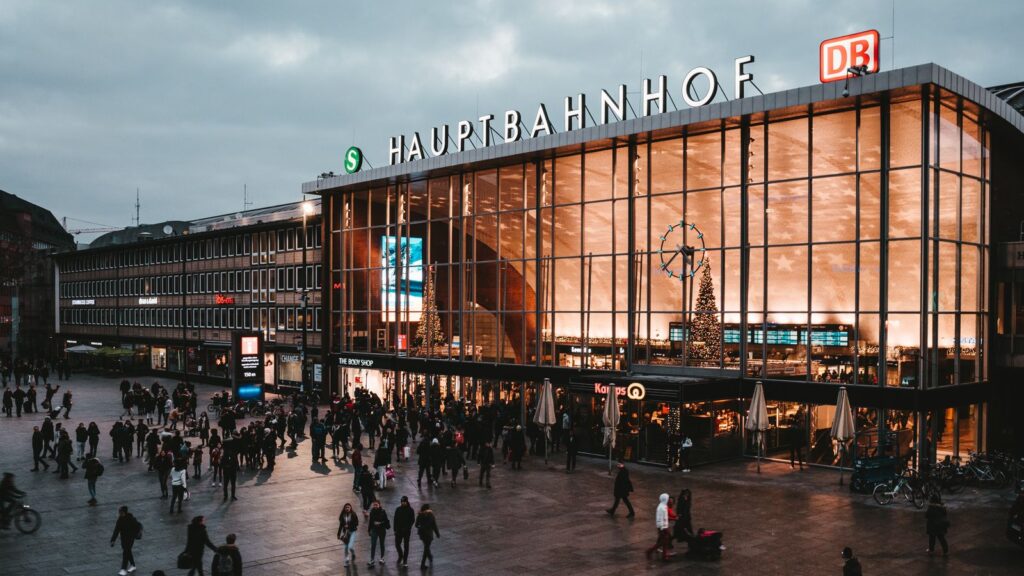
Book Hbf by default. It is Germany’s busiest railway station, with around 550,000 passengers a day, and it sits in central Hamburg next to the Kunsthalle. From the western exit it is roughly 12 minutes on foot to the Rathaus along pedestrianised shopping streets. No other Hamburg station gets you that close to the historic core.
Hbf is a through station with 14 platforms numbered from east to west. Platforms 1 to 4 are S-Bahn. Long-distance ICE, IC, EuroCity, RegionalJet, FlixTrain, Nightjet, and EuroNight services use platforms 5 to 14. The two cross-track footbridges are the Nordsteg at the north end of the trainshed and the smaller Südsteg at the south end. The Nordsteg has lifts and the Wandelhalle shopping mall. The Südsteg has only steps and escalators. If you have a suitcase, a pushchair, or stiff legs, head for the Nordsteg.
A small habit that saves time at Hbf is to find the Wagenstandsanzeiger, the train composition display on each platform. It tells you which sector A to F to stand in for your coach number. Find your sector. Then you walk straight to the right doors when the train pulls in instead of running the length of the platform with luggage.
The mix of services makes Hbf the only sensible choice for international trains in most directions. EuroCity to Copenhagen, RegionalJet 27 to Berlin, Dresden, and Prague, ICE International towards Amsterdam, ÖBB Nightjet sleepers to Vienna and Zurich, SJ EuroNight to Stockholm, and the Snälltåget services to Stockholm (overnight seasonal sleeper, plus a new daytime train from May 2026) all call here.
A handful of facilities are worth knowing. Left-luggage lockers sit on the Nordsteg between retail units; there is no staffed left-luggage office any more. The DB Reisezentrum ticket office is in the east hall and is the place to fix anything an app cannot. Free station WiFi is limited to 30 minutes on the Telekom network. The DB Lounge above the east hall is only for 1st-class Flexpreis ticket holders on DB or Railteam partners. It is not open to Sparpreis or Super Sparpreis tickets, not to Interrail or Eurail passes, and not to Nightjet sleeper passengers in any class.
Hamburg-Altona: when to switch from Hbf
Choose Altona over Hbf only when one of these is true.
- Your hotel is in Altona, Ottensen, or near the Cruise Center Altona.
- You are catching the Marschbahn (RE 6 or RE 60) to Westerland on Sylt. Many of these trains start at Altona, and seat sectors are easier to find at the originating terminal during peak summer.
- You are starting a long-distance ICE journey south or east, and you would rather board at the originating station than join the same train as it pulls into Hbf already filling up.
Most of the ICE lines that head south or east from Hamburg actually begin their day at Altona. The list runs to ICE 1 and ICE 4 to the Ruhr, Cologne, Frankfurt, and Frankfurt Airport, ICE 18 and ICE 28 to Berlin and Munich, ICE 20 and ICE 43 towards Karlsruhe, Basel, Zurich, ICE 24 and ICE 25 to Munich via Würzburg, ICE 33 to Stralsund, ICE 42 to the Ruhr, plus RegionalJet 27 to Berlin, Dresden, and Prague. They all call at Hbf within a few minutes of leaving Altona. So if you live closer to the centre, just board at Hbf.
What Altona is not suited to is a quick trip into the historic core. From Altona you still need an S-Bahn or U-Bahn ride to reach the Rathaus or HafenCity. Boarding Altona “to save a transfer” rarely saves anything if your hotel is anywhere east of the centre.
A long-term note for anyone planning a future trip. Deutsche Bahn plans to replace today’s Altona terminal with a new station at Diebsteich, still called Hamburg-Altona, currently targeted to open by December 2029 and repeatedly delayed. Until then, the existing terminal on Scheel-Plessen-Straße is the Altona on every booking page.
Hamburg Dammtor and Hamburg-Harburg: the two niche choices
Hamburg Dammtor
Dammtor sits on the link line between Hbf and Altona. Most trains that stop here are the same Altona to Hbf services already on your itinerary, just one stop earlier. If you are staying around Stephansplatz, Planten un Blomen, the Congress Center Hamburg, or the university quarter, Dammtor is genuinely closer than Hbf and a sensible boarding point. For anyone else it is the same train, with fewer facilities and no advantage. Do not book Dammtor for international tickets unless the booking system explicitly shows your train calling there.
Hamburg-Harburg
Harburg sits south of the Elbe and serves the Harburg suburb. Some southbound ICE and IC trains towards Hannover and Bremen stop here, and FlixTrain FLX 20 calls at Harburg as well. It is a useful boarding point only if you are staying in Harburg or your itinerary lines up neatly with one of those southbound stops. From central Hamburg you would normally take the S3 or S31 down to Harburg, which removes most of the time saving against just boarding at Hbf.
Hamburg Airport (HAM) by train
Take S-Bahn line S1 from Hbf to Hamburg Airport (Flughafen). The journey is around 25 minutes. Daytime headway is every 10 minutes, with early-morning and evening trains running every 20 minutes. The S1 also calls at Altona via the link line. There is no premium airport rail product in Hamburg. The airport sits in HVV fare zone A, so a standard HVV single ticket covers the whole trip, with no airport surcharge to pay.
The one trick to know is the S1 train split at Ohlsdorf. The train leaves Hbf as two coupled three-car sets. At Ohlsdorf the front three cars carry on to the airport, and the back three head east to Poppenbüttel. Always check the platform car-position display at Hbf and board the front half if you are flying out. The airport station sits directly under terminals 1 and 2, so a short escalator brings you up into the check-in hall.
International trains from Hamburg
Hamburg Hbf is the practical hub for international trips. Most international services either start at Altona and call at Hbf within a few minutes, or run straight through Hbf without going as far as Altona. Treat Hbf as your default international station, and switch to Altona only when your hotel is already in the west of the city.
Copenhagen and Denmark
DB and DSB run the EuroCity service ECE 75 from Hamburg Hbf to Copenhagen via Padborg, Kolding, Odense, and Ringsted. Typical journey time is around 4 hours 30 minutes to 5 hours, and the exact route and timing can shift while engineering work on the Storebælt and Fehmarn Belt corridors continues. Check int.bahn.de or dsb.dk for your specific date before you book. Reservations are optional for the EuroCity, but they are well worth it on summer weekends.
Amsterdam and the Netherlands
ICE International runs from Hamburg Hbf to Amsterdam Centraal via Bremen and Osnabrück in roughly 5 hours. Service is limited each day, so plan around the timetable rather than turning up. Pass holders do not need a reservation, but on the busiest days a paid seat is worth the extra.
Berlin, Dresden, and Prague
RegionalJet 27 (RJ 27), operated jointly by ČD and DB, runs from Hamburg-Altona via Hbf to Berlin, Dresden, and Prague, with around four train pairs a day and a journey time near 7 hours end to end. Reservations are optional but heavily used.
Stockholm by train
There are three options from Hamburg to Stockholm via Denmark and southern Sweden, run by different companies on different commercial models. All three call at Hamburg Hauptbahnhof, not Altona.
- The SJ EuroNight from Berlin via Hbf to Copenhagen Airport, Malmö, and Stockholm runs year-round. Reservations are compulsory: a seat, couchette, or sleeper berth on top of any rail pass. Sleeper categories sell out earliest on Friday and Sunday departures and in summer. Fares are in EUR via DB and SJ.
- Snälltåget runs a seasonal overnight Berlin to Stockholm sleeper between roughly April and September, plus selected dates the rest of the year, calling at Hamburg Hbf via Copenhagen. Reservations are compulsory and sold in SEK on snalltaget.se. Sleeper berths and couchettes (liggvagn) sell first; seats are cheapest but make for a long night.
- From May 2026 Snälltåget also runs a daily daytime service between Stockholm and Hamburg Hbf via Copenhagen, with a typical Stockholm departure around mid-morning. Tickets sell in SEK on snalltaget.se. Reservations are compulsory.
Vienna, Innsbruck, Zurich, and Basel by Nightjet
ÖBB Nightjet runs two relevant overnight services from Hamburg Hbf. One leaves in the evening, splits at Nuremberg, and arrives the next morning in Munich and Innsbruck on one half and Linz and Vienna on the other. The other runs from Hamburg via Bremen, Karlsruhe, and Basel into Zurich. Reservations on Nightjet are compulsory for every passenger, pass holder or not, and sleeper categories (couchette, sleeper, deluxe sleeper) sell out before seats on the popular nights. Book on nightjet.com or oebb.at as soon as your dates are firm.
Tickets, fares, and rail-pass reservations
Reservations on DB long-distance trains (ICE, IC, EC) are optional. You can board with any valid ticket without one. They are sensible on peak corridors such as Hbf to Berlin on a Sunday evening or Hbf to Munich in summer. Night trains are different. Nightjet, EuroNight, and Snälltåget all require a reservation on top of any pass or ticket.
DB’s two main fare types behave very differently. Sparpreis is the cheapest advance fare, tied to one specific train, with limited refundability. Flexpreis is a full-flex fare, valid on any train of that class and day, and materially more expensive. If you might change plans, buy Flexpreis. If your dates and trains are fixed, buy Sparpreis early.
For Interrail and Eurail pass holders, ICE, IC, and EC do not require a reservation. A paid optional reservation is worth it on Friday afternoons, Sunday evenings, summer Saturdays, and any time you really need to sit together. The DB Lounge is not part of the pass: you need a 1st-class Flexpreis ticket or a Railteam partner card such as Eurostar Carte Blanche.
FlixTrain (FLX 20 and FLX 35) is a separate operator with its own tickets, not on Interrail or Eurail, and not refundable in the DB system. Book directly with FlixTrain. Inside Hamburg, the S-Bahn (including S1 to the airport), U-Bahn, and buses all run on the integrated HVV ticket sold via hvv.de and the HVV app. One HVV single ticket covers the airport S-Bahn run with no surcharge.
Before you pay, open the train details on int.bahn.de or your booking site and confirm three things: the exact station in Hamburg, the class of service, and the reservation status if it is a night train.
Frequently asked questions
What is the main train station in Hamburg?
Hamburg Hauptbahnhof (Hbf) is the main station and the right default for almost every journey. It is Germany's busiest railway station, with around 550,000 passengers a day, and it sits in central Hamburg next to the Kunsthalle. Hbf handles ICE, IC, EuroCity, RegionalJet, FlixTrain, OBB Nightjet, and SJ EuroNight services, plus Snalltaget to Stockholm. Choose another Hamburg station only when your hotel, the Sylt Marschbahn, or a specific Altona-origin ICE actually makes it better.
What does Hbf mean?
Hbf is the standard German abbreviation for Hauptbahnhof, meaning 'main station'. When a booking shows 'Hamburg Hbf', that is Hamburg Hauptbahnhof, the central long-distance station in Hamburg-Mitte. If a booking just shows 'Hamburg' with no Hbf, Altona, Dammtor, or Harburg suffix, open the train details and confirm the exact station before you pay.
Hamburg Hbf or Hamburg-Altona: which one should I use?
Use Hbf by default. It is more central and has the broadest international network. Choose Altona only when you have a specific reason: a hotel in Altona or Ottensen, an arrival at the Cruise Center Altona, the Marschbahn (RE 6 or RE 60) to Westerland on Sylt, or a long-distance ICE that begins at Altona where you would rather board the originating train than join it at Hbf. Most ICE lines that start at Altona also call at Hbf within a few minutes.
How do I get from Hamburg Hbf to Hamburg Airport by train?
Take S-Bahn line S1 from Hamburg Hbf to Hamburg Airport (Flughafen). The journey is around 25 minutes. Trains run every 10 minutes during the day and every 20 minutes early in the morning and late in the evening. The airport is in HVV fare zone A, so a standard HVV single ticket covers the whole trip with no airport surcharge. At Ohlsdorf the S1 splits: the front three cars carry on to the airport and the back three head to Poppenbuttel, so board the front half if you are flying out.
Which Hamburg station should I use for the Sylt Marschbahn to Westerland?
Use Hamburg-Altona. The Marschbahn services RE 6 and RE 60 to Westerland on Sylt run from Altona. Many of these trains originate at Altona, which makes seat sectors easier to find at the originating terminal during peak summer. If you are coming from central Hamburg, take an S-Bahn or U-Bahn to Altona, then board there.
Is there left-luggage storage at Hamburg Hbf?
Yes. Left-luggage lockers sit on the Nordsteg footbridge between the retail units. There is no longer a staffed left-luggage office, so the lockers are the only option. If you have heavy bags, use the Nordsteg rather than the Sudsteg, because the Nordsteg is the one with lifts.
Do I need a seat reservation on ICE trains from Hamburg?
No. Reservations on DB long-distance trains (ICE, IC, EC) are optional. You can board with any valid ticket without one. A paid reservation is sensible on peak corridors such as Hbf to Berlin on a Sunday evening or Hbf to Munich in summer, and Interrail and Eurail pass holders often book one on Friday afternoons, Sunday evenings, and summer Saturdays. Night trains are different: Nightjet, SJ EuroNight, and Snalltaget all require a reservation on top of any pass or ticket.
Which Hamburg station do night trains to Stockholm and Vienna use?
All three Stockholm options (SJ EuroNight year-round, Snalltaget seasonal sleeper, and the new Snalltaget daytime service from May 2026) call at Hamburg Hauptbahnhof, not Altona. OBB Nightjet to Munich, Innsbruck, Linz, and Vienna also runs from Hbf, as does the second Nightjet via Bremen, Karlsruhe, and Basel to Zurich. Reservations on all of these are compulsory for every passenger, and sleeper berths sell out before seats on popular nights.