
Munich has one main train station. For almost every long-distance journey, that is München Hauptbahnhof, known as München Hbf or Munich Hbf. Two secondary stations matter in specific situations. One thing to settle before you start planning: Munich Airport has no fast direct rail connection to the city centre in 2026. The S-Bahn gets you there in around 40 minutes.
München Hbf, the main station for almost all long-distance trains
For ICE, Railjet, EuroCity, Nightjet, and most intercity services, München Hbf is your station. Deutsche Bahn’s high-speed trains to Berlin, Hamburg, and Frankfurt depart from here. So do ÖBB Railjets to Vienna and Budapest, EuroCity trains to Zurich, and Nightjet sleepers to Rome and beyond. Book Hbf and you will be right the vast majority of the time.
The station is a terminus, so trains come in and back out the same way. That matters in one practical sense: there are no ticket barriers between the concourse and the platforms, and the layout is flat, so changing trains with luggage is easy. Do check the departure boards for your platform rather than assuming where your train will be.
Not all trains use the main hall. München Hbf has four distinct platform areas, and knowing which one your train uses avoids a last-minute sprint.
| Platform group | What uses it | Practical note |
|---|---|---|
| 1-2 (underground) | S-Bahn only (incl. airport S1 and S8) | Escalators down near platform 26; follow signs for S-Bahn tief |
| 5-10 (Holzkirchen wing) | BRB Meridian to Salzburg, Westbahn to Vienna, some Railjets | Walk south along platform 11; about 150 m from the main hall |
| 11-26 (main hall) | ICE, IC, EC, most Railjets, Nightjet, international trains | Straight off the main concourse |
| 27-36 (Starnberger wing) | EC to Zurich (often here), regional trains to Garmisch and scenic Innsbruck route | Walk north along platform 26; about 150 m from the main hall |
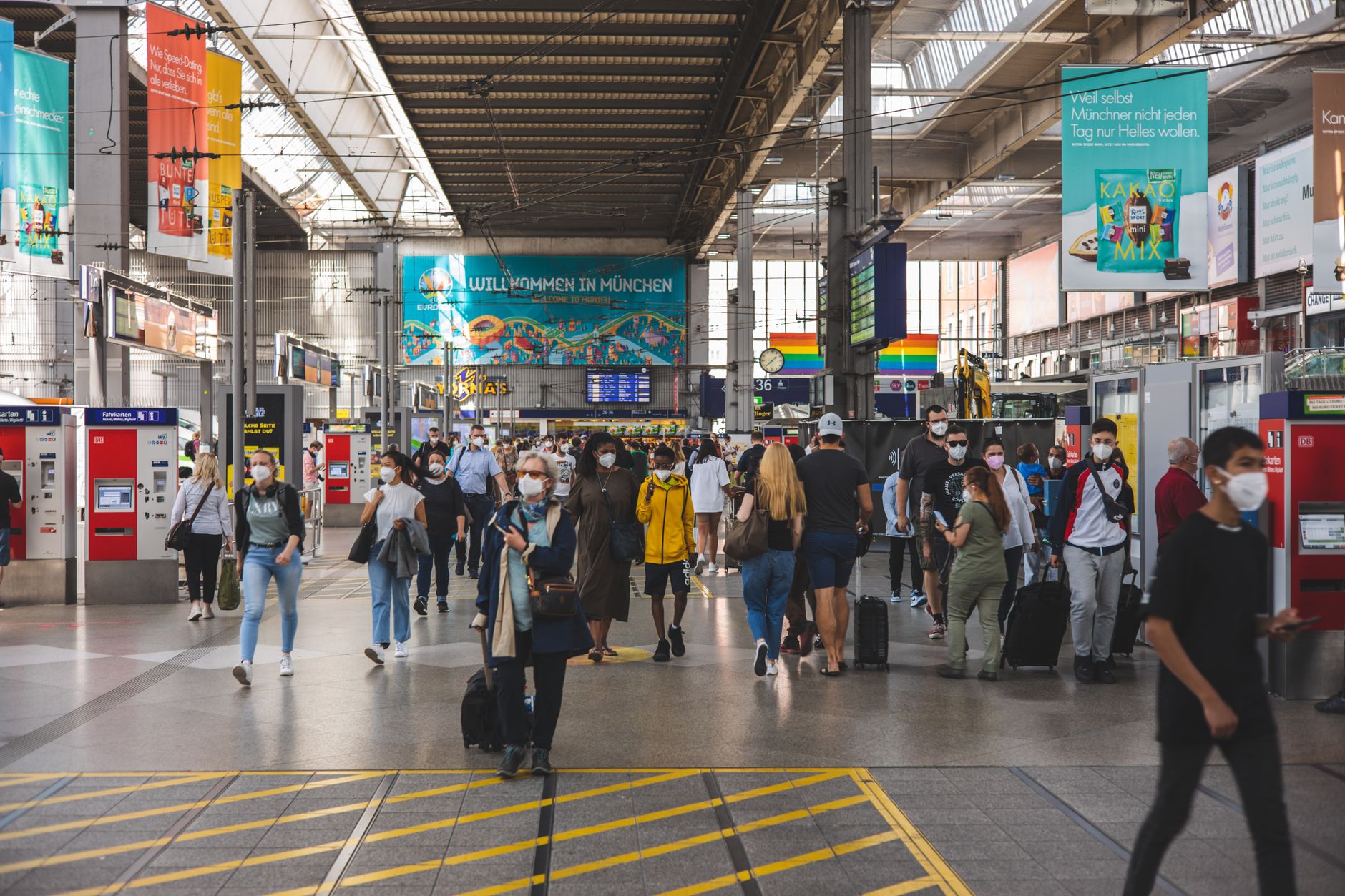
One thing to know about the station in 2026: it is mid-renovation. The main concourse is narrower than it used to be because construction work has moved into the area behind the buffer stops. Main access is through side exits on either side of the building. The DB ticket office (Reisezentrum) is at the south end, opposite platform 10. The layout is manageable, but it is not the grand open station you might expect.
Marienplatz, Munich’s central square, is about 1.3 km from the north exit and a 15-minute walk along a pedestrianised shopping street.
München Ost, the station for some overnight trains
Most travellers never need München Ost. The ones who do are catching a Nightjet service that does not call at Hbf at all.
The Nightjet trains running between Paris and Vienna, and between Brussels and Vienna, bypass München Hbf to avoid having to change direction. They call at München Ost instead. The overnight service connecting Stuttgart with Venice, Budapest, and Zagreb also uses Ost. If your Nightjet origin or destination is Paris or Brussels, check your ticket before you travel. It will say either München Hbf or München Ost clearly, and they are not close to each other.
Getting between the two is quick. The S-Bahn lines S1, S2, S3, S4, S6, S7, and S8 all run from München Ost to Hbf in 8 minutes. Trains run frequently. At München Hbf, board at the underground platforms 1 and 2. At München Ost, use platforms 1, 2, or 3.
München Ost itself is functional but basic. There is a ticket office, some food options, and coin-operated luggage lockers in the underpass. It is not the place to plan a long wait.
München-Pasing, the stop worth knowing about for western journeys
München-Pasing sits on the western side of the city and is served by a large share of ICE and IC trains travelling between Munich and Augsburg, Stuttgart, and points west. Most visitors should go all the way to Hbf. But Pasing is useful in two cases: if your hotel is in western Munich, or if you are connecting to or from Augsburg without needing to enter the city centre.
Check the DB timetable for your exact journey. If Pasing appears as a stop, it is a legitimate alternative. Trains continue from Pasing to Hbf in a few minutes, so you are not stranded if you overshoot.
Getting from Munich to the airport by train
Munich Airport (MUC) does not have a direct express rail link to the city. This is one of the most common surprises for travellers arriving in Munich expecting the kind of fast airport connection that exists at Frankfurt, where ICE trains stop at the airport itself. Munich does not have that. The airport connection is the S-Bahn, and it takes around 40 minutes.
Two S-Bahn lines serve the airport: S1 and S8. Both run from platforms 1 and 2 at München Hbf, the underground S-Bahn platforms near the north end of the main concourse. S8 travels via Ostbahnhof (München Ost) and is usually slightly faster; S1 takes a different route via Feldmoching. Either line gets you to the terminal.
A Bayern-Ticket covers the airport S-Bahn journey. Without one, buy an MVV zone ticket from the machines on the platform. Check the MVV journey planner at mvv-muenchen.de for real-time departures, since S-Bahn frequency varies by time of day.
Build in 40 to 45 minutes. Allow extra time for early-morning departures, which can be affected by lower S-Bahn frequency.
Operators and trains at München Hbf
Several train companies use München Hbf, and identifying the correct one before you book is the detail most likely to catch you out.
Deutsche Bahn (DB) is the main operator. Its ICE high-speed trains serve Berlin, Hamburg, Frankfurt, Cologne, and Nuremberg. DB also runs IC and EuroCity trains, including the EC services to Zurich.
ÖBB (Österreichische Bundesbahnen) operates Railjet trains from Munich to Vienna and Budapest, calling at Salzburg, Linz, and Wien Hauptbahnhof. ÖBB also runs Nightjet overnight trains from Munich to destinations including Vienna, Rome, and other European cities. Interrail and Eurail Passes are valid on ÖBB services.
Westbahn is a private Austrian operator with its own trains between Munich, Salzburg, and Vienna. It is not the same as the ÖBB service and does not share ticketing with DB. Interrail and Eurail Passes are not valid on Westbahn. If you hold a pass, the Westbahn is not an option unless you buy a separate Westbahn ticket at westbahn.at or at the station. Westbahn trains depart from platforms 5 to 10, the Holzkirchen wing south of the main hall.
BRB (Bayerische Regiobahn) runs the Meridian regional trains between München Hbf and Salzburg via Rosenheim. These are regional services, not high-speed, with journey times of around 1 hour 30 to 1 hour 45 minutes. They use platforms 5 to 10. The Bayern-Ticket is valid, making BRB a popular choice for day trips to Salzburg.
BOB (Bayerische Oberlandbahn) operates regional trains from München Hbf towards Holzkirchen, Tegernsee, Miesbach, and Bayrischzell. If you are planning a day trip into the Bavarian lakeland, BOB is the service to look for. The Bayern-Ticket covers it.
Reservations, rail passes, and the Bayern-Ticket
Reservation rules vary by train type, and the difference matters more here than on many European rail routes.
On ICE trains, reservations are optional. You can board without one. That said, reservations are worth adding on busy routes to Berlin and Frankfurt in peak periods, where trains fill up quickly.
ÖBB Railjets to Vienna also do not require reservations on most departures. Always check the specific train, because rules can vary by service.
Nightjet trains are different. A reservation is compulsory, and it is separate from your Interrail or Eurail Pass. The pass covers the travel day; you still need a Nightjet reservation for your seat, couchette, or sleeper. Book as early as you can if you want a couchette or a proper sleeper, because those places sell out before seats on popular routes. Munich to Rome and Munich to Paris are the most competitive.
The Bayern-Ticket is a regional day pass covering S-Bahn, RE, RB, BRB, and BOB trains in Bavaria. It covers the airport S-Bahn journey and the BRB regional train to Salzburg. It does not cover ICE, IC, EC, or Railjet trains. If you want to travel to Salzburg on a fast DB or ÖBB service, you need a separate ticket for that train even if you already have a Bayern-Ticket.
Interrail and Eurail Passes are valid on DB, ÖBB, and BRB trains. They are not valid on Westbahn. On the Munich-Vienna corridor especially, make sure you know which operator is running your specific train before you board.
Frequently asked questions
What is the main train station in Munich?
München Hauptbahnhof, usually written as München Hbf or Munich Hbf, is the main station. It handles nearly all long-distance trains to and from Munich, including ICE, Railjet, EuroCity, and most Nightjet overnight services.
Is München Hbf the same as Munich Central Station?
Yes. München Hauptbahnhof is sometimes called Munich Central Station in English, but it is the same place. On tickets and departure boards, you will see it written as München Hbf or just München.
How many train stations does Munich have for long-distance trains?
Most long-distance trains use München Hbf. Two secondary stations also handle certain services: München Ost on the eastern side of the city, and München-Pasing to the west. München Ost is mainly relevant for Nightjet overnight trains that bypass Hbf.
Is there a direct train from Munich Airport to the city centre?
No. Munich Airport (MUC) does not have a direct express rail link to the city in 2026. The connection is the S-Bahn, which takes around 40 minutes from the airport to München Hbf.
How long does the S-Bahn take from Munich Airport to München Hbf?
Around 40 minutes on either the S1 or S8 line. Both run from München Hbf platforms 1 and 2 (underground). S8 travels via Ostbahnhof and is usually slightly faster. A Bayern-Ticket covers this journey.
Which trains use München Ost instead of München Hbf?
Certain Nightjet overnight trains bypass Hbf to avoid reversing direction. These include the Nightjets running between Paris and Vienna, and between Brussels and Vienna. The overnight Stuttgart to Venice, Budapest, and Zagreb service also calls at München Ost. Check your ticket to confirm which station is listed.
Does Westbahn accept Interrail or Eurail passes?
No. Westbahn is a private Austrian operator with its own ticketing and is not a participating Interrail or Eurail operator. If you want to travel on Westbahn between Munich and Vienna, you need to buy a separate Westbahn ticket at westbahn.at or at the station. ÖBB Railjets on the same corridor do accept Interrail and Eurail Passes.
Is a reservation required on ICE trains from Munich?
No. Reservations on ICE trains are optional. You can board without one. That said, adding a seat reservation on busy routes such as Munich to Berlin or Munich to Frankfurt is a sensible precaution, especially in peak periods when trains fill up. Nightjet trains are different: a reservation is always compulsory and must be booked separately from your pass.