
Train service

OBB
ÖBB è l'operatore ferroviario nazionale austriaco, noto per i treni Railjet e per Nightjet, la più ampia rete europea di treni notturni.
Check times & pricesOfficial website Check times & prices
CFF
CFF is Switzerland’s national rail operator, known for punctual, fully electrified train services across the country and beyond.
Check times & pricesOfficial websiteTrain tickets

Raileurope
Rail Europe is a leading travel tech company specializing in European train bookings for over 15,000 travel professionals worldwide.

Trainline
Trainline sells rail and coach tickets worldwide on behalf of major UK and European transport companies.

Omio
Omio connects you with over 1,000 transport providers - trains, buses, flights, and more - to simplify your travel planning.
A Europe train tour is a multi-city rail itinerary through several countries or regions, either planned independently with a pass or booked as an escorted package with hotels and guides included. Most people start from the UK. The Eurostar from London St Pancras connects Paris in around 2 hours 16 minutes, and from there the rest of the continent opens up.
The format varies considerably. A scenic day journey on the Glacier Express in Switzerland is a Europe train tour. So is a two-week independent trip from Berlin to Budapest using an Interrail pass and booked-ahead hotels. So is a fully guided escorted tour with a professional manager handling every station transfer. What they share is that the train is the main way you move.
The case for travelling Europe by train
European train stations are in city centres. That is the core practical advantage. You arrive at Paris Gare du Nord or Roma Termini rather than an airport an hour outside the city. On London to Paris, the total door-to-door time by Eurostar is competitive with flying once you add airport check-in, security, and the transfer from Charles de Gaulle.
On most European corridors under 700 km, rail generates significantly fewer emissions than flying. This is not decoration; it is a genuine trade-off some travellers care about.
Comfort is different from flying rather than simply better. Seats are wider. You can walk to the dining car. Luggage goes overhead without fees. On scenic routes, the window is the main attraction and the journey is the point.
A pass or point-to-point ticket suits most European itineraries. The rail network is dense enough that almost every combination of cities you would want to visit is reachable by train.
Top Europe train tour itineraries
These five itineraries cover the most popular rail tour formats. They are starting points rather than fixed plans. Exact times, services, and operators vary by date and season.
City classics by rail (10 to 12 days)
Route: London to Paris to Brussels to Amsterdam to Berlin
The Eurostar from London St Pancras to Paris Gare du Nord takes around 2 hours 16 minutes. From Paris, Eurostar high-speed services reach Brussels in around 1 hour 20 minutes and Amsterdam in around 3 hours 30 minutes. Berlin from Amsterdam is best done by ICE, typically around 6 hours with a change, or by night train overnight.
Every train on this route requires a reservation. Book it when you book the ticket. Seats without reservations are not guaranteed, and on Eurostar you cannot board at all without one.
| City | Recommended stay | What to do |
|---|---|---|
| London | 2 nights | West End shows, British Museum |
| Paris | 2 nights | Louvre, Eiffel Tower, Montmartre |
| Brussels | 1 night | Grand Place, Belgian food |
| Amsterdam | 2 nights | Canal walks, Van Gogh Museum |
| Berlin | 2 to 3 nights | Brandenburg Gate, Museum Island |
This route works in all seasons. Summer is busy; spring and early autumn are easier.
Grand Central Europe (14 to 16 days)
Route: Amsterdam to Berlin to Prague to Vienna to Budapest to Munich
The trains here are intercity rather than high-speed: EuroCity services, Railjet between Vienna and Budapest, and IC between Germany and Czech Republic. Journey times are longer than on the western high-speed network but the trains are comfortable, the routes often follow rivers or valleys, and you see a different kind of Europe.
Prague to Vienna takes around 4 hours by EuroCity. Vienna to Budapest by Railjet is around 2 hours 40 minutes. Neither leg requires a mandatory reservation, but booking a seat in advance is sensible in summer.
Allow 2 to 3 nights in Prague, Vienna, and Budapest. That is enough for the main sights. This route works best in spring and early autumn; July and August are the most crowded months at all four cities.
Alpine highlights (9 to 11 days)
Route: Zurich to Lucerne to Chur to St Moritz to Zermatt to Geneva
This itinerary is built around Switzerland’s panoramic trains. The two centrepieces are the Glacier Express and the Bernina Express.
Glacier Express: Zermatt to St Moritz via Andermatt, around 8 hours, crossing the Oberalp Pass at 2,033 metres. Seat reservations are required. The reservation fee is CHF 54 per person, the same for first and second class. Pass-holders pay this on top of their Interrail or Eurail pass. Book through SBB or Matterhorn Gotthard Bahn. Panoramic car seats on popular summer dates sell out months ahead. If you want to do this in July or August, book by March.
Bernina Express: Chur to Tirano in Italy, around 4 hours. This is a UNESCO World Heritage railway, climbing to 2,253 metres at the Bernina Pass before descending into the Valtellina in Italy. Reservations are required: the fee is CHF 44 in summer and CHF 40 in winter. Book through Rhätische Bahn (RhB) or SBB.
Build at least one free day into Zermatt. The Gornergrat rack railway from Zermatt station gives clear Matterhorn views from 3,089 metres. It is worth the separate excursion fare.
Mediterranean rail escape (10 to 12 days)
Route: Barcelona to Valencia to Nice to La Spezia to Florence to Rome
Spanish AVE high-speed trains cover Barcelona to Valencia in around 1 hour 35 minutes. They are fast and reliable, with mandatory reservations. The AVE gets you south quickly; the scenery starts properly after Nice, along the Ligurian coast towards La Spezia.
La Spezia is the right base for Cinque Terre. The five villages are connected by a short regional train service. Check whether your pass covers the Cinque Terre train or whether a separate regional ticket is needed before you board.
April through June and September are the most practical months for this route. July and August are crowded and hot, which affects the enjoyment considerably on the slower coastal sections.
Scandinavia and fjords by rail (9 to 12 days)
Route: Copenhagen to Gothenburg to Oslo to Flam to Bergen
The Bergen Line from Oslo to Bergen takes around 7 hours across Hardangervidda, Europe’s highest mountain plateau, at around 1,300 metres. In summer, the plateau is open tundra with scattered lakes. In winter, it runs through snow tunnels with barely any visible sky. Both versions are worth seeing.
From Myrdal, the Flåm Railway descends 866 metres in 20 kilometres to Aurlandsfjord. Around 1 hour. One of the steepest standard-gauge railways in the world. The “Norway in a Nutshell” combination (Bergen Line, Flåm Railway, fjord ferry) can be booked as a single package or assembled independently. June and September give the best balance of daylight and manageable crowds.
Iconic scenic and luxury trains in Europe
Some trains are the reason for the trip rather than just the transport. These are the routes worth building an itinerary around.
Scenic classics
Glacier Express (Zermatt to St Moritz)
Around 8 hours across the Swiss Alps. The train crosses 291 bridges and passes through 91 tunnels, climbing to the Oberalp Pass at 2,033 metres. Often called the world’s slowest express train, a label the Glacier Express itself uses with pride. Panoramic windows run the length of the carriages. Reservation required; CHF 54 per person. Book early.
Bernina Express (Chur to Tirano)
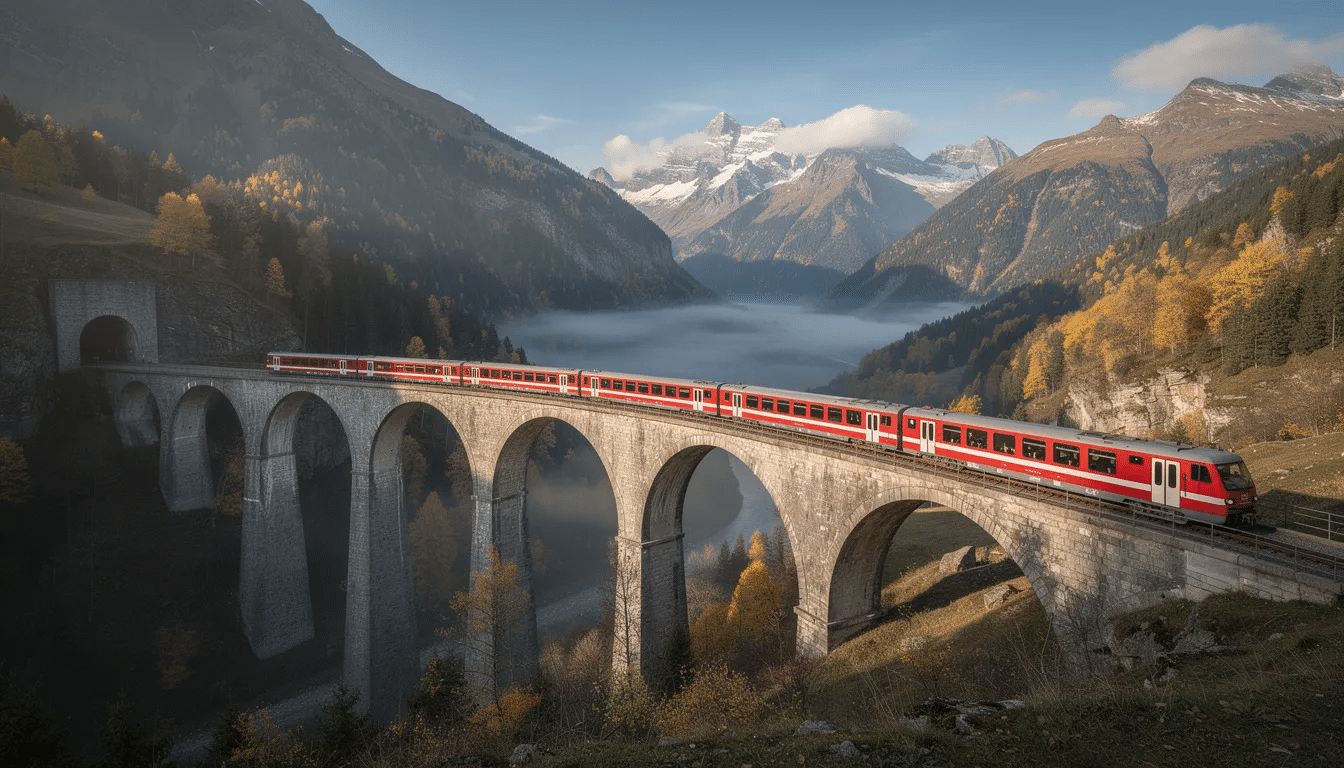
Around 4 hours on a UNESCO World Heritage railway. The train climbs to the Bernina Pass at 2,253 metres and descends into Italy at Tirano. The Landwasser Viaduct and the Albula spiral tunnels are the engineering highlights, both over a century old. Reservation required: CHF 44 in summer, CHF 40 in winter (book through Rhätische Bahn or SBB).
Flåm Railway (Myrdal to Flåm)
20 kilometres, around 1 hour, descending 866 metres. Operates year-round. The train stops briefly at Kjosfossen waterfall mid-descent. Best combined with the Bergen Line as part of a longer Norwegian itinerary.
Rhine Valley (Koblenz to Rüdesheim)
A regular regional train route along the Middle Rhine, a UNESCO World Heritage stretch. Medieval castles above steep vineyards on both banks. Not a panoramic service. The appeal is a slow train through one of Germany’s most photogenic river valleys, with no special booking needed.
West Highland Line (Glasgow to Mallaig)
Around 5 hours 15 minutes through the Scottish Highlands. The Glenfinnan Viaduct is midway through the route. The regular ScotRail service covers the same route as the Jacobite steam train at a fraction of the price, and it runs year-round.
Semmering Railway (Austria)
Used by regular ÖBB services between Vienna and Graz. The Semmering Pass section, built in the 1850s, was the world’s first mountain railway and is UNESCO listed. No special ticket needed beyond a standard rail ticket.
Belgrade-Bar Railway (Serbia to Montenegro)
Around 11 hours from Belgrade to Bar through deep river canyons, mountain viaducts, and remote terrain. Not a comfort service, but it covers ground that most travellers never see and is increasingly popular with rail enthusiasts and Balkan itinerary planners.
Luxury trains
Venice Simplon-Orient-Express (VSOE)
Operated by Belmond. Restored 1920s carriages with private cabins, marquetry interiors, and a formal dining car. Routes include London to Venice, Paris to Venice, and occasional Istanbul itineraries. Runs seasonally, typically spring through autumn. Fares start from around £3,500 per person for the cheapest cabin on shorter routes; suites and longer itineraries cost considerably more. Book 9 to 12 months ahead for popular dates. The train itself is the experience.
Belmond Royal Scotsman
Departures from Edinburgh through the Scottish Highlands. Two to seven night itineraries. Mahogany-panelled carriages, whisky distillery visits, highland castle excursions. Seasonal operation, typically spring to autumn.
Golden Eagle Danube Express
Luxury itineraries across Central and Eastern Europe, including Budapest, Vienna, Prague, and Istanbul. Themed journeys on a seasonal schedule. Check the Golden Eagle website for current routes.
El Transcantabrico Gran Lujo
Northern Spain from San Sebastian to Santiago de Compostela. Around 8 days through the Cantabrian coast, regional wine stops, and medieval towns. Seasonal.
Escorted vs independent Europe train tours
The right choice depends on what you want the trip to feel like.
Escorted tours
An escorted tour means a professional tour manager handles every transfer, hotel, and group excursion. You travel with a group on fixed departure dates. Operators including Great Rail Journeys, Rail Trail, and similar specialists bundle reserved train seats, 3 to 4 star hotels near stations, luggage handling between stations and hotels, and some or all meals.
This format suits first-time visitors to Europe, travellers who want logistics handled end-to-end, and those who prefer the social element of a group. Most departures run from spring through early autumn.
Group sizes vary: some operators offer departures of 10 to 15 people, others run up to 35. The smaller groups give you more flexibility at stops.
Independent tours
Independent rail travel means you book your own trains and hotels and move at your own pace. The tools are either an Interrail or Eurail pass for flexible multi-country travel, or point-to-point tickets for fixed-date itineraries booked in advance.
| Aspect | Escorted | Independent |
|---|---|---|
| Planning required | Minimal | Significant |
| Flexibility | Low | High |
| Cost per day | Higher | Lower |
| Social element | Group dynamics | Solo or partner |
| Logistics | Handled | Self-managed |
Point-to-point advance tickets on high-speed routes can be 50 to 60 percent cheaper than walk-up prices. Early booking matters most on Eurostar, TGV, AVE, and Frecciarossa, where prices rise sharply as the travel date approaches. For a two-week trip with 4 or more long-distance legs across different countries, a global pass often makes financial sense.
Semi-escorted options
Some providers book hotels and train reservations in advance and send you off with destination notes but no guide. You travel independently using their logistics. This suits travellers comfortable making their own way day to day but who want the booking complexity handled. Check carefully what is included; some packages cover only hotels and main train reservations, leaving local transport and excursions to you.
Planning and booking your Europe train tour
Booking lead times
High-demand services fill up quickly. These are the booking windows that matter:
| Service | Recommended booking lead time |
|---|---|
| Venice Simplon-Orient-Express (popular dates, suites) | 9 to 12 months |
| Glacier Express and Bernina Express (peak summer) | 4 to 6 months |
| Eurostar (London to Paris, London to Amsterdam) | 3 to 6 months |
| Paris to Barcelona AVE | 3 to 4 months |
| Nightjet sleepers and couchettes (popular routes) | 2 to 4 months |
| Italian Frecciarossa | 2 to 3 months |
| Christmas market season (late November to December) | 6 months or more |
| Regional trains | 1 to 4 weeks, or walk-up |
Tickets vs passes
Point-to-point tickets work best for short, fixed-date trips. Book at least 2 to 3 months out on high-speed services to get decent prices; earlier for July and August. For a multi-country trip of 7 or more travel days over a 1 to 2 month period, an Interrail Global Pass (for European residents) or Eurail Global Pass (for non-Europeans) usually makes financial sense compared to booking each leg separately.
The pass covers the train fare, not the seat reservation. On every high-speed train listed above and both Swiss scenic trains, a separate paid reservation is required on top of the pass.
Night trains in Europe
ÖBB Nightjet operates Europe’s main overnight train network. Active routes include Berlin to Vienna, Hamburg to Zurich, Brussels to Vienna, Amsterdam to Vienna, and Rome to Vienna, among others. The Paris Nightjet network was discontinued in December 2025. Paris currently has no overnight sleeper rail connection to the rest of Europe.
Night train accommodation comes in three categories: a seat, a couchette (fold-down bunk in a shared compartment, with pillow and blanket), and a private sleeper with a proper berth. Take the couchette or sleeper if you plan to sleep. Seats are cheaper but uncomfortable for a full overnight journey.
Pass-holder couchette and sleeper reservations on Nightjet typically cost EUR 30 to 60 depending on the route and accommodation type; check at booking as fees vary.
Seat reservations
A pass or a point-to-point ticket does not automatically include a seat. Reservations are separate on most high-speed and scenic trains, and on some they are compulsory.
Key rules:
- Eurostar: reservation always required
- French TGV: reservation always required
- Italian Frecciarossa: reservation required
- Spanish AVE: reservation required
- Glacier Express: reservation required; CHF 54 per person
- Bernina Express: reservation required; CHF 44 summer, CHF 40 winter (book through Rhätische Bahn or SBB)
- German ICE: optional but advisable on busy dates
- ÖBB Nightjet: couchette and sleeper reservation required; seat reservation optional
- Regional trains: rarely required
Reserve through operator websites or SBB for Swiss trains. For multi-country trips, Rail Europe aggregates many European operators. Expect CHF 54 for the Glacier Express, CHF 44 to 40 for the Bernina Express, and typically EUR 5 to 35 for most other high-speed services.
Luggage
European trains have no strict luggage limit, but you carry your own bags through stations and up stairs. One suitcase and a day bag is the practical ceiling for most multi-city itineraries. Station luggage lockers cost around EUR 4 to 8 for several hours; larger stations have them; smaller ones may not.
Escorted tour operators generally include luggage transfers between hotels and stations.
Accommodation
Most escorted packages use 3 to 4 star hotels near major stations. For independent travel, a hotel within 10 to 15 minutes of the main station saves time and simplifies early departures.
Practical tips
In Italy, regional train tickets must be validated at the yellow machines on the platform before you board. This applies even to printed tickets. Failure to validate is a fineable offence and the rule catches a lot of first-time visitors.
France experiences periodic industrial action. Check disruption notices before travel, particularly for SNCF services on intercity and regional lines.
Download operator apps before you travel. DB Navigator covers German rail well; SNCF Connect handles French services; Trainline covers multiple European countries and works for booking too.
Arrive 15 to 30 minutes before high-speed departures. These trains leave on time and do not wait.
Keep valuables in a bag that stays on your person at busy stations, particularly in Paris, Rome, and Barcelona.
Frequently asked questions
What are the best scenic train routes in Europe?
The Glacier Express (Zermatt to St Moritz) is the most celebrated. Around 8 hours across the Swiss Alps, crossing the Oberalp Pass at 2,033 metres, with panoramic windows on both sides of the carriages. A seat reservation is required: the fee is CHF 54 per person, and panoramic seats on popular summer dates can sell out several months ahead. The Bernina Express (Chur to Tirano) covers a UNESCO World Heritage railway in around 4 hours, climbing to 2,253 metres at the Bernina Pass before descending into Italy. For Norwegian scenery, the Bergen Line from Oslo to Bergen (around 7 hours across Hardangervidda) combined with the Flam Railway descent to Aurlandsfjord is hard to beat. In Scotland, the West Highland Line from Glasgow to Mallaig takes around 5 hours 15 minutes through the Highlands, passing the Glenfinnan Viaduct mid-route.
Can I use an Interrail or Eurail Pass for a Europe train tour?
Yes, and for a multi-country trip with 7 or more travel days over a 1 to 2 month period, a Global Pass often makes financial sense compared to booking each leg separately. Interrail is for European residents; Eurail is for travellers from outside Europe. The pass covers the train fare, not the seat reservation. On every high-speed service in western Europe (Eurostar, TGV, AVE, Frecciarossa) and on both Swiss panoramic trains (Glacier Express, Bernina Express), a separate paid reservation is required on top of the pass. Nightjet couchette and sleeper reservations for pass-holders typically cost EUR 30 to 60 depending on the route and accommodation type. For a short trip with fixed dates, point-to-point advance tickets on individual routes are usually cheaper than a pass.
How do I book the Venice Simplon-Orient-Express?
Book direct through Belmond at belmond.com, or via a luxury travel agent who handles Belmond itineraries. The VSOE operates seasonally, typically spring through autumn, and runs routes including London to Venice and Paris to Venice. Fares start from around £3,500 per person for the cheapest cabin on shorter routes; suites and longer itineraries cost considerably more. Popular dates and cabin categories sell out 9 to 12 months ahead, so book early if you have a specific departure in mind. Belmond's website shows current availability and pricing. A luxury travel agent can help with cabin selection and pre-trip logistics.
Are Nightjet night trains still running in 2026?
Yes. ÖBB Nightjet operates Europe's main overnight rail network, and the core routes are active. In 2026, these include Berlin to Vienna, Hamburg to Zurich, Brussels to Vienna, Amsterdam to Vienna, and Rome to Vienna, among others. The Paris Nightjet network was discontinued in December 2025, so there is currently no overnight sleeper connection to or from Paris within the Nightjet network. Book a couchette or sleeper rather than a seat if you plan to sleep on the journey; seats are cheaper but uncomfortable for a full overnight trip. Couchette and sleeper reservations for pass-holders typically cost EUR 30 to 60 depending on the route and accommodation type.
What should I know before booking the Glacier Express?
The Glacier Express runs from Zermatt to St Moritz (or vice versa) in around 8 hours, passing through Andermatt and crossing the Oberalp Pass at 2,033 metres. A seat reservation is required, and the fee is CHF 54 per person for both first and second class. Book through SBB (sbb.ch) or Matterhorn Gotthard Bahn. Second class has the same panoramic windows as first; first class adds table-service meals, which some travellers consider the best part of the trip. For summer travel in July and August, book panoramic seats by March as popular dates sell out months ahead. The train runs year-round, but the Alpine scenery is different in snow and in summer, so the season matters for what you see out of the window.
Is it cheaper to book an escorted Europe rail tour or plan independently?
Independent travel is almost always cheaper per day, but the gap is smaller than it looks. Escorted tours bundle train reservations, 3 to 4 star hotels near stations, luggage transfers, and some meals into a single price. Independent travel means booking each leg separately, often at advance-purchase prices that are 50 to 60 percent lower than walk-up fares on high-speed routes. The real cost comparison depends on how many legs you have, how far in advance you book, and whether you value having logistics handled. Escorted tours also remove the planning effort and provide a guide, which matters for first-time visitors to Europe. For experienced travellers comfortable with multi-country rail booking, independent travel gives more flexibility at lower cost. Semi-escorted options (where an operator books trains and hotels but sends you off without a guide) sit in between on both cost and flexibility.