Train service

CFF
CFF is Switzerland’s national rail operator, known for punctual, fully electrified train services across the country and beyond.
Check times & pricesOfficial website Check times & prices
Trenitalia
Trenitalia is Italy’s state-owned rail operator, running high-speed, intercity, and regional trains across the country and beyond.
Check times & pricesOfficial websiteTrain tickets

Omio
Omio connects you with over 1,000 transport providers - trains, buses, flights, and more - to simplify your travel planning.

Trainline
Trainline sells rail and coach tickets worldwide on behalf of major UK and European transport companies.

Raileurope
Rail Europe is a leading travel tech company specializing in European train bookings for over 15,000 travel professionals worldwide.
The train from Zurich to Zermatt takes around 3 hours 20 minutes to 3 hours 35 minutes, with a change of trains at Visp. Two companies share the route: Swiss Federal Railways (SBB) covers Zurich to Visp, and Matterhorn Gotthard Bahn (MGB) runs the final narrow-gauge climb into Zermatt. Zermatt is car-free. The train is not just the most convenient way to arrive — it is the only practical option.
SBB sells through-tickets covering both operators, so you buy a single ticket for the whole journey. The change at Visp is well-signed and the standard connection gives you comfortable time to switch platforms. Full-fare 2nd class tickets start from around CHF 65, with advance and day-pass options available for less. Check sbb.ch for the fare on your exact date.
How the route works
Train operators on this route
SBB Intercity trains cover the two-hour leg from Zurich HB to Visp. At Visp, you board an MGB train for the 65-minute section up to Zermatt. MGB runs narrow-gauge trains designed for the mountain gradient on this final stretch.
SBB Intercity trains offer free Wi-Fi via the SBB FreeSurf portal, power outlets at every seat, a dedicated family car, and wheelchair-accessible facilities. MGB trains are more compact but adequate for the scenic valley run to Zermatt.
The Visp transfer
Every standard Zurich to Zermatt service requires a change at Visp. SBB through-ticketing means one ticket covers both legs, but you do change trains. At Visp, follow signs to the MGB departure platform. The connection is straightforward for most travellers. With heavy luggage, consider using SBB’s baggage forwarding service to send bags directly to Zermatt before you leave Zurich.
For the best views of the valley on the MGB section, sit on the right-hand side of the train from Visp.
Journey times
Most departures take 3 hours 20 minutes to 3 hours 35 minutes, including the Visp change. Trains run roughly once an hour throughout the day. Check sbb.ch for departures that fit your schedule, as timing varies by day and season.
The route covers approximately 235 km from Zurich HB to Zermatt.
Starting from Zurich Airport
If you are flying into Zurich, check sbb.ch for trains from Zurich Airport (Flughafen) to Zermatt. Many connections require only the Visp change and do not need an additional stop at Zurich HB. Confirm your exact routing before boarding, as this depends on your specific departure time.
Rail passes and tickets
Interrail and Eurail passes
Here is the catch many travellers miss. Interrail and Eurail passes do not cover the MGB segment from Visp to Zermatt. Your pass is valid on the SBB leg from Zurich to Visp, but you must buy a separate MGB ticket for the final section. You can do this at Visp station or in advance via sbb.ch or the MGB website.
Do not assume your rail pass covers the entire journey. The pass gap on MGB is one of the most common planning errors on this route.
Swiss Travel Pass
The Swiss Travel Pass covers the full route, including the MGB section to Zermatt. This makes it more practical than an Interrail or Eurail pass for this specific journey. If you plan to travel widely in Switzerland, the Swiss Travel Pass is generally the more useful option.
The pass gives unlimited travel on trains, buses, and boats across the Swiss national network for 3, 4, 5, 6, 8, or 15 consecutive days. It also includes free entry to many Swiss museums and discounts on some mountain excursions. Check the Swiss Travel Pass pages on this site or at sbb.ch for current prices.
Tickets and prices
Standard tickets
Full-fare 2nd class tickets from Zurich to Zermatt typically start from around CHF 65. First class starts from around CHF 108. Prices are dynamic and vary by travel date, demand, and booking window. Use sbb.ch for the exact fare on your departure — third-party platforms do not always show the full range of fare types.
Saving on tickets
SBB Supersaver Tickets offer up to 50% off on specific departures when booked ahead. These are fixed-time tickets. Changes after purchase may involve a fee or full loss of the fare, so confirm your travel plans before buying a Supersaver.
Saver Day Passes cost CHF 52 in 2nd class, or CHF 29 if you hold a Half Fare Travelcard. The Half Fare Travelcard gives a 50% discount on standard SBB fares and makes sense if you plan two or more longer journeys in Switzerland.
Book early for peak periods. Demand is highest in December to February (winter sports) and July to August, and advance Supersaver fares on popular morning departures can sell out. Mid-week and off-peak times are easier to book at lower prices.
Where to buy
Book at sbb.ch or the SBB mobile app. These give the full timetable, all available fare types, and mobile ticketing. Station ticket counters at major Swiss stations also sell tickets with English-speaking staff.
Third-party platforms can be useful for an initial price check, but verify any booking fees and cancellation conditions before confirming. SBB direct gives the most flexibility on changes.
The Glacier Express
The Glacier Express is not a faster or alternative version of the Zurich to Zermatt journey. It is a dedicated scenic panoramic train connecting St. Moritz or Davos to Zermatt through a different route via Andermatt. The journey takes around 8 hours. It runs seasonally, requires advance reservation, and carries a scenic supplement on top of the base rail ticket. Fares are in CHF; check the Glacier Express website or sbb.ch for current pricing.
Choose the Glacier Express if you want a full-day Alpine scenic experience. Choose the SBB/MGB connection via Visp if you want to arrive in Zermatt efficiently.
Views along the route
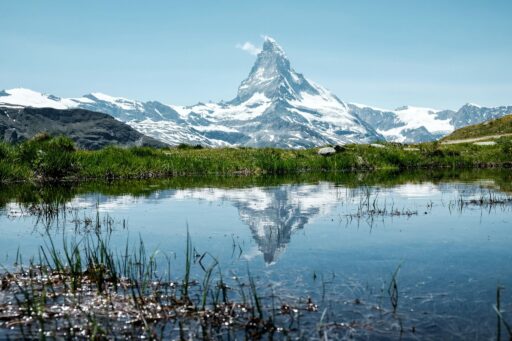
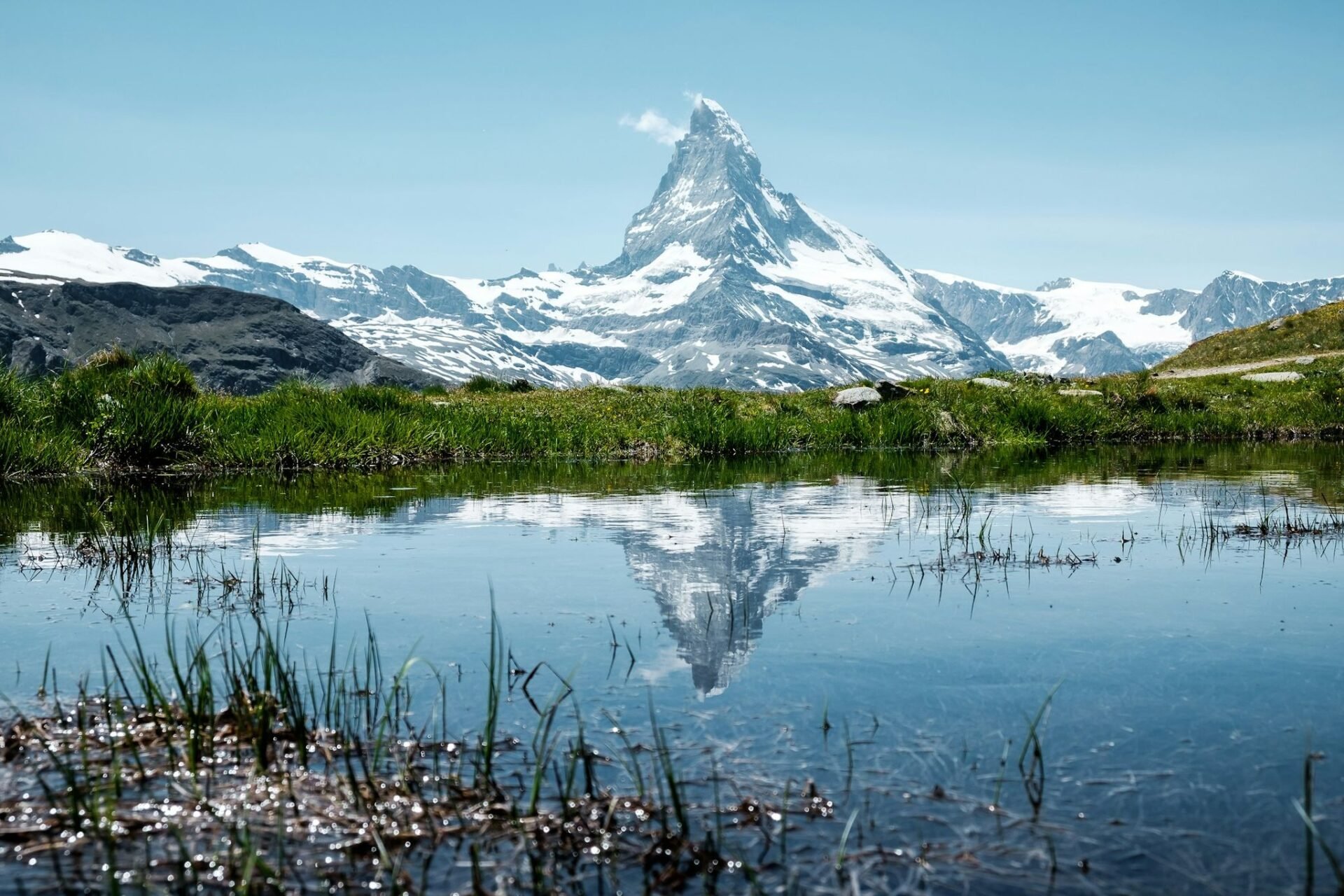
The SBB leg from Zurich passes through the broad Rhone Valley before reaching Visp. On the MGB section, the train climbs from around 640 metres at Visp to 1,620 metres at Zermatt, following the narrow Matter Valley. The Matterhorn comes into view on the final approach. The most dramatic scenery is on the MGB section.
Arriving in Zermatt
Zermatt station sits in the centre of the village. No cars are permitted in Zermatt, so the train drops you directly into the pedestrian zone. Most hotels are within walking distance of the station; for others, electric taxis run from the station forecourt.
The station has luggage storage, ticket offices, and information points for onward excursions.
Getting around Zermatt
Transport in Zermatt runs on electric taxis and electric buses. For the mountains, the Gornergrat Railway departs from close to the main station and offers views of the Matterhorn and surrounding peaks.
If you are joining the train at Taesch — the last car-accessible village before Zermatt — a shuttle service runs every 20 minutes and takes about 12 minutes to Zermatt station. Most travellers arriving from Zurich will not need this, as the SBB/MGB connection runs all the way to Zermatt.
Saving money: practical summary
- Book SBB Supersaver fares early, particularly for peak-season departures
- Use a Saver Day Pass: CHF 52 in 2nd class, or CHF 29 with a Half Fare Travelcard
- Get a Half Fare Travelcard if you are making more than one long SBB journey in Switzerland — the 50% discount applies across the network
- With a Swiss Travel Pass, the full Zurich to Zermatt route is covered at no additional fare cost
- With an Interrail or Eurail pass, budget separately for the MGB ticket (Visp to Zermatt), which the pass does not cover
Frequently asked questions
How long does the Zurich to Zermatt train journey take?
Most Zurich to Zermatt trains take around 3 hours 20 minutes to 3 hours 35 minutes, including the change at Visp. Trains run roughly once an hour throughout the day. Check sbb.ch for the exact departure times on your travel date.
How much does a Zurich to Zermatt train ticket cost?
SBB full-fare 2nd class tickets typically start from around CHF 65. Advance Supersaver fares and Saver Day Passes (from CHF 29 with a Half Fare Travelcard, or CHF 52 without) can reduce the cost. Prices vary by travel date and how far ahead you book. Check sbb.ch for current fares.
Which train operators run the Zurich to Zermatt route?
Two operators share the route. Swiss Federal Railways (SBB) runs the Zurich to Visp section on Intercity trains. Matterhorn Gotthard Bahn (MGB) operates the final narrow-gauge section from Visp into Zermatt. SBB sells through-tickets covering both legs.
Why does the train to Zermatt use narrow-gauge trains?
The MGB section from Visp to Zermatt climbs from around 640 metres to 1,620 metres through a narrow mountain valley. Narrow-gauge trains are better suited to the tight gradients and curves on this stretch. Zermatt itself is a car-free village, so the MGB is the only direct way to arrive by land.
What amenities are available on Zurich to Zermatt trains?
SBB Intercity trains on the Zurich to Visp section offer free Wi-Fi via the SBB FreeSurf portal, power outlets at every seat, a dedicated family car, and wheelchair-accessible facilities. The MGB section to Zermatt uses smaller trains without the same range of facilities, but the journey takes just over an hour.
Does an Interrail or Eurail pass cover the full Zurich to Zermatt journey?
No. Interrail and Eurail passes cover the SBB leg from Zurich to Visp, but the MGB section from Visp to Zermatt is not included in either pass. Pass holders must buy a separate ticket for the Visp to Zermatt section, available at Visp station or in advance via sbb.ch. The Swiss Travel Pass does cover the full route including MGB.