

Train service

SNCF
SNCF is France’s state-owned rail operator, running high-speed, regional, and international TGV services across Europe.
Check times & pricesOfficial website Check times & prices
Renfe
Renfe is Spain’s national railway operator, offering high-speed, long-distance, and regional train services with extensive domestic coverage.
Check times & pricesOfficial website
Ouigo
Ouigo is SNCF’s low-cost train service offering affordable high-speed travel in France, Spain, and Belgium with simplified onboard amenities.
Check times & pricesOfficial websiteTrain tickets

Raileurope
Rail Europe is a leading travel tech company specializing in European train bookings for over 15,000 travel professionals worldwide.

Trainline
Trainline sells rail and coach tickets worldwide on behalf of major UK and European transport companies.

Omio
Omio connects you with over 1,000 transport providers - trains, buses, flights, and more - to simplify your travel planning.
There are no direct trains from Barcelona to Nice. Every connecting itinerary requires at least one change, most commonly at Marseille St-Charles, and the total journey takes anywhere from around 7 hours 10 minutes on the fastest available option to 13 hours or more depending on the connection you choose and the date you travel. The core station pair is Barcelona Sants to Nice Ville.
Key facts at a glance
| Detail | Figure |
|---|---|
| Direct trains | None |
| Typical changes | 1 (usually Marseille St-Charles); some itineraries require 2 or more |
| Fastest journey time | Around 7h10 |
| Typical bookable range | 8 to 13+ hours depending on connection and date |
| First departure (Barcelona to Nice direction) | Around 06:10 – verify before booking |
| Last departure (Barcelona to Nice direction) | Around 19:55 – verify before booking |
| Route distance | About 490-493 km |
| Fare from | €103 (May 2026 Omio example; prices are dynamic) |
| Rail passes accepted | Interrail Global Pass, Eurail Global Pass |
| Reservation required with pass | Yes – compulsory on TGV/AVE high-speed legs |
Timetables, fares, and available connections vary by travel date, so check live schedules before booking.
Understanding the route structure
Because no single train covers the Barcelona to Nice journey, you need to piece together two distinct rail legs.
The first leg takes you from Barcelona Sants to Marseille St-Charles by a high-speed service. Renfe AVE and SNCF TGV INOUI trains operate on this cross-border corridor. The route passes through Avignon TGV and Aix-en-Provence TGV before arriving in Marseille. Depending on the date, you may find several departures to choose from across the day, with the first option from Barcelona leaving around 06:10.
The second leg runs east from Marseille along the French Mediterranean coast to Nice. Depending on the date and time of day, this may be a TGV INOUI long-distance service, an SNCF Intercités, or a TER/ZOU regional train. The coastal line passes through Cannes and Antibes before reaching Nice Ville. Some itineraries may also use Nice Saint-Augustin as a destination variant, but Nice Ville is the main city-centre station for most travellers.
The quality and pace of the second leg varies considerably. A well-timed TGV connection from Marseille to Nice is fast and comfortable; a slower TER/ZOU regional train on the same stretch adds significantly to the total journey time. When planning, look at the connection time at Marseille carefully and consider whether the second leg is a fast intercity service or a regional stopper.
Route options compared
The table below sets out the main planning approaches.
| Option | Typical total time | Typical scenario | Best for |
|---|---|---|---|
| Same-day fast connection via Marseille | From around 7h10-9h | Barcelona Sants early morning > Marseille St-Charles > TGV or Intercités to Nice Ville | Travellers wanting one full day’s journey |
| Same-day slower connection via Marseille | 10-13+ hours | Later or less frequent connection; regional TER/ZOU for Marseille-Nice leg | Flexible travellers; lower-fare options |
| Overnight break in Marseille | Two separate days | Travel Barcelona to Marseille one afternoon; hotel in Marseille; continue to Nice next morning | Travellers wanting a relaxed trip, or when late connections make same-day travel risky |
| Bus (direct coach services exist) | Often 12-14+ hours | Long but sometimes lower cost | Budget priority, not speed |
| Flight via connecting airports | Varies by door-to-door time | Barcelona El Prat to Nice Côte d’Azur, with airport transfers at both ends | Those prioritising speed above experience |
For most travellers, the best default is a same-day itinerary with a comfortable connection at Marseille St-Charles. Aim to leave Barcelona early, as morning departures give you the most options for the onward Marseille to Nice leg and leave room to recover if the first service is delayed. If your first leg arrives late at Marseille, or if the only remaining connections are slow or expensive, an overnight stop there is a sensible alternative and gives you a chance to explore Marseille itself.
Tickets, fares and booking
Fares on this route are dynamic and rise as the travel date approaches. A May 2026 fare example was €103 for the full Barcelona to Nice journey; this is a point-in-time example and prices will differ by date and how far in advance you book.
Booking early generally unlocks cheaper advance fares on both the Spanish high-speed leg (Renfe AVE) and the French legs (SNCF TGV INOUI, SNCF Intercités). Retailers including Rail Europe, Trainline, and Omio sell through-itinerary tickets for this journey. You can also book each leg separately via Renfe’s own channels and SNCF Connect, which can sometimes reveal different fare combinations. Comparing both approaches before confirming is worth the extra few minutes.
When booking separate legs, Barcelona to Marseille advance fares can sometimes be found at considerably lower prices than a full through-ticket, making separate bookings an attractive option if the timetable works for your dates. The trade-off is that if one leg is delayed and your tickets are separate, the second operator is not automatically obliged to rebook you onto a later service. For that reason, if you do book legs separately, build a generous connection window at Marseille St-Charles.
As a general rule, allow at least 45 to 60 minutes at Marseille if your legs are on separate tickets. Cross-border services can occasionally run a few minutes behind schedule, and a comfortable buffer protects you if that happens.
A general three-piece luggage allowance may apply on some trains for this route. Exact luggage rules are set by each individual operator and can differ between Renfe and SNCF services, so check the specific conditions on your ticket when booking.
Rail passes: Interrail and Eurail
Both the Interrail Global Pass (for European residents) and the Eurail Global Pass (for non-European travellers) are valid on the trains that make up this journey, covering both the Spanish and French portions of the route.
However, holding a pass does not mean you can simply board. On all TGV INOUI and AVE high-speed trains, a seat reservation is compulsory, even for passholders. Interrail specifically notes that TGV reservations are required and that the number of seats available to passholders is limited. Eurail similarly confirms that French high-speed trains require reservations.
In practical terms this means:
- Book your reservation as early as possible, especially in peak summer months when passholder quota seats sell out quickly.
- A reservation fee applies on top of your pass for each high-speed leg.
- TER/ZOU regional trains on the Marseille to Nice coastal section generally do not require advance reservations, but check the conditions for your specific service.
- If you are travelling in July or August, do not leave your reservation until the last minute. Passholder allocation on popular cross-border TGV/AVE departures can be exhausted weeks in advance.
If passholder quota seats are sold out on your preferred TGV or AVE departure, you may need to consider a slower alternative or book a point-to-point ticket for that leg instead. Your pass remains valid for regional trains on the Marseille to Nice corridor where no reservation is needed, which gives you a fallback option even if the fast services are full for pass holders.
Stations and connections in detail
Barcelona Sants is the main departure point for all international high-speed trains from Barcelona. It is well connected to the city by public transport, making it easy to reach from most parts of Barcelona. Allow time to reach the station before your departure, particularly on cross-border services.
Marseille St-Charles is the main connection hub for this journey. It is a large terminus station in central Marseille with onward connections into the city. The station has waiting space and facilities if you have time between your two legs. When connecting here, check the departure board on arrival to confirm the platform for your onward service to Nice.
Nice Ville is the principal destination station and is centrally located in Nice, within easy reach of the city centre. Nice Saint-Augustin appears in some retailer search results as an alternative Nice stop. It is closer to Nice Côte d’Azur airport but further from the city centre. Most visitors should target Nice Ville unless they have a specific reason to alight at Saint-Augustin, such as onward travel to the airport.
Cannes and Antibes are intermediate stops on the Marseille to Nice coastal leg. If your plans include visiting the Cannes or Antibes area, you could build a stop here into your itinerary without adding a separate journey, since the train passes through both on its way to Nice.
Scenery along the Barcelona to Nice rail route
The route has two quite different characters. The first leg, from Barcelona Sants to Marseille St-Charles, is a high-speed service that runs partly through tunnels and across flat plains in southern France. There are views of the Catalan countryside north of Barcelona and the Rhône valley area near Avignon, but much of this leg is optimised for speed rather than scenery.
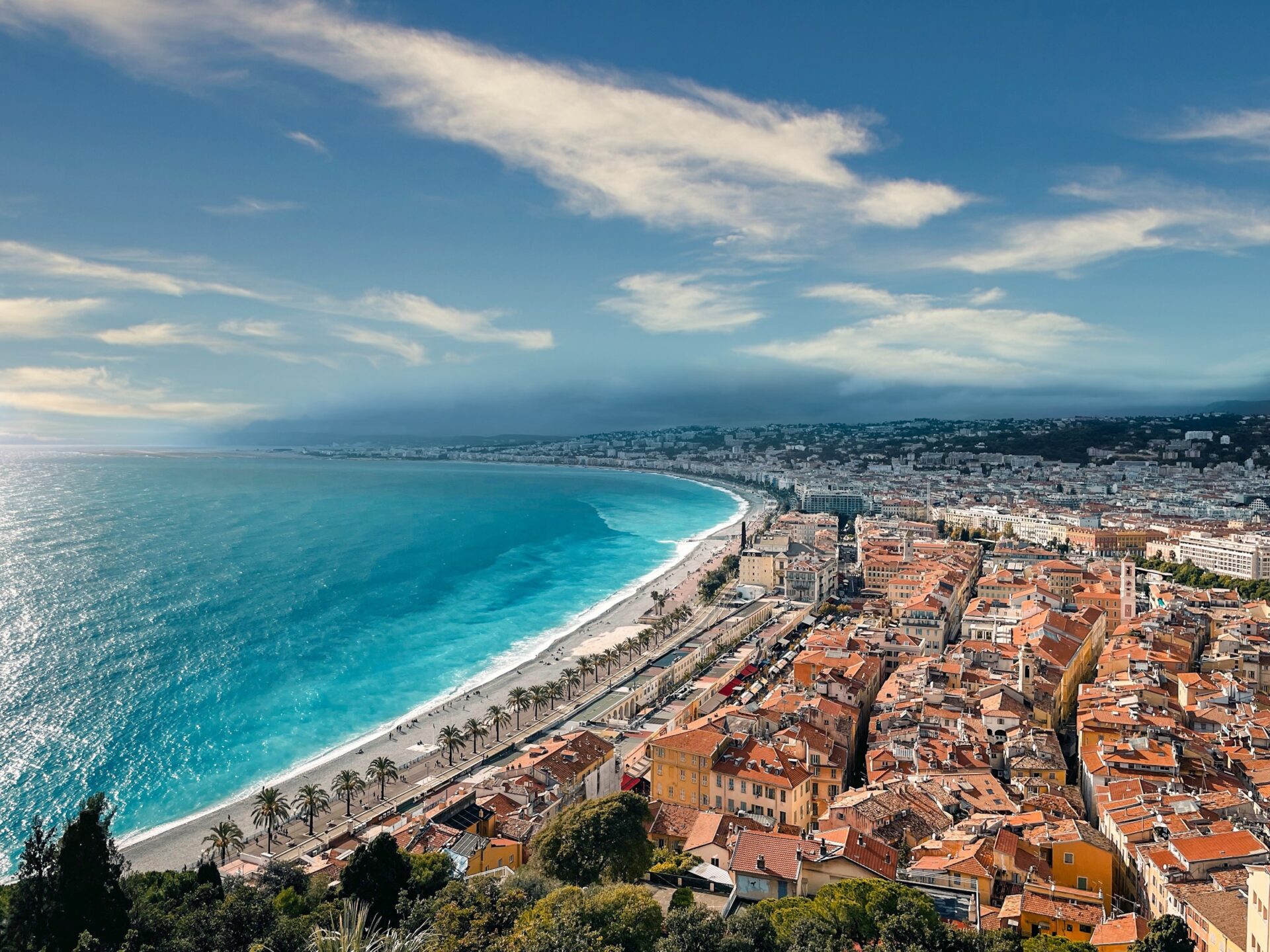
The second leg, from Marseille east along the coast to Nice, is notably more scenic. The line runs close to the Mediterranean for much of its length, with stretches between Toulon and Cannes offering attractive coastal views. This is one of the reasons many travellers find the train more enjoyable than flying on this route: the journey itself is part of the experience, particularly on the French coastal stretch.
Train versus bus versus flight
The train is not the fastest option door-to-door, but it offers a comfortable journey with no airport security queues, reasonable luggage allowances, and onboard space to move around. The city-centre to city-centre advantage is genuine: Barcelona Sants and Nice Ville are both well inside their respective cities, whereas airports at both ends require additional transfers.
Coach buses between Barcelona and Nice exist and can be cheaper, but journey times are typically 12 to 14 hours or more, and comfort over that duration is a significant consideration. For a long overnight journey this can work for very budget-focused travellers, but for most people the train is preferable.
Flying is generally faster in terms of air time, but airport transfers at both ends and the time spent at the airport erode that advantage. Once you account for the full door-to-door journey, the gap between flying and taking a well-timed train connection can narrow considerably.
For travellers who want to see the French Mediterranean coastline and arrive in Nice city centre without the stress of airports, the train has clear advantages, particularly on the Marseille to Nice section, which runs along the coast through Cannes and Antibes.
Booking tips for 2026
- Book the Barcelona Sants to Marseille St-Charles leg as early as possible. Advance Renfe/TGV fares are significantly cheaper than on-the-day prices, and the best seats go quickly on peak summer dates.
- Search both combined through-tickets and separate legs to find the best combination. Retailers such as Rail Europe, Trainline, and Omio show through options; Renfe and SNCF Connect let you price the two legs individually.
- If you hold an Interrail or Eurail pass, add your TGV/AVE reservation at the same time as you confirm your travel dates. Do not assume availability will still exist when you get closer to the trip.
- Allow at least 45 to 60 minutes connection time at Marseille St-Charles if your two legs are on separate tickets, and consider a longer buffer if you are travelling in a busy period.
- The first departure from Barcelona in the direction of Nice is around 06:10 and the last is around 19:55 for current timetable planning. Verify exact times on your specific travel date before booking.
- If you plan to travel in July or August, book several weeks ahead. This is one of the busiest leisure corridors in Europe during the summer peak, and both fares and passholder seat availability tighten considerably.
- Check whether your preferred departure is a TGV INOUI, Intercités, or regional TER/ZOU for the Marseille to Nice leg. The TGV and Intercités are generally faster and more comfortable; the regional trains take longer but often do not require advance reservations.
Frequently asked questions
Is there a direct train from Barcelona to Nice?
No. There are no direct trains from Barcelona to Nice. All itineraries require at least one change, most commonly at Marseille St-Charles.
How long does the train from Barcelona to Nice take?
The fastest available option is around 7 hours 10 minutes, but many bookable itineraries take 8 to 13 hours or more depending on the connection and date. Use these figures as planning guidance and check live schedules before booking.
Which station in Nice should I use?
Nice Ville is the main city-centre station and the right choice for most travellers. Nice Saint-Augustin can appear as an alternate Nice stop and is closer to Nice airport, but further from the city centre.
Can I use an Interrail or Eurail pass from Barcelona to Nice?
Yes. Both the Interrail Global Pass and the Eurail Global Pass are valid on this cross-border journey. However, seat reservations are compulsory on all TGV and AVE high-speed trains, and the number of passholder seats is limited - book your reservation early.
Is the train or bus better from Barcelona to Nice?
The train is faster, more comfortable, and offers better luggage conditions. Coach buses can be cheaper but typical journey times are 12 to 14 hours or more. For most travellers, the train is the better choice.