
Train service

Eurostar
Eurostar is an international high-speed rail operator connecting the UK, France, Belgium, the Netherlands, and Germany.
Check times & pricesOfficial website Check times & prices
Amsterdam to Paris by Eurostar: direct trains in around 3 hours 15 minutes to 3 hours 35 minutes. Around 10 direct departures a day on weekdays, from Amsterdam Centraal to Paris Gare du Nord. Advance fares from €35.
Amsterdam to Paris train in a nutshell
The fastest direct Eurostar takes around 3 hours and 15 minutes from Amsterdam Centraal to Paris Gare du Nord. Most departures run between 3 hours 20 minutes and 3 hours 35 minutes. On a typical weekday, around 10 direct trains leave Amsterdam, with the first usually around 06:10 and the last around 20:10.
Eurostar has operated this route since October 2023, when Thalys merged into the Eurostar brand. If you see Thalys mentioned on older booking pages or travel forums, that is the same service.
Advance Standard fares can start from around €35 when booked early. Book a few weeks out and you should budget €70 to €130. Flexible or same-day fares can exceed €180. Booking ahead makes a real difference on this route, both on price and seat availability.
One-change options via Brussels exist, but they add at least an hour. For most travellers, the direct Eurostar is the right call.
Route overview
The Eurostar travels south through the Netherlands, Belgium and northern France on dedicated high-speed lines. It stops at Schiphol Airport, Rotterdam Centraal, and Brussels-Midi, then continues to Paris. You cross three countries but stay entirely within the Schengen Area, so there is no passport control on this journey.
These intermediate stops do not require a change of train. You stay in your seat the whole way.
| Service | Typical journey time |
|---|---|
| Direct Eurostar (fastest) | ~3h 15m |
| Direct Eurostar (typical) | 3h 30m to 3h 38m |
| One-change via Brussels | 4h to 6h+ |
Timetables
Timetables change by season and day of week, so check the live schedule on Eurostar.com or NS International before you book. The broad pattern on weekdays: first trains leave Amsterdam around 06:00 to 06:30, with roughly hourly departures through the morning and early afternoon, then fewer options after 17:00. Last departures are usually around 20:00 to 20:30.
Weekends follow a similar first and last departure window with slightly fewer mid-morning options.
If you are travelling over a public holiday or school holiday week, check availability early. Trains can fill quickly and popular departures sometimes sell out.
Ticket classes
Eurostar currently offers three classes:
Standard is the right choice for most travellers. You get a reserved seat, free WiFi (connection can drop in tunnels), EU power sockets at most seat pairs, and access to the onboard café bar. Luggage allowance is two large bags (up to 75 cm) plus one small item.
Standard Premier offers extra legroom, a quieter coach, and light at-seat catering on most departures. A meaningful step up without the Business Premier cost.
Business Premier is Eurostar’s first class. It includes lounge access at Amsterdam Centraal and Paris Gare du Nord, a hot meal at your seat, priority boarding, and a spacious seat designed for working. The right choice for regular business travellers or those who want the full experience.
Across all classes, tickets come in flexibility tiers. Non-flex is cheapest with limited or no changes. Semi-flex allows date and time changes with a fee. Fully flexible allows unlimited changes and full refunds, at a significantly higher price. For most travellers with firm plans, non-flex is fine.
Prices
The cheapest Standard advance fares start from around €35, though you need to book early for those. Book 30 to 60 days out and you should expect to pay €70 to €130 for Standard. Leave it to the last minute and you can easily pay more than €150.
Several things push fares up. Friday afternoon and Sunday evening trains cost more than midweek midday ones. Summer school holidays, Easter week, King’s Day (27 April), Bastille Day (14 July), and Paris fashion weeks all affect availability. Trains fill at peak times, and booking early is not just about price.
To get the best fare: set a reminder for when Eurostar opens bookings, typically six months ahead. Pick Tuesday to Thursday departures if your dates are flexible, and compare midday against morning and evening trains on the same day.
Children under 4 travel free without a seat. Discounted fares exist for accompanied children and young people. Check Eurostar.com for current child fare conditions, as they vary by ticket type.
Where to book
Eurostar.com is the natural starting point. It covers all classes, flexibility tiers, and the full schedule. Book here for direct contact with the operator if anything changes.
NS International (nsinternational.com) is the Dutch national rail international service and works well if you are combining the Amsterdam to Paris leg with other Dutch rail journeys.
SNCF Connect is useful if you need to link this journey with onward French rail connections.
Trainline, Rail Europe, and Omio show the same trains but may add booking fees of 5 to 10 percent. They are handy for multi-leg itineraries across several operators, but for a straightforward Amsterdam to Paris booking, the official sites are the better choice.
Your seat is assigned at the time of booking. You will have a coach and seat number before you travel. No scramble on the platform.
Stations
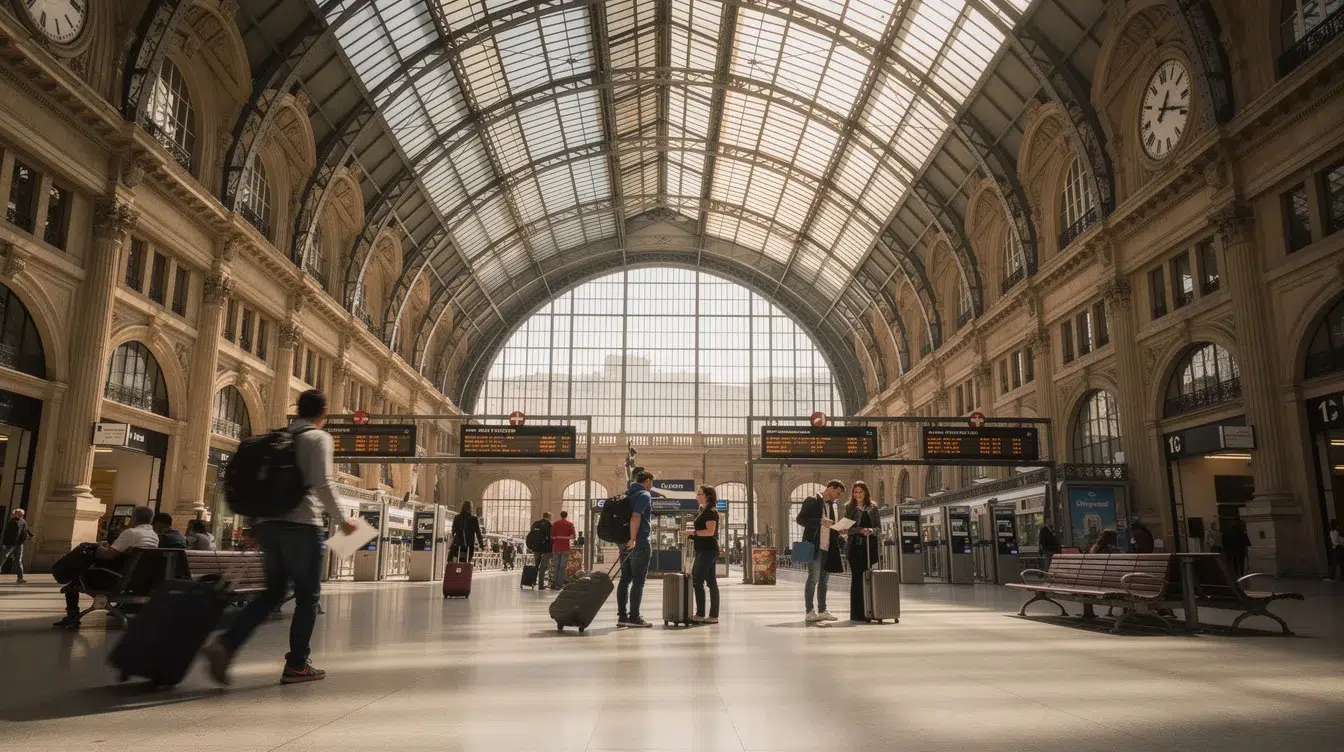
Amsterdam Centraal is where almost everyone starts. It is in the centre of Amsterdam with metro, tram, and bus connections directly outside. Eurostar trains typically depart from platforms 14 or 15 on the western side, though the exact platform is shown on the departure boards on the day. Arrive at least 20 to 30 minutes before departure.
If you are flying into Schiphol Airport and heading to Paris without stopping in Amsterdam, note that several Eurostar services stop at Schiphol Airport before Rotterdam. That can save a trip into the city entirely.
Paris Gare du Nord is the arrival station. It is one of the busiest stations in Europe, with plenty of onward connections: Metro lines 4 and 5, RER B to Charles de Gaulle in around 30 minutes, and the full Paris RER network. Taxis and buses are outside the main exits. Business Premier passengers have lounge access here.
Check the departure boards on arrival if you are catching an onward train. Platform doors close 2 to 5 minutes before departure.
Onboard
Seats are assigned, so you know your coach and seat before you board. Bags go in the overhead rack or at the luggage areas at the carriage ends. The allowance is generous: two large bags plus one small item, no strict weight limit.
WiFi works well on the open stretches through the Netherlands and northern France. Expect dropouts in the tunnels between Belgium and France. Most seat pairs have EU power sockets.
Standard class passengers visit the café bar for food and drinks. Standard Premier passengers get a light meal at their seat on most departures. Business Premier passengers are served a hot meal.
Alternatives
One-change via Brussels
When direct Eurostar trains are sold out or expensive, you can travel from Amsterdam to Brussels by IC or intercity train (roughly two hours, usually no reservation needed), then connect to a TGV from Brussels-Midi to Paris Gare du Nord (around 1 hour 22 minutes, reservation required). Total: four to five hours depending on the connection. Split ticketing adds booking complexity and the time cost is real. This route occasionally undercuts direct fares, but it is not a like-for-like comparison.
GoVolta budget trains (from December 2026)
GoVolta, a Dutch rail start-up, plans to launch a low-cost direct Amsterdam to Paris service from 14 December 2026, with fares reportedly from around €19. The planned journey time is around 6 hours, with stops at Antwerp and Ghent. If it launches as planned, this would give budget travellers a much cheaper if slower alternative to Eurostar. Check GoVolta’s website for confirmed timetables and fares before booking, as details may change before the service starts.
European Sleeper night train
The European Sleeper runs an overnight service connecting Amsterdam and Paris via Brussels. You travel through the night in a couchette or sleeper berth and arrive in Paris in the morning. See the European Sleeper guide for current timetables and reservation details.
Long-distance buses
FlixBus and BlaBlaCar Bus run Amsterdam to Paris services with advance fares from around €15 to €30. Journey times are seven to nine hours. Fine for travellers with flexible schedules and no time pressure. Not a realistic option for a day trip or a work trip.
Flying
Schiphol to Paris CDG takes around 1 hour 15 minutes in the air. Add the trip to Schiphol, airport procedures, and the transfer from CDG into central Paris, and door-to-door time is typically four to five hours. Flying only makes sense if you are connecting to or from a long-haul flight.
The short answer: take the direct Eurostar. It beats flying door-to-door, requires no airport procedures, and both stations sit in the city centre. If the Eurostar is sold out or over budget, the GoVolta service (once it launches) or the IC + TGV via Brussels are the practical alternatives.
Rail passes
Both Interrail (for European residents) and Eurail pass (for non-European residents) are valid on the Amsterdam to Paris Eurostar. But a pass alone is not enough to board. You must book a separate seat reservation through Eurostar before you travel.
The seat reservation fee for pass holders on the Amsterdam to Paris Eurostar is typically around €32 for Standard class. Standard Premier and Business Premier cost more. Pass-holder quota on Eurostar is capped, so book early in summer and around school holidays.
On IC trains between Amsterdam and Brussels, pass holders can usually travel without a reservation or with a low-cost fee. If you then connect to a TGV from Brussels to Paris, that leg requires a paid reservation too.
Is a pass worth it on this route?
For most single-route travellers, no. A direct-ticket return booked in advance costs roughly €70 to €120. A multi-day Interrail or Eurail pass plus two Eurostar seat reservations (return) will typically cost more. A pass starts to make financial sense when you are combining Amsterdam to Paris with several other international journeys in the same trip. Run the numbers before you buy.
Check-in, documents and the EES question
The Amsterdam to Paris Eurostar travels entirely within the Schengen Area. There is no passport control and no airport-style security. Boarding works like any other train.
What you need:
- A valid ticket (mobile QR or printed).
- A valid travel document: EU and Schengen citizens can use a passport or national identity card. Non-EU travellers should carry their passport and check current Schengen entry requirements if relevant.
A common question among travellers: does the EU Entry/Exit System (EES) apply to this route? No. EES applies to non-EU nationals crossing into the Schengen Area at an external border. The Amsterdam to Paris Eurostar does not cross any external Schengen border. EES has no bearing on this journey.
Random document checks can happen but are brief. Arrive 20 to 30 minutes before departure.
When to travel
Best value: Tuesday to Thursday, outside school and public holiday weeks. Midday trains cost less than morning peak or Friday evening services. Shoulder periods (early spring and late autumn) offer the best combination of availability and price.
High-demand periods: July and August, Easter, the May bank holiday cluster, Christmas and New Year. Book months ahead if you must travel during these windows. Trains can sell out, especially for Business Premier and Standard Premier.
Punctuality: Eurostar on this route runs to time for the large majority of departures. Occasional delays of 10 to 30 minutes can occur due to maintenance, weather, or congestion at Brussels. If you are catching an onward flight from Paris CDG, allow at least 90 minutes of buffer to absorb any delay and account for the RER B journey from Gare du Nord.
Frequently asked questions
How long does the train from Amsterdam to Paris take?
Direct Eurostar trains take between 3 hours 15 minutes and 3 hours 38 minutes from Amsterdam Centraal to Paris Gare du Nord. The fastest departures on a given day are usually around 3 hours 20 minutes. Check your specific train when booking, as times vary by departure.
How many trains run daily between Amsterdam and Paris?
On a typical weekday, around 10 direct Eurostar trains run from Amsterdam Centraal to Paris Gare du Nord. First departure is usually around 06:10, last around 20:10. Fewer services run on weekends.
How cheap can Amsterdam to Paris train tickets get?
Standard advance fares can start from around €35 on the cheapest promotional departures. Booking a few weeks out, expect to pay €70 to €100 for Standard class. Same-day and flexible fares are considerably higher. Book as early as possible if price is the priority.
Do I need to change trains between Amsterdam and Paris?
No. Direct Eurostar trains run without a change from Amsterdam Centraal to Paris Gare du Nord. Some services call at Schiphol, Rotterdam Centraal, and Brussels-Midi en route, but you stay on the same train throughout.
What ticket classes are available on the Amsterdam to Paris Eurostar?
Eurostar offers Standard, Standard Premier, and Business Premier. Standard suits most travellers. Standard Premier adds extra legroom and at-seat catering. Business Premier includes lounge access, a hot meal at your seat, and priority boarding.
Is a rail pass worth it for Amsterdam to Paris?
For a single return trip, usually no. A return booked in advance on Standard typically costs €70 to €120 point-to-point, while a multi-day Interrail or Eurail pass plus Eurostar seat reservations (typically around €32 each way for Standard) will generally cost more. A pass makes more sense when you are combining Amsterdam to Paris with several other international rail journeys on the same trip.
Does the EU Entry/Exit System (EES) apply to this route?
No. The Amsterdam to Paris Eurostar travels within the Schengen Area throughout. EES, which applies to non-EU nationals at external Schengen borders, does not apply to this journey. You do not need to go through any border check on the Amsterdam to Paris Eurostar.