
Almost every traveller who needs a train to Salerno needs the same station. It sits on Piazza Vittorio Veneto in the city centre, and Italians call it Stazione di Salerno or simply Salerno Centrale. The Italo app sometimes labels it Salerno (Amalfi Coast). It is all the same place.
The complications start with the names. Salerno also has a short urban metro line that runs east from the central station, and online booking pages occasionally let you pick those minor stops by accident. None of them are useful to a visitor. The other complication is what happens after you arrive. Salerno is the train gateway to the Amalfi Coast, but the buses and ferries that take you on to Amalfi or Positano do not leave from the station forecourt. They leave from Piazza della Concordia, a short walk away on the seafront.
This guide covers the one station you will actually book, the operators that go there, the fastest ways to reach it from Rome, Florence, Milan and Naples, and how to switch onto the Amalfi Coast once you arrive.
Salerno train stations at a glance
| Station | Location | Best for | Avoid if |
|---|---|---|---|
| Salerno Centrale (Salerno, Stazione di Salerno, Salerno (Amalfi Coast)) | Piazza Vittorio Veneto, city centre | All Italo, Frecciarossa, Frecciargento, Frecciabianca, Intercity, night, and through regional trains | Nothing. This is the station almost every visitor needs. |
| Metro Salerno stops (Torrione, Pastena, Mercatello, Arbostella, Arechi) | Eastern suburbs along a 5.66 km commuter line | Local commuters going to the stadium, hospital, or eastern neighbourhoods | Any long-distance arrival or departure. |
For visitors, the decision is made for you. Salerno Centrale is the station to book.
Salerno Centrale: the only station you will book
Salerno Centrale stands on Piazza Vittorio Veneto, on the edge of the historic centre and a short walk from the seafront promenade. The building has been there since 1866 and is still recognisable from its five arched entrances. Inside there are five passenger platforms with around eleven tracks, the standard mix of bars, shops and a taxi rank in front, and step-free routes to every platform via lifts and ramps. Assistance for travellers with reduced mobility is run by RFI’s Sala Blu desk in Naples, which covers Salerno from 07:45 to 22:30 and asks you to request help at least one hour before your train.
The station is also the southern endpoint for every major Italian operator that runs into Campania. Trenitalia Frecciarossa, Frecciargento and Frecciabianca services stop here. So do Trenitalia Intercity and Intercity Notte, the night train from Milan and Turin down to Reggio Calabria. Italo high-speed trains also use it, on routes from Turin, Milan, Bologna, Florence, Rome, Naples and (on selected runs) Venice and Padua. Regional Trenitalia services link Salerno onward to Battipaglia, Paestum, Sapri and inland to Potenza.
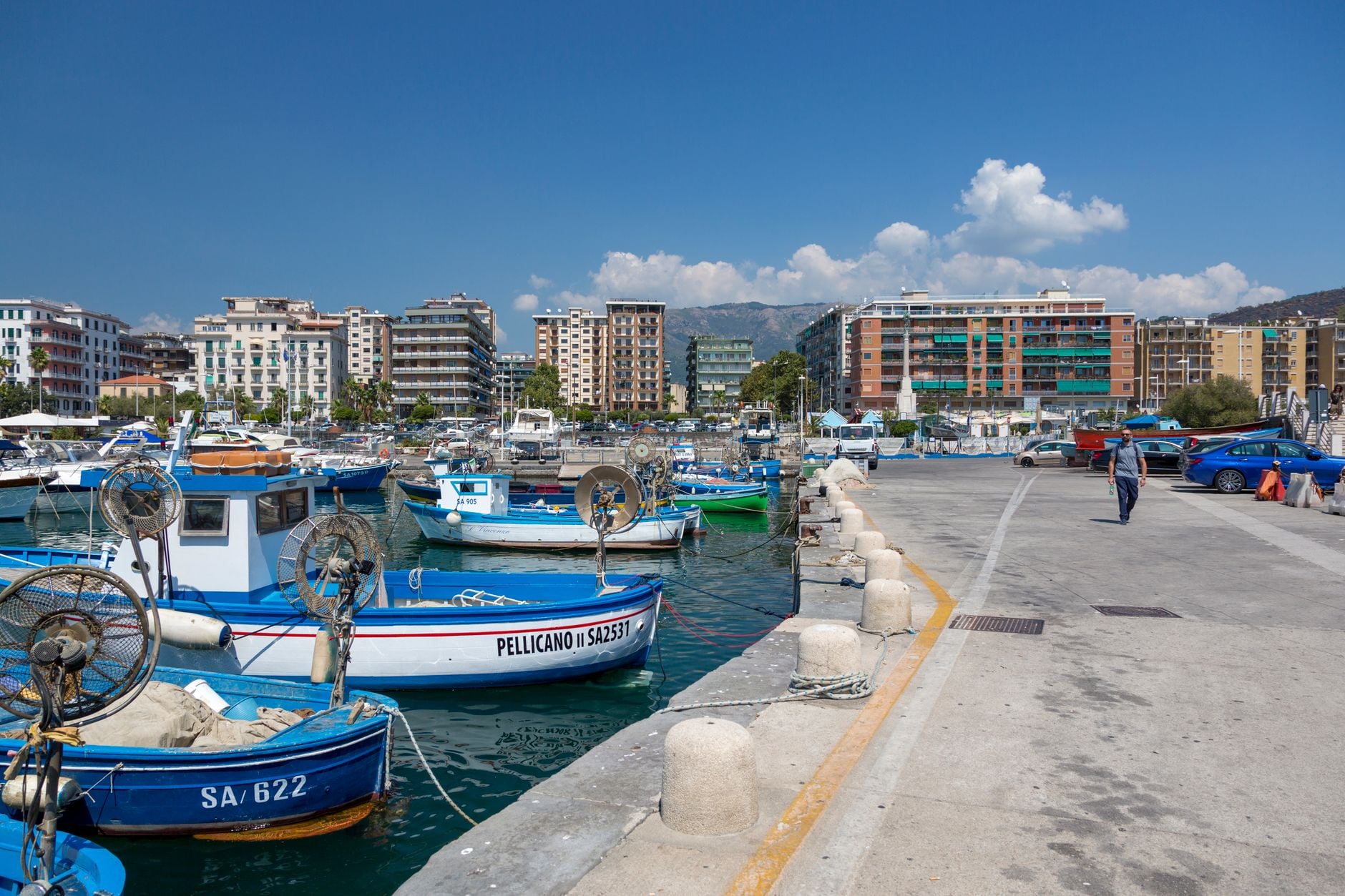
Getting around the station is straightforward. The forecourt taxis are metered. The seafront and old town are within a 10 to 15 minute walk. For onward travel this matters: Piazza della Concordia, where the SITA Sud buses for the Amalfi Coast and the ferries for Amalfi and Positano leave from, is about 650 metres away. That is an easy 8 minute walk.
What “Salerno (Amalfi Coast)” means on Italo and OTAs
Search for trains to Salerno on the Italo app, on an OTA, or on a third-party booking site, and you may see the station listed as Salerno, Salerno Centrale, Salerno railway station, or Salerno (Amalfi Coast). They are all the same station. Italo uses the Amalfi Coast label as a marketing cue for tourists. The IATA-style code on the ticket is ISR and the address on the booking confirmation will read Piazza Vittorio Veneto either way.
The risk is small but real. People rebook the same trip on a different name, or pay for a transfer they do not need, because the label looked unfamiliar. Before you pay, open the train details and confirm the arrival shows one of those four names.
Trains from Rome, Florence, Milan and the north
For a southbound Italian high-speed run, book a direct service into Salerno Centrale rather than buying separate legs through Naples. As of June 2026, Italo advertises Rome to Salerno in about 1 hour 40 minutes, Florence to Salerno in about 3 hours 30 minutes, and Milan to Salerno from 37,9€ when booked early. Trenitalia Frecciarossa offers comparable journey times on the same corridor.
The catch is that not every service runs through. On some departures Naples is the southern terminus, and you change to a connecting train for the last 35 to 40 minute leg. The fix is to filter by direct trains on the operator site, or to open the train details and confirm there is no change at Napoli Centrale before you pay. Treat the headline journey time as orientation, not a promise. Your exact train may shave or add a few minutes.
Italo and Trenitalia sell separately and price differently. Check both, especially at short notice. The cheaper option can flip from day to day.
Naples to Salerno: the easy 35 to 40 minute hop
Naples to Salerno is one of the shortest useful intercity trips in Italy. Italo and Trenitalia Frecce both run it in around 37 minutes, with Italo advance fares from 8,9€ as of June 2026. Trenitalia Regionale services cover the same route in about 70 minutes, with a fixed low fare and no reservation needed.
Choose by what you value. If your time is short or you have a Frecce-friendly Interrail or Eurail Pass with a paid reservation, take the high-speed train. If you want the cheapest walk-up fare, take the regional. If you are basing in Naples and day-tripping to the Amalfi coast, the regional ticket is often the better fit because it lets you turn up at the platform and go.
The decision changes when you are choosing a base. Naples has more arrivals, more flights, and more nightlife. Salerno is quieter and closer to the Amalfi ferries and buses. With a 37 minute hop in either direction, you can pick whichever base suits the rest of your trip without losing access to the other.
Onward to Amalfi, Positano, Sorrento and Paestum
This is where most Salerno arrivals start to plan badly. The Amalfi Coast buses and the Amalfi and Positano ferries do not leave from the train-station forecourt. They leave from Piazza della Concordia, the seafront square 650 metres west of the station. It is an easy 8 minute walk along the harbour.
SITA Sud runs the regular bus to Amalfi, with onward connections to Praiano, Positano, Maiori and Minori. In high season the Amalfi service runs roughly hourly from early morning until late evening, with thinner schedules in winter. Buy tickets at the SITA office or at the tobacconist on the square before boarding. Buses get full in summer. The queue is real.
Ferries are the other option, and on a clear day they are by far the most pleasant. The Salerno to Amalfi ferry costs from about €11.50, and the Salerno to Positano service from about €16.50, as of June 2026 prices published by seat61. Ferries are mainly an April to October offer and can be cancelled in rough weather. Operators on this dock include Travelmar, Alicost and NLG. Check the day’s schedule on the dock board or the operator’s site before you commit, especially on Sundays and at the shoulder edges of the season.
For Sorrento, the seasonal ferry from Salerno is the comfortable option. Outside that season, the practical route is by train to Napoli Centrale and then onto the Circumvesuviana from Garibaldi station to Sorrento. For Paestum and its Greek temples, take a Trenitalia Regionale southbound from Salerno; the journey is about 35 to 40 minutes.
Metro Salerno and the suburban stations
Salerno’s local commuter line is called Metro Salerno, and it is the reason third-party booking sites sometimes show stations called Torrione, Pastena, Mercatello, Arbostella or Arechi. The line is run by Trenitalia, opened in 2013, and runs 5.66 km east from Salerno Centrale to Arechi (the stadium and hospital). Six stations total, including the central one. Headways are around 30 minutes, with first trains from about 06:21 and last trains around 23:12.
For a visitor, the line almost never matters. Frecce, Italo, Intercity and through regional trains do not stop at the metro stops. The only realistic reason to use it is if your hotel or appointment is at the eastern end of Salerno, near Arechi stadium or the hospital. If a booking page lets you pick one of these as your arrival station for a high-speed trip, treat it as a UI quirk and change it back to Salerno (Centrale).
Operators and ticket types
Trenitalia and Italo are different companies, with separate apps, separate fares and separate refund rules. Treat them as competitors, not a single system.
Trenitalia runs every Frecciarossa, Frecciargento, Frecciabianca, Intercity, Intercity Notte and Regional service into Salerno. Italo runs only its own high-speed Italo trains. Frecce, Italo and Intercity require a seat reservation; Regionale does not. A regional ticket is valid for any regional service on the day. A Frecce, Italo or Intercity ticket is tied to a specific train and time.
A practical default: open both Trenitalia and Italo when you are price-checking the main Rome, Florence and Milan corridors. The cheaper operator can flip from day to day, particularly at short notice. For the Naples to Salerno hop, regional tickets are the simplest if you do not need the saved time.
Rail passes and Salerno
If you are travelling on an Interrail or Eurail Pass, your pass is valid on Trenitalia services into Salerno but not on Italo. For Frecciarossa, Frecciargento, Frecciabianca, Intercity and Intercity Notte, pass-holders also need a separate paid seat reservation. Reservation prices vary by train, date and class, and they can sell out on popular departures.
Two practical points. Book the pass-holder reservation as early as you can if you are travelling on a Frecce on a weekend or a public holiday in summer; pass-holder seats are a fixed quota and they are the first to disappear. Second, if Italo has the cheaper price by a wide margin, buy the Italo ticket and use the pass on another leg. The pass is not the cheapest option on every train.
For regional services, your pass covers the ride and no reservation is needed. That makes Naples to Salerno and Salerno to Paestum two of the easiest pass journeys in the south.
Salerno Costa d’Amalfi Airport and other things travellers ask about
Salerno Costa d’Amalfi Airport (QSR) is at Pontecagnano, about 17 kilometres east of the city. It handles a limited, mostly seasonal schedule of flights and is not currently on the Metro Salerno line. A planned eastward extension of the metro to the airport has been talked about for years and has not opened. Reach the airport by bus or taxi from Salerno Centrale, or treat Naples Capodichino as the practical air gateway for the region.
Two other questions come up often. Salerno is not the same as Napoli Centrale; they are 53 kilometres apart and about 35 to 40 minutes by Frecce or Italo. And the port that ferries serve is Salerno’s Concordia dock on Piazza della Concordia, not a separate terminal. Confirm the dock name on your ferry ticket and walk down from the station. Do not chase a different port name on a map.
Frequently asked questions
How many train stations are there in Salerno?
Salerno has one main railway station, Salerno Centrale on Piazza Vittorio Veneto, plus five smaller stops on the local Metro Salerno line: Torrione, Pastena, Mercatello, Arbostella and Arechi. For any Italo, Frecciarossa, Intercity or long-distance regional service, Salerno Centrale is the only useful station.
Is Napoli Centrale the same as Salerno?
No. Napoli Centrale and Salerno are two different stations, about 53 kilometres apart. Italo and Trenitalia Frecce run between them in around 37 minutes; Trenitalia Regionale services take about 70 minutes for a much lower fare.
What does Salerno (Amalfi Coast) mean on the Italo app?
It is the same station as Salerno Centrale. Italo uses the Amalfi Coast label as a marketing cue because Salerno is the train gateway to Amalfi and Positano. The IATA-style code on the ticket is ISR and the address on your booking confirmation will read Piazza Vittorio Veneto.
Which Salerno train station is closest to the ferry?
Salerno Centrale is the closest station to the ferry. The Concordia ferry dock on Piazza della Concordia is about 650 metres from the station, an 8 minute walk along the seafront.
How do I get from Salerno train station to Amalfi?
You have two options. SITA Sud runs regular buses from Piazza della Concordia, next to the ferry dock and 650 metres from the station, to Amalfi roughly hourly in high season. Between April and October, ferries from the Concordia dock reach Amalfi in around 35 minutes for about 11.50 euros, weather permitting.
Does Italo go to Salerno?
Yes. Italo runs high-speed services into Salerno Centrale from Turin, Milan, Bologna, Florence, Rome, Naples and (on selected runs) Venice and Padua. As of June 2026, Italo advertises Rome to Salerno in about 1 hour 40 minutes and Naples to Salerno in 37 minutes.
Can I use an Interrail Pass on trains to Salerno?
Yes, on Trenitalia services (Frecciarossa, Frecciargento, Frecciabianca, Intercity, Intercity Notte and Regional). On Frecce and Intercity you also need a separate paid seat reservation, which can sell out on busy departures. Interrail and Eurail Passes are not valid on Italo, which is privately operated.