
Barcelona has four stations that matter to travellers, and the right one depends on your train, not on which station is most central. Most long-distance and high-speed trains use Barcelona Sants. Some regional and Intercity services also stop at Passeig de Gracia or Estacio de Franca. A smaller number of Avlo long-distance departures leave from Sant Andreu Comtal (also written Condal), in the outer north of the city. That last detail catches more travellers out than any other. Read your full ticket before you set off.
Barcelona Sants: the main hub for long-distance and high-speed trains
For almost every long-distance journey, you need Barcelona Sants. It handles all AVE, Avlo (from Sants), Iryo, and Ouigo high-speed services, all SNCF Voyages (TGV) trains from Paris, and the bulk of Renfe Intercity and Cercanias suburban services. The station is large and busy. It is also easy to navigate once you understand its layout.
The key detail to know before you arrive is the platform split.
The platform split at Sants
Platforms 1 to 6 are standard gauge and serve all high-speed trains: AVE, Avlo, Iryo, Ouigo, and TGV. To reach these platforms, you pass through airport-style luggage X-ray at one of three access points (A, B, or C). This became a fixed requirement at these platforms in 2023. Queues can run 10 to 15 minutes at busy periods. Arrive at Sants at least 30 minutes before your high-speed departure.
Platforms 7 to 14 are broad gauge and serve Rodalies (Cercanias) suburban trains and some Intercity services to Valencia and Alicante. No luggage screening. You pass through automatic ticket gates using the QR code on your ticket. These platforms can be reached much closer to departure.
If you have a Renfe or Iryo mainline ticket and want to catch a connecting Rodalies train to Passeig de Gracia or Franca first, the QR code on your long-distance ticket opens the suburban gates under the Combinado Cercanias arrangement. No separate suburban ticket required.
Getting to and from Sants
Metro lines L3 and L5 both stop at Sants Estacio, directly inside the station on the northern side. L3 connects Sants with Placa Espanya, the Liceu metro stop on La Rambla, and the Gothic Quarter. L5 runs towards Sagrada Familia. Taxi ranks sit on the station forecourt and at the rear of the building, near the hotel above the station. The walk to the top of La Rambla is around 3.1 km, roughly 40 minutes on foot.
For the airport, take Rodalies R2 Nord from platforms 7 to 14. See the airport section below.
Passeig de Gracia: the most central stop
Passeig de Gracia sits underground beneath one of Barcelona’s main boulevards, in the heart of the Eixample district. It is the most centrally located of the four stations.
Many Renfe Intercity and Media Distancia trains stop here as their second Barcelona call, right after Sants. If your service calls at Passeig de Gracia, you can board or alight there instead of travelling to or from Sants. For travellers staying in the Eixample, near Sagrada Familia, or anywhere in central Barcelona, this removes the need for a metro ride. Check your specific service before assuming it stops here. Not all do.
The station also serves Rodalies lines R2, R3, and R4, including the R2 Nord airport service. Metro connections are L2, L3, and L4, though spread across two separate station entrances on the street above. Signs inside the underground platforms make the connections clear.
Passeig de Gracia does not serve AVE, Iryo, Ouigo, or TGV trains. Those all go from Sants.
Estacio de Franca: beautiful but limited
Estacio de Franca is in the La Ribera quarter, near the Barceloneta metro station (L4). It takes its name from its original role as the terminus for trains arriving from France. That role ended years ago.
All high-speed trains from Paris now arrive at Sants. Franca today handles a selection of regional and Media Distancia services, mainly to the Catalan coast, plus some Rodalies connections. Most long-distance travellers never need it.
Know it for two reasons. First, if your ticket names Franca as your station, the Rodalies R2 connects Sants to Franca in around 15 minutes, running every 5 to 15 minutes. Second, the Renfe ticket windows at Franca are often quieter than the busy windows at Sants. If you need to collect a passholder reservation in person and you have time, Franca is worth the short detour.
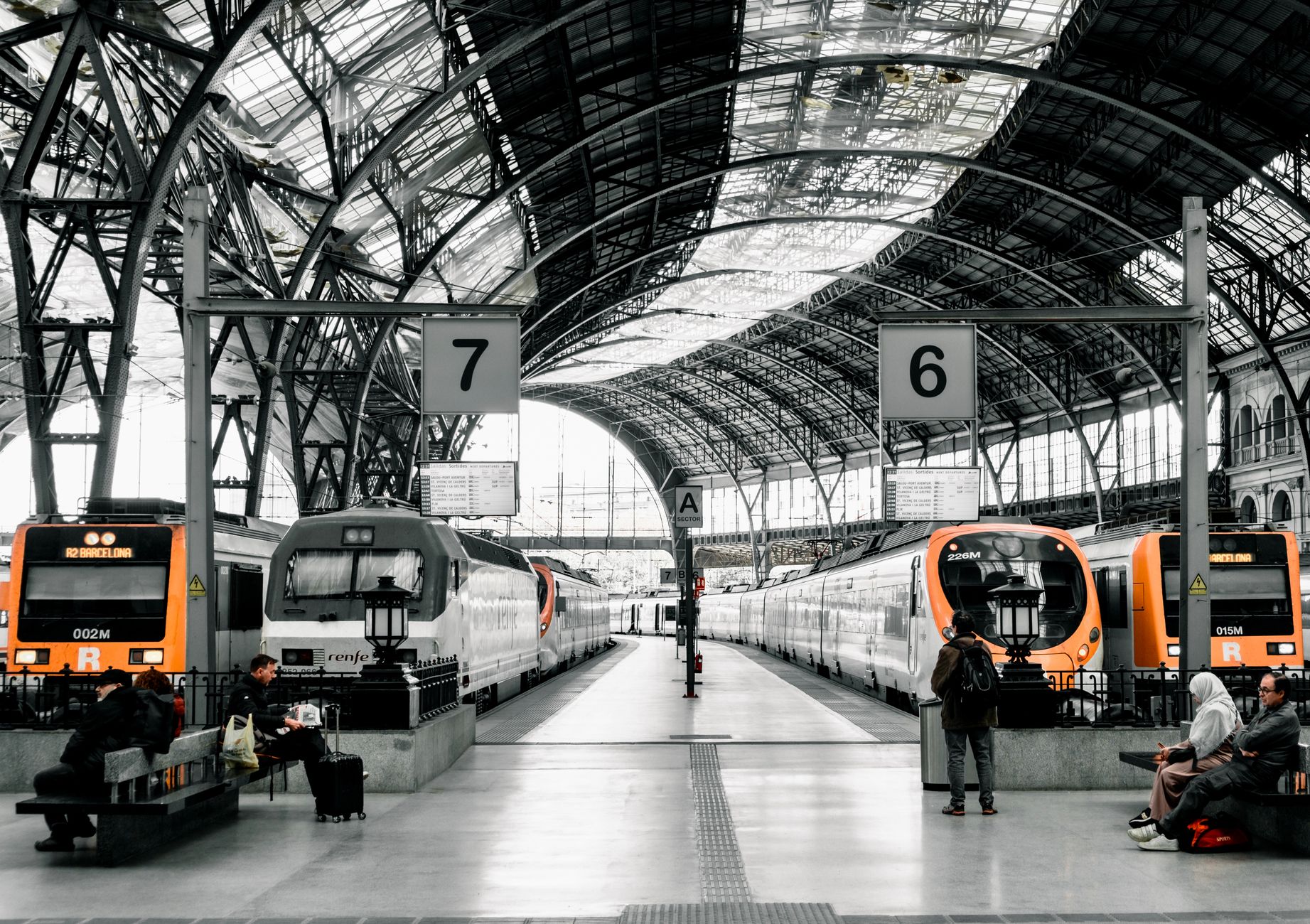
There is no security screening at Franca. Show your ticket and board. The historic iron and glass trainshed is one of the most attractive railway interiors in Spain. Barceloneta metro station (L4) is a 400-metre walk from the entrance.
Sant Andreu Comtal: the low-cost station trap
Some Avlo services depart from Sant Andreu Comtal (also written Condal) rather than Barcelona Sants. The two are not interchangeable. Sant Andreu Comtal is in the outer north of the city, and is a completely separate station from Sants.
The trap is easy to fall into. Booking pages often display the city name (“Barcelona”) without specifying the station. You read the itinerary quickly, assume Sants, and plan your morning accordingly. Your train was at Sant Andreu Comtal.
Before you pay for any Avlo fare, open the full booking details and confirm the exact departure station. Look for the station name or code in the confirmation. If it says “Barcelona-Sant Andreu Comtal” or “Barcelona Sant Andreu Condal”, plan your route there, not to Sants. Avlo routes to Figueres-Vilafant and some Madrid Atocha departures run from this station. The fare may look like a Sants departure but is not.
Getting to the airport by train from Barcelona
The most direct rail link between central Barcelona and Barcelona El Prat Airport is the Rodalies R2 Nord from Sants or Passeig de Gracia. The journey from Sants to Aeroport (T2) takes around 19 to 20 minutes. Trains run roughly every 30 minutes.
The train arrives at Terminal 2. A free shuttle bus connects T2 with T1. If your flight departs from T1, add 10 to 15 minutes for the shuttle transfer.
Metro L9 Sud serves both terminals but does not connect directly to Sants or Passeig de Gracia. From Sants, you would need to transfer to L3 first. The R2 Nord is a simpler journey.
Aerobus coaches also run from Placa de Catalunya and Passeig de Gracia directly to T1 and T2, with a journey of around 35 minutes depending on traffic. Some travellers prefer it for the direct terminal drop, particularly for T1.
Buy your R2 Nord ticket at the station ticket machines on platforms 7 to 14 at Sants, or use the Rodalies app. The R2 Nord does not appear on Renfe’s long-distance booking system. It is a suburban service purchased separately.
Reservations and rail passes on Barcelona trains
A seat reservation is compulsory on every high-speed train from Barcelona. This applies to AVE, Avlo, Iryo, Ouigo, and the TGV from Paris. Your Interrail or Eurail pass covers the travel day but does not include the reservation. You need to book and pay for it separately.
This is most important on Avlo and Ouigo. Both are low-cost operators with their own approach to pass reservations. Ouigo does not accept Interrail or Eurail pass reservations through most standard booking channels. Avlo accepts them but with limited availability. Check each operator before you assume your pass is valid on a low-cost departure.
For Renfe AVE and Euromed services, pass-holder reservations are bookable at Renfe.com or at Renfe ticket windows at the station. As of June 2026, pass-holder reservation fees on AVE routes varied by route and class. Check the current fee on Renfe.com before you travel.
Iryo accepts pass reservations through its app and website, but allocations on popular routes such as Barcelona to Madrid can be limited. Book ahead.
Cercanias and Rodalies services do not require reservations and are not pass-dependent. Buy a standard suburban ticket at the station or through the Rodalies app.
Frequently asked questions
What is the main train station in Barcelona?
Barcelona Sants is the main station. It handles all high-speed trains including AVE, Avlo, Iryo, Ouigo, and international TGV services from Paris, as well as most Intercity and Cercanias suburban trains.
Does Barcelona Sants have airport-style security?
Platforms 1 to 6 at Sants require you to pass your luggage through an X-ray scanner before entering the high-speed departures area. This applies to AVE, Avlo, Iryo, Ouigo, and TGV trains. Allow at least 30 minutes before your scheduled departure. Cercanias trains on platforms 7 to 14 do not require security screening.
How do I get from Barcelona Sants to the city centre?
Metro lines L3 and L5 run directly from Sants Estacio station inside the building. L3 connects to La Rambla and the Gothic Quarter. A taxi rank is on the station forecourt. The walk to the top of La Rambla is around 40 minutes.
Do all Barcelona long-distance trains go from Sants?
Most do, but not all. Some Avlo services depart from Barcelona Sant Andreu Comtal (also called Condal), a separate station in the outer north of the city. Always check the exact station on your ticket before you travel, not just the city name.
Can I use an Interrail or Eurail pass on Barcelona high-speed trains?
Your pass covers the travel day, but a separate seat reservation is compulsory on all high-speed services including AVE, Avlo, Iryo, and Ouigo. Ouigo does not accept pass reservations through most channels. For Renfe AVE services, book the reservation at Renfe.com or at a Renfe ticket window.
How long does the train from Barcelona to the airport take?
The Rodalies R2 Nord from Sants to Barcelona El Prat Airport Terminal 2 takes around 19 to 20 minutes. A free shuttle bus connects T2 and T1 at the airport. Buy your ticket at the Rodalies ticket machines on platforms 7 to 14 at Sants.
What is Estacio de Franca used for today?
Estacio de Franca handles regional and some Media Distancia services, mainly to destinations along the Catalan coast. It no longer serves high-speed or long-distance trains. Its Renfe ticket windows can be quieter than those at Sants if you need to pick up a passholder reservation in person.