Updated
Luggage on European Trains: What to Know
Most European trains let you carry bags free without check-in or weight limits; Eurostar, OUIGO and Avlo impose stricter size and item rules.
Need to check a bag against a train service's published allowance? Use the train luggage allowance checker.
Most European trains let you bring your own bags free, with no check-in or weight limit, though a few budget and international services set stricter rules.
The general rule for luggage on European trains
There is no airport-style check-in on almost any European train. You carry your bags to the platform, load them yourself, and keep them with you for the whole journey. Nobody weighs your suitcase, and on the vast majority of mainline and regional services there is no formal size limit either. The trade-off is that you are entirely responsible for getting your own luggage on and off, often with a short dwell time at the station, so pack what you can actually carry alone up a step and down a platform.
That freedom has a real exception. Eurostar and the budget high-speed brands, OUIGO and Avlo, enforce specific size and item limits. Go over them and it costs money, at the station or online. Knowing which category your train falls into before you travel is the single most useful thing this guide can tell you.
Storing your luggage on board
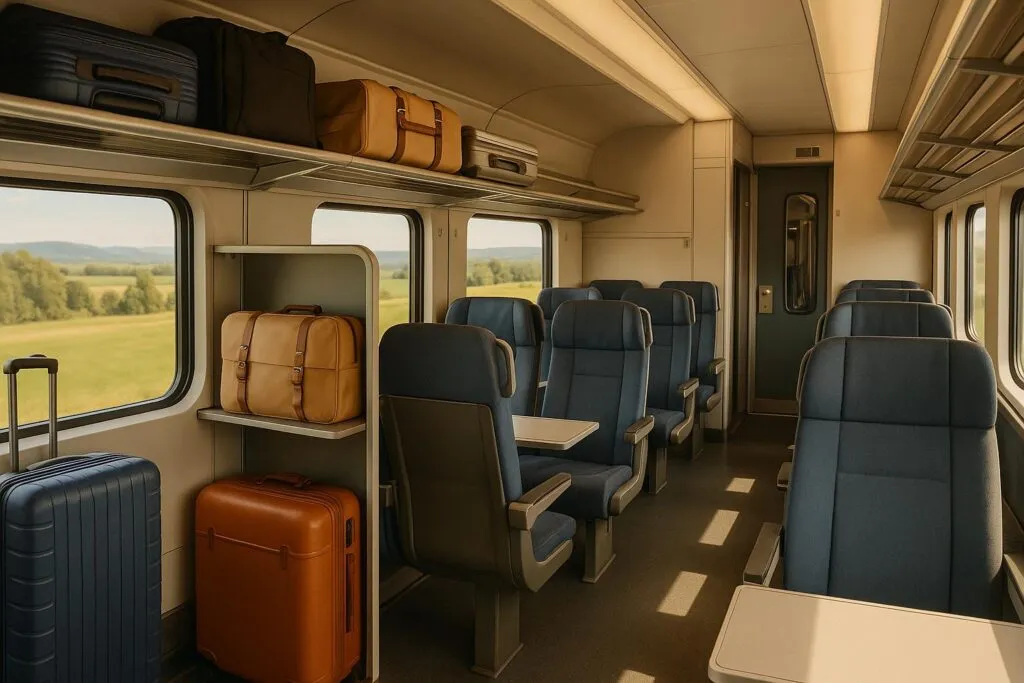
Every European train gives you three places to put a bag. Small items go under the seat in front of you or the one you are sitting in. Medium bags fit the overhead rack above your head, though on many trains that rack is shallow and better suited to a backpack than a large suitcase. Bigger cases go in the open luggage stacks at the end of each carriage, by the doors.
Those end-of-carriage stacks are the only place a full-size suitcase reliably fits on most high-speed trains. They fill up fast. If you are travelling with a large case on a busy Eurostar, TGV INOUI, or Trenitalia Frecciarossa service, board as early as the platform allows and head straight for a stack near your carriage. Wait until everyone else has boarded, and you will spend the journey with a case wedged in the aisle.
Eurostar's luggage rules in detail
Eurostar has no weight limit, but it does limit how many pieces you can bring and how long each one can be. Standard and Plus tickets include 2 pieces of luggage plus 1 item of hand luggage; Premier tickets include 3 pieces plus 1 hand luggage item. Each piece can be up to 85cm long on routes to and from London, or up to 75cm long on routes to Belgium, the Netherlands, and Germany. Hand luggage covers backpacks, handbags, briefcases, and laptop bags, and does not count against your main allowance.
Go over that allowance and what happens next depends on which side of the Channel you are travelling on. On routes to Belgium, the Netherlands, and Germany, you do not need to book anything in advance: turn up with an extra or oversized item and pay €30 per item at the station on the day, provided the case is no longer than 200cm. On routes to and from London, Eurostar wants you to book ahead through its Travel Services team, and the pricing rewards planning: an extra piece of luggage costs £35 if booked more than 48 hours before departure, rising to £55 if you book within 48 hours. Oversized items follow the same pattern at £60 or £75, sports equipment at £45 or £60, and musical instruments at £35 or £55. This London service only runs on selected trains, so check availability in Manage Your Booking before you assume you can turn up with a bike or a second oversized case.
One rule that catches first-time travellers out: all luggage on Eurostar and French trains must be labelled with your name, and every bag goes through airport-style security screening before boarding, even though it then travels with you rather than being checked. Build a few extra minutes into your station arrival time for that reason alone.
Eurostar's security screening also means the usual airport-style prohibited-items rules apply: no firearms or replicas, no flick knives or blades over the legal length, no flammable liquids such as petrol or camping gas canisters, and no incapacitating sprays. Nail polish and hairspray are fine, and the list is not exhaustive, so contact Eurostar before you travel if you are unsure about a specific item. This matters more on Eurostar than on most domestic trains, because Eurostar is the one service on this list that physically screens every bag before boarding.
TGV INOUI, Intercites, and OUIGO in France
On TGV INOUI and Intercites services within France and to nearby countries (Luxembourg, Spain, Italy, Brussels, and Freiburg im Breisgau in Germany), the standard allowance is 2 suitcases plus 1 item of hand luggage, or 1 suitcase, 1 special item such as a bike or musical instrument, and 1 hand luggage item. Hand luggage tops out at 40 x 30 x 15cm, and your suitcase can measure up to 70 x 90 x 50cm. That suitcase figure is the one worth remembering: it is generous enough for almost any wheeled case sold for European travel.
SNCF enforces this one more firmly than Eurostar does on its non-compliance fee. Bring one item of excess or non-compliant luggage and you are charged €50, two items cost €100, and three or more cost €150. That scale means a single oversized bag is a manageable inconvenience, but travelling with a family's worth of extra cases without checking the rules first can get expensive fast.
OUIGO, SNCF's budget high-speed brand, works differently again. Every ticket includes one hand bag up to 40 x 30 x 15cm and one carry-on up to 55 x 35 x 25cm, with no weight limit on either. Anything beyond that, including a second suitcase or an oversized item up to 130 x 90 x 50cm and 30kg, needs the extra-luggage option. Add it when you book, or up to 30 minutes before departure, and it costs €5. Turn up at the station with an extra bag you have not booked, and the on-the-spot charge is €20. Booking the option in advance is one of the clearest "check this before you pay" moments in European budget rail travel, because the difference between €5 and €20 for the same bag is entirely about timing.
Budget trains in Spain: Avlo and OUIGO Espana
Spain's two low-cost high-speed brands both use the same airline-style logic as OUIGO in France, and their allowances are close but not identical, so do not assume one covers you for both. Avlo, Renfe's budget brand, includes one hand bag up to 36 x 27 x 25cm and one cabin case up to 55 x 35 x 25cm in the ticket price, with no weight limit on either. A larger additional bag, up to 85 x 60 x 35cm or 180cm total, can be added for €10 at booking, or €15 if added afterwards, either online up to 30 minutes before departure or at the station.
OUIGO Espana includes one cabin bag up to 55 x 35 x 25cm, measured including the handle, pockets, and wheels, which is a stricter reading than most travellers expect from a soft-sided suitcase. As with OUIGO in France, extra or larger luggage needs a paid add-on rather than being waved through, so check the current option and price on ouigo.com before you travel with more than a single cabin bag. If your Madrid to Barcelona or Madrid to Seville fare looks unusually cheap, the luggage allowance is very likely the part of the ticket doing the saving.
Mainline and regional trains without a strict limit
Outside Eurostar and the budget brands, most of the trains you will actually use for everyday European rail travel do not enforce a formal size limit at all. Germany's ICE, Italy's Trenitalia, Austria's OBB, and regional and TER services across the network all work on the same basic principle: you can bring what you can carry and store yourself, and staff are not measuring bags with a template at the door. Italo is a partial exception worth flagging: its cheapest Smart fare caps bags at 75 x 53 x 30cm, and oversized pieces may not be allowed on board, so check the fare conditions before assuming Italo behaves like Trenitalia. Deutsche Bahn's own guidance is one hand luggage item plus one additional piece up to 70 x 50 x 30cm, but in practice this is guidance rather than an enforced limit on most domestic and regional German trains.
That flexibility is genuinely useful if you are moving between countries on a longer trip: a case that would trigger a fee on Eurostar or OUIGO travels for free on the ICE leg either side of it. It also means you should not assume every European train works like a budget airline. The exceptions in this guide are exceptions for a reason, and the default, on most of the network, is closer to "bring what you can manage."
On Deutsche Bahn's ICE trains, where you actually put a bag matters more than whether you are allowed to bring it. Large cases go in the racks at the carriage entrance or in the gaps between back-to-back seats; medium bags go in the compartments above the seats, except on Intercity 2 trains, where those overhead spaces are too narrow for anything but a small bag. Arrive at the wrong end of an Intercity 2 with a large suitcase and the overhead rack simply will not take it, so head for the entrance area instead.
Switzerland's SBB and CFF trains follow the same relaxed principle, with one practical detail worth knowing: on the duplex InterCity lines (IC1, IC6, IC8, IC61, and IC3), dedicated luggage space sits on the upper level near the stairs, and platform displays mark which carriages have space free. SBB suggests keeping travel bags or suitcases under or between seats where you can. The 23 kg maximum applies to luggage registration, not to bags carried on board.
Luggage allowance by operator, at a glance
| Operator | Included allowance | Extra or oversized fee | Where to check |
|---|---|---|---|
| Eurostar | 2 to 3 items, up to 85cm (London) or 75cm (Continental) | £35 to £75 (London, pre-booked) or €30 per item (Continental, walk-up) | eurostar.com |
| TGV INOUI / Intercites | 2 suitcases up to 70 x 90 x 50cm plus hand luggage | €50 to €150, tiered by item count | sncf-connect.com |
| OUIGO France | 1 hand bag plus 1 carry-on up to 55 x 35 x 25cm | €5 (booked in advance) or €20 (at the station) | ouigo.com |
| Avlo (Spain) | 1 hand bag plus 1 cabin case up to 55 x 35 x 25cm | €10 at booking, €15 afterwards, for an additional larger bag | renfe.com |
| OUIGO Espana | 1 cabin bag up to 55 x 35 x 25cm | Paid add-on for extra or larger luggage | ouigo.com |
| ICE, Trenitalia, OBB, TER | No formal size limit; carry what you can manage | Not applicable | Operator's own site if travelling with a bike or ski equipment |
Treat the fees in this table as the current published rates rather than a fixed promise. Operators revise pricing between seasons, so confirm the live figure on the operator's own site before you book, especially for a Eurostar London-side excess booking where advance timing changes the price.
Booking through Rail Europe or another reseller
Rail Europe and similar resellers sell tickets across dozens of operators, but they do not set their own luggage rules. The allowance that applies to your journey is whichever operator actually runs the train, whether that is Eurostar, TGV INOUI, Trenitalia, or a regional service. Rail Europe's own guidance to passengers is the same general rule this article opens with: no check-in, one item of luggage plus one smaller hand item as a reasonable baseline, and check the specific operator's page if you are travelling with something bulky, a bike, or more than that. Booking through a reseller can be convenient, but it is not a shortcut past an operator's size limit or excess fee, so look up the operator before you assume your booking confirmation covers a second case.
Travelling without carrying your bags yourself
If you would rather not haul a case through a station at all, two operators offer a door-to-door courier alternative worth knowing about. Eurostar partners with Sherpr's Luggage Buddy service, which picks your bags up from an address you choose and delivers them to your destination, so you travel with only hand luggage. SNCF Connect runs a similar service called Mes Bagages, bookable in a few clicks for domestic French journeys. Both cost more than carrying your own bag and need to be booked ahead of travel, so they suit a traveller managing a bad back, a tight connection, or simply too many bags for one trip, rather than everyday use.
Keeping your luggage safe on board
Luggage theft on European trains is uncommon. It is not a myth either, and the pattern is specific enough to guard against. Train operators' own staff advice, published by operators including NS International, describes bag snatchers who walk through carriages scouting for unattended laptops and dark, inconspicuous bags left in the overhead racks or the end-of-carriage stacks. The riskiest moment is not mid-journey, it is at a station stop: one person distracts you or your travelling companion while another lifts a bag from the rack and steps off just as the doors close, often timed to the departure whistle so you cannot follow.
The practical response is simple. Keep your passport, phone, laptop, and wallet in a bag that stays with you at your seat, not in the end-of-carriage stack or the overhead rack out of your sightline. Smaller bags are safer on your body than in a rack; if a larger case has to go in the overhead rack, keep it somewhere you can actually see it, since operators' own staff report that full-size suitcases go missing occasionally, not just small bags. On overnight trains, where you will be asleep for hours, loop a strap through a fixed rail or use a cable lock on anything you are not keeping under your body or against the wall of a sleeper compartment. If you are travelling with a companion, take turns watching the luggage area during station stops rather than both stepping away at once, and be a little more alert around anyone boarding without luggage of their own who does not seem to be looking for a seat.
Station lockers and left luggage
Most major European stations offer a left-luggage service, either staffed offices or automated lockers, but this is not universal, and it thins out fast once you leave the largest cities. At smaller regional stations, do not expect any storage option at all.
Where pricing is public, it tends to scale with how long you leave your bag rather than charge a flat day rate. At Paris Gare du Nord, the official Consigne Conciergerie charges €4 for up to 4 hours, €7.5 for 4 to 12 hours, and €9.5 for 12 to 24 hours per item, a structure worth knowing if you only need a locker for a few hours between trains rather than a full day. Busy stations such as Rome Termini and Amsterdam Centraal run similar staffed or automated services, but pricing and hours vary by provider and can change with demand, so check the current rate at the specific station rather than assuming a fixed figure.
Independent storage apps such as Nannybag and Bounce offer an alternative at many stations: bookable storage at nearby shops, hotels, or cafes, usually cheaper than an official station locker and easier to reserve in advance during peak summer travel. If you are arriving at a major station in July or August and need storage for a full day of sightseeing, booking one of these in advance is a reasonable hedge against station lockers filling up.
A checklist before you travel
The rules in this guide change by operator, not by country, so the one habit worth building is checking the specific train you have booked rather than assuming yesterday's rule applies today.
- Confirm which brand you are actually travelling on. A cheap fare on OUIGO, Avlo, or OUIGO Espana usually means a smaller included allowance than a full-fare TGV INOUI, Trenitalia, or Renfe AVE ticket.
- If you are close to a size or item limit, add the extra-luggage option when you book rather than at the station. OUIGO's €5 versus €20 gap is the clearest example, but Eurostar's advance-versus-late pricing works the same way.
- Label every bag with your name before you travel on Eurostar or a French train, and build in extra time for security screening on Eurostar specifically.
- If you are changing between a budget brand and a mainline service on the same trip, pack for the stricter leg. A bag that is fine on the ICE half of your journey may not be fine on the OUIGO half.
- For left luggage at a major station in peak season, book an app-based option like Nannybag or Bounce in advance rather than assuming a station locker will be free when you arrive.
Frequently asked questions
Where do I put my suitcase on a train in Europe?
Small daypacks fit under the seat in front of you, medium bags fit the overhead rack, and full suitcases go in the open stacks at the end of each carriage, which is the only spot a big case reliably fits. If those end stacks are already full on a busy departure, a soft-sided bag can often still be wedged into the gap between a pair of seats facing each other; a hard-shell case usually cannot, which is one more reason to board early with a large suitcase rather than counting on a backup spot.
How strict is Eurostar about luggage?
Eurostar enforces its size limit at the platform: each piece of luggage can be up to 85cm long on routes to and from London, or up to 75cm long on routes to Belgium, the Netherlands, and Germany, with no weight limit either way. Every bag also goes through airport-style security screening before boarding. Go over the size or item allowance and the fee depends on your route: pay £35 to £75 to pre-book extra luggage through Eurostar's Travel Services team on London routes, cheaper if booked more than 48 hours ahead, or pay €30 per item at the station on the day for Continental routes, no booking required.
How big a suitcase can I bring on a European train?
It depends on the operator, not the country. Most mainline and regional trains, including ICE in Germany, Trenitalia in Italy, and OBB in Austria, have no strict size limit at all. Eurostar caps each piece at 85cm on London routes or 75cm on Continental routes. TGV INOUI and Intercites allow suitcases up to 70 x 90 x 50cm. Budget brands are stricter: OUIGO in France and Spain, and Avlo in Spain, include one cabin bag up to 55 x 35 x 25cm and charge extra for anything bigger. Check your specific operator's page before you travel with an oversized case.
Do you keep your luggage with you on Eurostar?
Yes. Eurostar has no checked baggage: you carry your bags through security and onto the train yourself, and they stay with you for the journey. If you need to send extra or oversized luggage separately, Eurostar's Travel Services team offers a pre-booked service on selected London routes, priced from £35 for excess luggage or £60 for an oversized item when booked more than 48 hours ahead, rising if you book late. Check eurostar.com for which trains carry the service and current pricing.
Is it safe to leave luggage on a train in Europe?
The specific trick to watch for: a bag snatcher carries their own dark, nondescript rucksack, often stuffed with old newspapers, and swaps it for yours on the luggage rack while you are distracted or asleep. You often will not notice until you reach your destination and open what turns out to be someone else's empty bag. Keep valuables on your body rather than in any rack, and if you are travelling with a companion, take turns keeping half an eye on the luggage area, especially at station stops.
Are there luggage lockers at European train stations?
Availability and price are not the only things that vary. Opening hours do too: staffed left-luggage rooms often keep set hours rather than staying open around the clock, for example Rome Termini's KiPoint runs from 07:00 to 21:00, so a late-night or early-morning arrival can mean no staffed option at all, only lockers. Even lockers can be fully booked during busy periods; Gare du Nord's own operator says as much about its consigne, so do not assume one will be free without a backup plan in peak season.
What is the luggage allowance on Rail Europe trains?
One detail worth checking on a Rail Europe or similar reseller booking: your confirmation email or ticket normally names the actual operator running your train in the small print, for example Eurostar, TGV INOUI, or a national rail company. That operator name, not Rail Europe's own site, is what you should search for when you look up the exact luggage allowance, because the reseller's general guidance is only a starting baseline.