

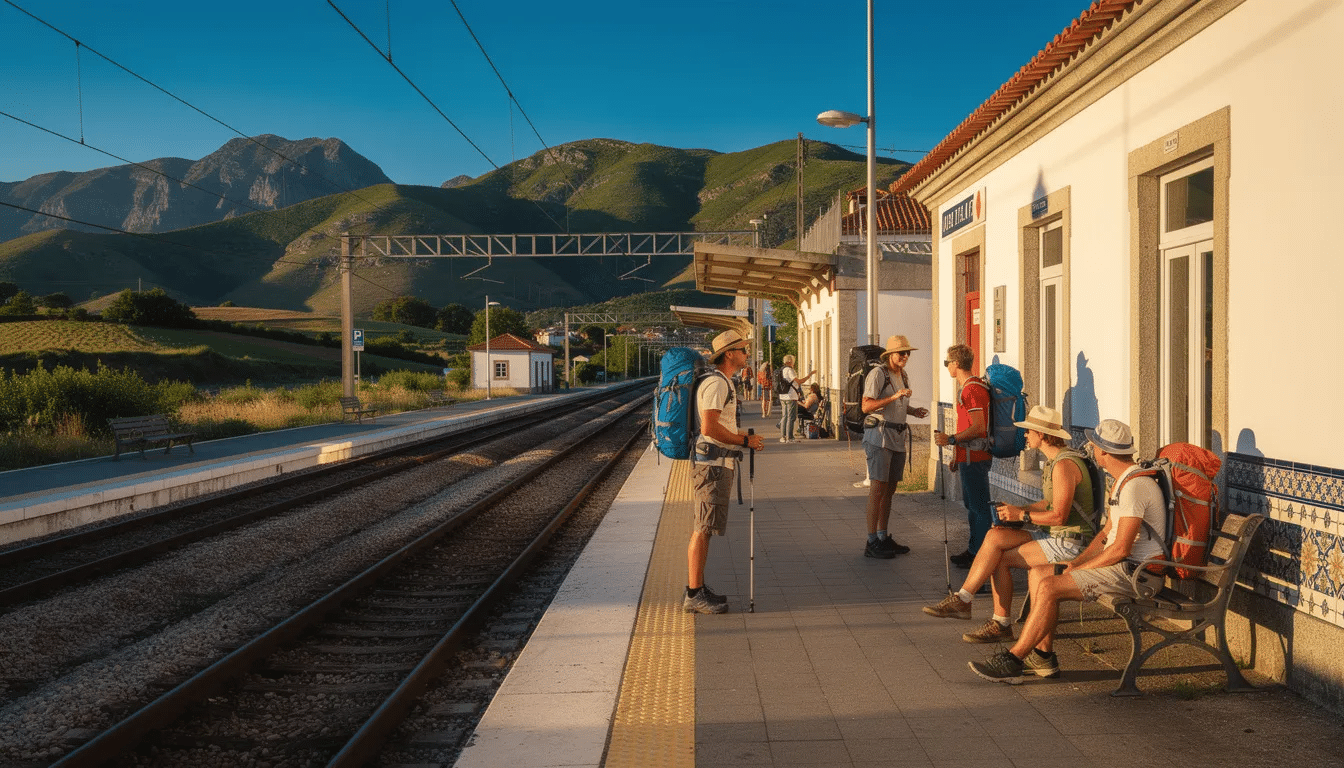
Train service

CP - Comboios de Portugal
CP - Comboios de Portugal is Portugal's national passenger rail operator, covering long-distance Alfa Pendular and Intercidades trains, regional services, and urban trains around Lisbon and Porto.
Check times & pricesOfficial website Check times & prices
Train tickets

Raileurope
Rail Europe is a leading travel tech company specializing in European train bookings for over 15,000 travel professionals worldwide.

Trainline
Trainline sells rail and coach tickets worldwide on behalf of major UK and European transport companies.

Omio
Omio connects you with over 1,000 transport providers - trains, buses, flights, and more - to simplify your travel planning.
Portugal is one of Europe’s more Interrail-friendly countries, as long as you plan your long-distance legs ahead. The local trains are easy and turn-up-and-go. The fast trains are not. Before you buy any pass, it helps to know where the system is relaxed and where it ties you to a reservation.
Quick verdict on Interrail reliability in Portugal
Yes, Portugal is covered by Interrail, and for most rail-minded trips it works well. Regional and suburban trains run by CP (Comboios de Portugal) take no reservation, so you can travel on the spot around Porto, Coimbra, and the lines near Lisbon. The catch is the fast network. Alfa Pendular and Intercidades trains, which carry most long-distance traffic, need a paid seat reservation for pass holders, and popular departures sell out in high season.
Reservation fees here are low, around €5 per journey, well below France or Italy. Availability is the real pressure point. Spontaneous travel is fine for short northern hops like Porto, Braga, and Guimarães, but Lisbon to Porto, Lisbon to Faro, and any cross-border leg need booking days or weeks ahead in summer.
Who it suits: multi-stop rail trips with a bit of planning, and travellers visiting several cities over one to three weeks who want flexibility on departure times.
Who it does not suit: last-minute coastal hopping, beach-focused Algarve holidays where buses dominate, or a simple weekend with one or two train legs.
How Portugal fits into a Global Pass itinerary
This section is for travellers on an Interrail Global Pass who want to fold Portugal into a wider European route. One fact shapes everything else: Portugal sits at the end of the line.
Cross-border rail into Portugal is limited. There is currently no high-speed rail link between Portugal and either Spain or France, and direct international services are sparse. The cleanest entry is the Celta train from Vigo to Porto, which takes a little over two hours when running as a through train. Heading in from Madrid means a long ride via Badajoz with multiple changes, often ten to eleven hours, and many travellers cover the Madrid to Lisbon corridor partly by coach because the rail options are slow or infrequent. The Global Pass does not cover those replacement buses.
Once you are inside Portugal, domestic pass use is simple. A Global Pass works on CP trains exactly as a Portugal One Country Pass would. The geography is the constraint, not the rules. A Barcelona to Lisbon run can eat two travel days with current timetables and changes, so visit Portugal when you have spare days, not when you are trying to maximise European coverage.
Alfa Pendular and Intercidades services are the domestic backbone. Lisbon to Porto, Lisbon to Faro, and Lisbon to Guarda all need reservations. CP sells tickets and reservations up to two months ahead, so book early, and book first the legs that connect to a flight or ferry out of Lisbon or Faro, because those sell out earliest. In Lisbon, long-distance AP and IC trains use Santa Apolónia and Oriente, not the central Rossio or Cais do Sodré stations, so check your reservation for the departure station before travel day.
Typical Global Pass patterns into Portugal:
| Route pattern | Travel days needed | Reservations required |
|---|---|---|
| Paris, Madrid, Lisbon, Porto | 3 to 4 days | Madrid to Lisbon (often bus), Lisbon to Porto |
| Barcelona, Valencia, Madrid, Lisbon | 3 to 4 days | Several Spanish segments, Lisbon to Algarve |
| Madrid, Porto, Northern Portugal loop | 2 to 3 days | Celta train, Alfa Pendular |
| Vigo to Porto entry only | 1 day | Celta train reservation |
Global Pass holders still pay reservation fees on Portuguese long-distance trains. Premium overnight services from Spain are not free either. Those need supplements or separate tickets.
Cross-border and high-speed dependence
Weak cross-border links to Spain are Portugal’s biggest rail gap. The Vigo to Porto connection works well for arrivals from Galicia, though engineering works can replace part of it with a bus across the border, so check the live timetable before you rely on it. The Badajoz corridor towards Madrid is harder, with awkward changes around Entroncamento and only a couple of trains a day on some border segments.
Inside Portugal, long-distance travel leans heavily on Alfa Pendular and Intercidades. Skipping them to dodge reservations costs you real time:
- Lisbon to Porto: roughly 2 hours 35 minutes by Alfa Pendular against close to 8 hours by regional trains
- Lisbon to Faro: around 3 hours by Alfa Pendular, or about 3 hours 30 minutes by Intercidades, against nearly 7 hours regionally
- Porto to Coimbra: about 1 hour by fast train against 2 hours 30 minutes or more regionally
Regional alternatives exist, but they often make a same-day multi-city plan impossible. The fees are low. What chips away at the hop-on-any-train feeling is that the reservations are compulsory, and that feeling is what draws people to Interrail in the first place.
Availability risks for popular Global Pass patterns
Some routes face steady reservation pressure that Global Pass users should plan around.
High-risk routes:
- Lisbon to Porto, the country’s busiest corridor
- Lisbon to Faro and Lisbon to Lagos for Algarve beach access
- Porto to the Algarve via the Lisbon connection
- Cross-border Celta segments during Spanish holiday periods
Peak pressure periods:
- July and August, when AP and IC trains are often heavily booked early
- Easter week
- Christmas and New Year
- Portuguese public-holiday bridges, including 1 May, 10 June, and 15 August
Reservation quotas for pass holders can run out before general tickets on some trains, so do not leave it late in peak season.
Using a Portugal One Country Pass vs normal tickets
This section is for travellers staying inside Portugal, weighing the Interrail One Country Pass against standard CP tickets.
The honest answer turns on advance fares. CP Promo fares on Alfa Pendular and Intercidades, bought ahead, can fall well below the standard price, with discounts of up to 65 per cent for tickets booked eight or more days out, so a long leg like Lisbon to Porto can drop to around €10 to €20 in limited quantities. So default to advance CP tickets for a simple point-to-point trip, and switch to the One Country Pass when you have several long-distance legs in a short window, say five to eight cities in seven to ten days, and you want to change plans without forfeiting a cheap non-refundable Promo fare. The pass buys flexibility, not a lower headline price.
A Portugal One Country Pass is priced by the number of travel days and your age band, and Interrail adjusts prices over time, so treat any single figure as a guide rather than a quote. Check the live price on Interrail for your exact travel-day count and age before you decide. The comparison below shows the shape of the decision, not fixed prices.
Rough cost comparison (pass plus reservations against advance tickets):
| Scenario | Pass plus reservations | Advance tickets |
|---|---|---|
| 4 cities, 7 days (Porto, Coimbra, Lisbon, Faro) | pass price plus around €20 reservations | roughly €60 to €90 with Promo fares |
| 6 cities, 10 days with regional side trips | pass price plus around €25 reservations | roughly €100 to €150 depending on flexibility |
| Porto region only, 5 days | pass price plus €0 reservations | roughly €20 to €40 in regional tickets |
Most regional and urban trains, including the Porto suburban network and many Regional services, take no reservation. You just find a seat and go, which makes dense local exploring around Braga, Guimarães, and Aveiro genuinely easy.
Every Alfa Pendular and Intercidades journey still needs a paid reservation, even with the One Country Pass, so do not assume the pass alone lets you board a fast train. Pass-holder reservations cannot be bought online or outside Portugal, so make them at a CP ticket desk at a major station before you board, and have your pass details to hand.
A residency note worth knowing: people resident in Portugal cannot buy the Portugal One Country Pass for their own country, so this guide is written for visitors planning a Portugal-only rail trip.
In short, the pass makes most sense for visitors stringing together several long-distance legs plus side trips inside a month. If your plan is really just Lisbon to Porto and back, or a single Lisbon to Faro return, advance tickets will usually win.
Typical One Country Pass itineraries in Portugal
A few common trip shapes where the pass tends to come up:
Classic north to south (7 to 10 days, 4 to 5 travel days): Porto, Coimbra, Lisbon, Évora, Faro or Lagos. This uses four or five pass travel days, with reservations on the Porto to Coimbra, Coimbra to Lisbon, and Lisbon to Faro legs. Slot in regional connections for the smaller stops.
Northern Portugal focus (3 to 5 travel days): base yourself in Porto with day trips to Braga, Guimarães, Aveiro, and Viana do Castelo. This runs mostly on regional and urban trains with no reservations, so it suits travellers who want maximum spontaneity.
Central spine loop (3 to 4 travel days): Lisbon, Tomar, Coimbra, Aveiro, and back to Lisbon, mixing Intercidades and Regionais. It leaves room to change plans if the weather or your mood shifts.
Limitations to note:
- Bus-dominated regions, including the Alentejo interior and many Algarve coastal villages, have thin rail coverage
- The pass suits travellers happy to centre a trip on rail-served towns
- Slow travellers spending four or five nights per city may do better on single tickets
Supplements, reservations and where money leaks away
The extra costs a pass holder meets in Portugal are worth tallying before you buy.
Mandatory reservations:
- Alfa Pendular seat reservation: around €5 per journey, in either class
- Intercidades seat reservation: around €5 per journey, in either class
- Cross-border Celta to Vigo: a separate reservation, made at the station counter
Possible extra costs:
- Scenic tourist trains that Interrail does not cover, which need separate full-price tickets
- Any private operators outside the CP network
These fees are per leg, so they add up on a multi-city tour, though the per-seat cost stays low. A short pass used for only two big journeys plus a few cheap regional hops can still lose value against advance Promo fares. Before committing, map your likely journeys and add up pass plus reservations against the advance fares for the same routes. The result surprises people in both directions.
Where Interrail works well in Portugal
Interrail, Global or One Country, delivers real value in these cases:
- Multi-stop city trips along the main spine (Porto, Coimbra, Lisbon, Faro) inside a one-month window, where you value changing departure times without penalty
- Rail-dense northern exploring around Porto, plus Braga, Guimarães, Aveiro, and Viana do Castelo, mostly on regional trains with no reservations
- Longer Global Pass trips where Portugal is the final chapter and you have spare travel days
- Shoulder-season travel (March to June outside Easter, and September into early November), when reservation availability is good and crowds thin out
- Flexibility-first travellers happy to spend a little more to reorder stops or change stay lengths without penalty
- Families, since young children travel free and child passes are discounted
Where Interrail is a poor fit in Portugal
Cases where a pass is not cost-effective or practical:
- Short, simple trips, like a long weekend in Lisbon with a day out to Sintra or Cascais, where cheap urban tickets do the job
- Very price-sensitive travellers who can lock in fixed dates well ahead and grab deep Promo discounts, often beating the pass
- Beach-heavy Algarve holidays, where local buses and hire cars move you between resort towns better than the thin coastal rail line, leaving the pass idle for days
- Highly spontaneous summer trips that want same-day long-distance decisions in July and August, when reservation rules leave only the awkward departures
- Non-rail destinations, including small inland villages in the Alentejo, remote surf spots, or Douro vineyards beyond the railheads
- Single-city stays built around boats, museums, and monuments, where you barely move between regions
Interrail is a tool for rail-led, multi-city travel. In Portugal, anyone basing a trip on one or two cities with the odd side trip usually does better without a pass.
Decision checklist for using Interrail in Portugal
Run through these before you buy.
For One Country Pass users:
- Will you take at least four or five substantial intercity journeys within a month?
- Do you need the freedom to change trains a day or two before departure?
- Are you visiting four or more rail-connected cities across different regions?
- Does your age band (youth, adult, senior) get a favourable pass price?
- Have you checked that advance Promo fares are not far cheaper for your specific route?
For Global Pass users:
- Is Portugal a real focus, with several days of rail use, or just a quick side trip?
- Do you have spare travel days to absorb slow border crossings?
- Have you checked current cross-border timetables from Spain?
- Are you ready to book Portuguese reservations once CP opens the date for peak travel?
Practical steps before deciding:
- Map your actual journey with specific stations and dates
- Check current reservation fees on the CP website or the Rail Planner app
- Compare total pass plus reservation cost against advance ticket prices for your routes
- Verify cross-border timetables, since these change and affect routing
- Consider whether a bus or flight serves a particular segment better
The bottom line: choose Interrail for Portugal if you are touring several cities over one to three weeks with a bit of planning. Choose standard CP tickets or mixed transport if you want a simple city break, can book far ahead for fixed dates, or mainly want beach time where the trains do not reach.
Frequently asked questions
Does Interrail work well in Portugal?
Yes, for travellers who plan their long-distance legs ahead. Regional and suburban CP (Comboios de Portugal) trains take no reservation, so local travel around Porto, Coimbra, and Lisbon is turn-up-and-go. Only the fast Alfa Pendular and Intercidades trains tie you to a booked seat.
Which Portuguese trains require mandatory reservations?
Alfa Pendular and Intercidades, the long-distance fast trains, need a paid seat reservation for pass holders. Regional and urban CP services do not. The pass-holder reservation fee is low, around €5 per journey in either class.
Can I book Interrail pass-holder reservations online before I arrive?
No. Pass-holder reservations for Alfa Pendular and Intercidades cannot be bought online or from outside Portugal. Make them at a CP ticket desk at a major station before you board, and have your pass details ready.
When is it hardest to secure reservations on Portuguese trains?
In July and August, around Easter week, over Christmas and New Year, and on Portuguese public-holiday bridges such as 1 May, 10 June, and 15 August. Pass-holder quotas can sell out before general tickets, so book early in peak season.
How cheap can advance CP tickets be compared to a pass?
CP Promo fares on Alfa Pendular and Intercidades, booked eight or more days ahead, can carry discounts of up to 65 per cent, so a long leg like Lisbon to Porto can fall to roughly €10 to €20 in limited quantities. For a simple point-to-point trip, advance tickets often beat a pass.
When does the Portugal One Country Pass deliver the best value?
When you string together several long-distance legs plus side trips in a short window, say five to eight cities in seven to ten days, and you want to change plans without losing a cheap non-refundable Promo fare. The pass buys flexibility, not a lower headline price.