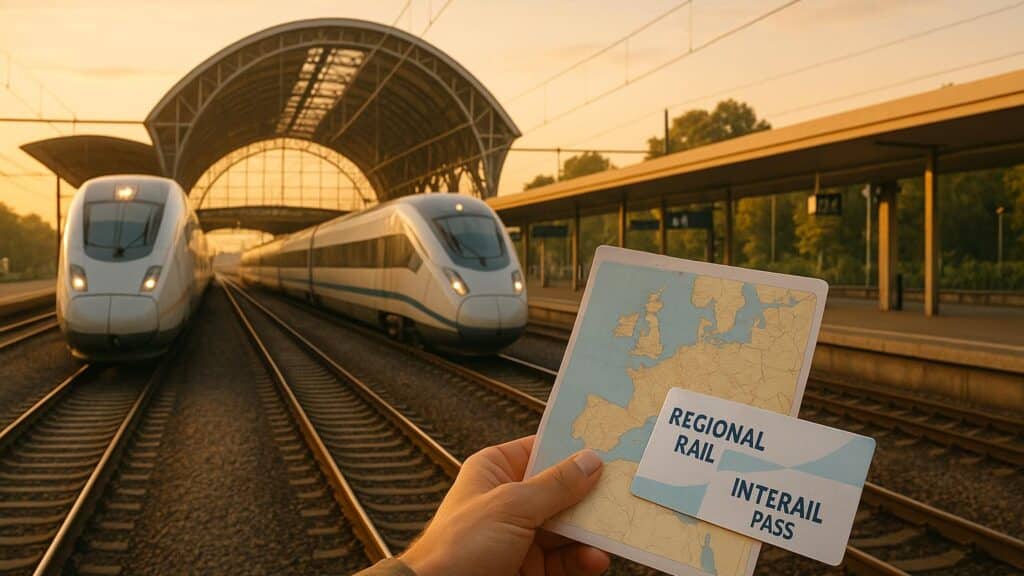



Planning a trip across Europe by train can feel overwhelming when you start researching tickets, routes, and prices for each individual leg. That’s where a Eurail Pass comes in—a single rail pass that unlocks train travel across 33 European countries without buying separate tickets for every journey.
Whether you’re dreaming of watching the Alps roll by from a panoramic window or hopping between capital cities on high speed trains, understanding how Eurail passes work is the first step to planning a seamless European adventure.
This guide breaks down everything you need to know: pass types, eligibility, reservations, costs, and practical tips to help you decide if a Eurail Pass makes sense for your travel plans.
Quick answer: what a Eurail Pass is (and who it’s for)
A Eurail Pass is a single train pass designed for non-European residents that grants access to most trains across 33 countries in Europe. Think of it as a golden ticket to the continent’s rail network—one pass, one purchase, and you’re ready to board trains from Portugal to Turkey, from Scandinavia to Greece.
The pass gives you unlimited train travel on your valid travel days. Depending on the option you choose, you might have 4 days of travel within a month, 15 consecutive days of travel, or even up to 3 months of continuous passes that let you ride as many trains as you want, every single calendar day.
Here’s the quick breakdown:
- Who it’s for: Residents outside Europe and the UK (Americans, Canadians, Australians, New Zealanders, and travelers from Asia, Africa, and Latin America)
- European residents: If you live in Europe or the UK, you need an Interrail Pass instead—same trains, similar prices, different product
- Main types: The Eurail Global Pass covers all 33 countries, while Eurail One Country Passes focus on a single country like Italy, France, or Germany
- Reservations: High speed trains, international trains, and overnight trains often require seat reservations and small fees (typically €10–€25), while regional trains and local trains usually let you hop on without any booking
To make this concrete: imagine you want to explore Italy over two weeks. With a Eurail Pass, you could take a morning train from Rome to Florence, spend a few hours wandering the Uffizi, then catch an afternoon train to Venice—all on the same calendar day using just one travel day from your pass. Or picture a bigger adventure: Paris to Brussels for Belgian waffles, then onward to Amsterdam for the canals, all covered by your global pass with just a couple of reservation fees added on.

Eurail vs. Interrail: what’s the difference?
If you’ve been researching European train travel, you’ve probably seen both “Eurail” and “Interrail” mentioned. The good news: they now cover the same train routes, the same countries, and offer nearly identical prices. The only real difference is who can buy which one.
Eurail is exclusively for non-European residents. If your passport is from the United States, Canada, Australia, New Zealand, or most countries in Asia, Africa, or Latin America, Eurail is your option. It doesn’t matter where you’re currently living—what counts is your official residency status.
Interrail is for people legally resident in Europe, including the UK, Norway, Switzerland, and Turkey. If you hold a European passport or have legal residency in a participating European country, you’ll purchase an Interrail Pass instead.
This distinction matters because conductors on European trains can check eligibility. If you buy a Eurail Pass but are actually a European resident (or vice versa), you could face problems during ticket inspections—potentially being asked to purchase a new fare on the spot.
The practical difference ends there. A Eurail Global Pass and an Interrail Global Pass both cover the same 33 countries, the same train routes, and the same reservation requirements. If you’re traveling with friends and some are European residents while others aren’t, no problem—you can still ride the same specific train together. One person shows their Eurail Pass, another shows their Interrail Pass, and you both pay similar reservation fees for your seats.
Before you buy, double-check your passport and residency status to make sure you’re purchasing the correct pass type.
Types of Eurail Passes
Eurail offers several pass types designed for different travel styles. The main distinctions come down to geography (how many countries you want to visit) and validity pattern (whether you want scattered travel days or unlimited consecutive travel).
Eurail Global Pass
The flagship option is the Eurail Global Pass, which covers all 33 participating countries from Portugal in the west to Turkey in the east, and from Finland in the north to Greece in the south. This is the pass for travelers who want to explore multiple countries on a single rail pass.
Global Pass options typically include:
- Flexi passes: 4, 5, 7, 10, or 15 travel days within a 1-month or 2-month validity window
- Continuous passes: 15 days, 22 days, 1 month, 2 months, or 3 months of unlimited daily travel
If you’re planning a classic multi-country backpacking route—say, Amsterdam to Berlin to Prague to Vienna to Budapest—the Eurail Global Pass covers all of it without needing separate tickets for each country’s railway carriers.
Eurail One Country Passes
If your trip focuses on just one country, a Eurail Single Country Pass often makes more sense financially. These passes are available for most major European countries including Italy, France, Germany, Spain, Norway, and Greece.
One country passes work similarly to the global option but cost less since you’re covering a smaller network. They’re ideal if you’re spending two weeks exploring Italian cities (Rome, Florence, Venice, Milan) or taking a focused journey through the fjords of Norway.
Regional and Multi-Country Passes
Some travelers fall in between—wanting to explore a specific region rather than all of Europe or just one nation. Options like the Scandinavia Pass (covering Denmark, Sweden, Norway, and Finland) or passes combining neighboring countries give you focused coverage without paying for networks you won’t use.
A note on Switzerland: While Switzerland is included in the Eurail Global Pass, travelers focusing solely on Swiss rail often find the separate Swiss Travel Pass offers better value and more comprehensive coverage of the country’s famous scenic trains and mountain railways. If Switzerland is your main destination, compare both options before purchasing.
Choosing the right pass type
Your choice depends on your itinerary:
- 2 weeks across Spain and Portugal: A Global Pass or regional pass covering both countries
- 1 month all over Central Europe: Eurail Global Pass with 10 or 15 travel days
- 10 days exploring only Germany: A Germany One Country Pass
Flexi vs continuous: how validity and travel days work
Understanding how travel days work is crucial to getting value from your Eurail Pass. Every pass has two key components: an overall validity period and a number of travel days within that period.
Flexi passes explained
A flexi pass gives you a set number of travel days (such as 4, 7, 10, or 15) that you can use non-consecutively within your validity window (typically 1 or 2 months).
On each travel day, you get unlimited train travel from 00:00 to 23:59. You could take one long journey or board multiple trains all day long—it counts as just one travel day.
Example: With a 7-days-in-1-month pass, you might travel Paris to Lyon to Nice on Monday (1 travel day used), then spend three nights exploring the French Riviera without using your pass. On Thursday, you head from Nice to Milan to Venice (2nd travel day). You still have 5 travel days left to use anytime in the next three weeks.
Continuous passes explained
A continuous pass is simpler: it’s valid every day for its entire duration. Buy a 15-day continuous pass, and you can ride trains every single day for 15 days straight without counting individual travel days.
These are best for intensive itineraries where you’re moving almost daily—typical for longer backpacking trips through 10+ cities.
The night train rule
Night trains get special treatment with flexi passes. When you board an overnight train that departs before midnight and arrives the next morning, you typically only use the departure date as your travel day (not both days). This makes night train routes attractive for flexi pass holders: you save a hotel night and only consume one travel day.
However, rules can have nuances depending on specific routes and operators, so double-check the current policies before relying on this for your planning.
When to choose each type
| Travel Style | Best Pass Type |
|---|---|
| City stays of 3–4 nights with occasional long train rides | Flexi pass |
| Daily or near-daily movement between cities | Continuous pass |
| 2-week trip with 4–5 major train journeys | 4 or 5 day flexi pass |
| Month-long backpacking across 10+ countries | 1-month continuous pass |
Who is eligible for a Eurail Pass (age groups and discounts)
Eurail is only for non-European residents, but within that group, different age categories unlock different prices and perks.
Youth passes (ages 12–27)
Travelers aged 12 to 27 qualify for Youth passes, which typically cost about 25% less than standard adult fares. Most youth passes are available only in second class, which is perfectly comfortable for the overwhelming majority of train rides across Europe.
Adult passes (ages 28–59)
The standard adult pass covers travelers from 28 to 59 years old. You can choose between first class and second class options. First class costs more but offers roomier seats, quieter cars, and sometimes additional perks.
Senior passes (ages 60+)
Travelers 60 and older often receive around 10% off adult prices with Senior passes. Like adult passes, these are available in both first class and second class.
Children travel free (ages 4–11)
Here’s where families save money: up to two children aged 4 to 11 can travel free with each paying adult’s pass. Children still need their own free pass (which you add at checkout), and they still pay any required reservation fees for specific trains. Infants under 4 don’t need a pass at all and travel free on a parent’s lap.
Important notes on eligibility
- Age categories are determined by your age on the first day of travel, not purchase date
- Exact age cutoffs can shift slightly over time, so verify current rules before buying
- Your passport number is linked to your pass—conductors may check ID
What countries and trains does a Eurail Pass cover?
The Eurail Global Pass currently covers 33 countries and more than 40,000 destinations across Europe’s rail networks—essentially any European train station you’re likely to want to visit.
Countries included
The pass covers major destinations including France, Germany, Italy, Spain, Portugal, Switzerland, Austria, the Netherlands, Belgium, Denmark, Sweden, Norway, Finland, Czechia, Hungary, Poland, Croatia, Slovenia, Greece, Turkey, and more. You can ride through Central Europe from Berlin to Budapest, explore Scandinavia from Copenhagen to the Arctic Circle, or island-hop through Greece using connecting ferry discounts.
Countries not covered include Albania, Belarus, Russia (the Russian Federation), and Ukraine. Kosovo and some smaller territories also fall outside the network. North Macedonia is included, as is Turkey up to Istanbul.
What trains are covered?
Your pass works on trains operated by national railway carriers in each country—Deutsche Bahn in Germany, SNCF in France, Trenitalia in Italy, Renfe in Spain, and so on. This includes:
- High speed trains: TGV in France, Frecciarossa and Frecciargento in Italy, ICE in Germany, AVE in Spain, Eurostar connecting London with Paris, Brussels, and Amsterdam
- Intercity and express trains: Standard long-distance services between major cities
- Regional trains: Slower services stopping at smaller towns
- Suburban trains: Local commuter services around major city hubs
- Night trains: Sleeper and couchette services like Nightjet connecting Austria, Germany, Italy, and Switzerland
Most scenic trains like the Bernina Express or Glacier Express in Switzerland are also covered, though they often require reservations and sometimes supplements.
What’s not covered?
- Metro and subway systems: City subways in Paris, London, Berlin, Rome, etc. require separate tickets
- Trams: Urban tram networks aren’t covered
- Some private railways: Certain heritage lines, mountain railways, or private operators may offer 25–50% discounts rather than full coverage
- Buses: Generally not included, though some connecting buses have discounts
For getting around within cities, plan on buying separate local transit tickets or day passes.

Reservations, supplements, and seat types
One of the most common points of confusion about Eurail: having a pass doesn’t always mean you can just hop on any train. For some trains, you still need a separate seat reservation.
Trains without reservations
In many countries, you can simply board trains with your pass and find an empty seat. This applies to most regional trains, local trains, and suburban train services in:
- Germany
- Austria
- Switzerland
- Belgium
- Netherlands
- Luxembourg
- Denmark
- Czech Republic
- Much of Central Europe
For these trains, just show your pass to the conductor when they come through. No advance booking, no extra fees.
Trains requiring reservations
High speed trains, international trains, and night train services almost always require reservations. Countries particularly heavy on reservation requirements include:
- France: TGVs and most long-distance services
- Italy: Frecciarossa, Frecciargento, and Frecciabianca high-speed services
- Spain: AVE and long-distance trains
- Sweden: High-speed and long-distance trains
- International routes: Eurostar, Thalys-style services, cross-border high-speed links
These reservations come with fees—you’re paying for a guaranteed seat, not just the right to travel.
Typical reservation fees
| Train Type | Typical Cost |
|---|---|
| Domestic high-speed (day) | €10–€20 |
| International high-speed | €15–€35 |
| Night train (seat) | €10–€20 |
| Night train (couchette) | €25–€50 |
| Night train (private sleeper) | €60–€150+ |
For example, Rome to Florence on a Frecciarossa often adds €10–€13 in reservation fees. Paris to Amsterdam by high-speed train typically costs around €20–€30 on top of your pass.
These fees add up, so factor them into your budget when deciding if a pass is worthwhile.
First class vs second class
Both classes are included in pass options, but you pay more for a first class pass:
- Second class: Perfectly adequate seating, used by the majority of European travelers, generally comfortable for journeys up to several hours
- First class: More spacious seats, quieter atmosphere, better chance of power outlets, sometimes complimentary drinks or at-seat service
First class rarely includes full meals—it’s more about comfort than luxury. For most travelers, second class works fine.
How to use a Eurail Pass (mobile vs paper)
Most travelers today use a Eurail Mobile Pass through the Rail Planner app, though paper pass options exist for some markets. Both require activation before your first journey.
Using the mobile pass
The Eurail mobile pass lives entirely on your smartphone. Here’s the workflow:
- Purchase online: Buy your pass up to 11 months before your trip
- Add to Rail Planner app: Download the free app and enter the code from your confirmation email
- Activate: Before your first train ride, activate the pass by entering your start date and passport number
- Add journeys: For each train you want to take, add it to your “trip” in the app
- Connect to pass: Toggle the journey onto your pass to generate a QR code
- Show to conductor: When the conductor comes through, display your QR code for scanning
Important: Adding a train in the Rail Planner app is not the same as making a reservation. The app helps you find trains and track your travel days, but you still need to book separate seat reservations for trains that require reservations.
Using a paper pass
Paper passes still exist but are less common. With a paper pass:
- Activate at a station: Visit a ticket office at any European train station to get your pass stamped with a start date (or purchase with a fixed date)
- Fill in the travel diary: Before each journey, write the date, departure station, and destination in the pass’s travel diary section
- Show to conductor: Present the paper pass along with your passport for inspection
Failing to fill in the travel diary before boarding can result in fines, so always complete this step on the platform before you get on.
A sample travel day
Mobile pass example: You’re in Amsterdam planning to reach Paris. Open the Rail Planner app, search for Amsterdam to Paris, select your preferred train, and add it to your trip. The app shows you whether reservations are required. You toggle the journey to your pass, creating your QR code. At the station, you board the train, and when the conductor arrives, you show your phone screen for scanning along with your passport.
Paper pass example: Before leaving Berlin for Prague, you stand on the platform and write today’s date, “Berlin Hbf” as departure, and “Praha hl.n.” as destination in your travel diary. On board, you show the filled-in pass and your passport to the conductor.
Is a Eurail Pass worth it? (when it saves money vs tickets)
The honest answer: it depends entirely on your itinerary, flexibility needs, and how you prefer to travel.
When a Eurail Pass saves money
A pass tends to offer good value when:
- You’re taking 5–10+ medium or long-distance train rides within a month
- You want flexibility to change plans without rebooking fees
- You’re visiting multiple countries on popular routes
- You’re traveling during peak season when advance tickets are expensive or sold out
- You prefer not to plan every train weeks in advance
The freedom to hop on most trains without pre-booking is genuinely valuable. Miss your intended train? Catch the next one. Decide to stay an extra night somewhere? No penalty.
When point-to-point tickets are cheaper
Buying advance point-to-point tickets can beat a pass when:
- You have a fixed itinerary booked 2–3 months ahead
- You’re taking only 2–3 long-distance trains
- Your specific route has heavily discounted promo fares
- You’re comfortable being locked into exact trains and times
For example, booking a Berlin to Prague ticket two months early might cost €19–€29, while a share of a Eurail Pass plus reservation fees could be €40+. But if you want to change that ticket, you’ll pay penalties or lose the fare entirely.
How to compare
Calculate your “per travel day” cost:
- Total pass price ÷ number of travel days you’ll actually use
- Add estimated reservation fees for your planned trains
- Compare to the sum of advance tickets for the same routes
If the pass works out to €50–€60 per travel day after reservations, but advance tickets for those routes total €200 for your whole trip, tickets win. If advance tickets would cost €500+ and the pass plus reservations equals €400, the pass wins—plus you get flexibility.
A sample comparison
Consider a 10-day trip: Berlin → Prague → Vienna → Budapest → Krakow → Berlin
With a 5-day-in-1-month Eurail Global Pass (around €270–€310 for adults), plus roughly €30–€50 in reservation fees where needed, you might spend €300–€360 total.
Booking each leg separately with advance tickets could cost €150–€250 if you lock in cheap fares early—or €400+ if you book late or need flexibility.
The pass wins if you value flexibility or can’t book weeks ahead. Tickets win if you have fixed dates and find good deals.
The mixed strategy
Many savvy travelers combine approaches: use a Eurail Pass for the expensive or flexible portions of their trip (international routes, spontaneous side trips) and buy separate cheap regional tickets for very short or heavily discounted hops.
Practical tips for planning with a Eurail Pass
Even with a flexible pass, a bit of advance planning goes a long way—especially during peak summer months (June–September) or holiday periods like Christmas and Easter.
Check timetables and reservation requirements early
Use the Rail Planner app and major operator websites (like Deutsche Bahn’s online timetable) to:
- Verify train times and journey durations
- See which trains require reservations
- Find alternative reservation-free regional trains that might take slightly longer but save money
Book popular routes ahead
Some trains have limited Eurail pass holder seats. Book reservations early for:
- Eurostar (London–Paris–Brussels–Amsterdam)
- TGVs in France, especially Paris routes
- Summer coastal trains in Italy and Spain
- Scenic trains like the Bernina Express
Running out of passholder spots doesn’t mean the train is full—just that you’d need to buy a regular ticket instead.
Strategic accommodation choices
For short stays (1–2 nights), book hotels or hostels near the main train station. You’ll save time and stress catching early departures or late arrivals.
For longer city visits, stay closer to the main attractions since you’ll only need to reach the station once at the end.
Factor overnight trains into your planning
An overnight train can save a travel day (on flexi passes) and a hotel night. Leaving Munich at 8 PM and arriving in Rome at 9 AM means you wake up in a new city without “losing” a day to transit.
Keep your phone charged
If using a mobile pass, a dead phone means you can’t show your ticket. Carry a backup power bank, and consider keeping screenshots of your confirmation emails just in case of technical issues.
Have backup plans
Strikes, delays, and cancellations happen. Know alternative routes or be prepared to adjust. The flexibility of a pass helps here—you can usually catch a different train without penalty.

Other benefits and extras that come with Eurail
Beyond train rides, Eurail pass holders unlock additional discounts and perks that can add real value over a multi-week trip.
Ferry and boat discounts
Many ferry operators offer 25–50% off for Eurail pass holders. This includes:
- Baltic Sea routes between Scandinavia and Germany
- Adriatic routes between Italy and Greece
- Connections to Greek Islands
- Routes between Britain and Ireland
You’ll typically pay a small port tax separately, and cabins for overnight crossings cost extra, but the base fare discount can be substantial.
Private and scenic railways
Some private railways and tourist trains not fully covered by the pass still offer 25–50% discounts. This helps offset the cost of must-do routes like certain Swiss mountain lines.
City cards and attractions
Eurail pass holders often receive:
- 10% off city cards in major cities like Paris, Barcelona, and Budapest
- Discounts at selected museums and attractions
- Reduced rates at partner hostels and hotels
These aren’t massive savings individually, but they add up over a longer trip.
How to find current benefits
Check the “Pass Benefits” section on the official Eurail website before you travel. Benefits change periodically, and new partnerships get added. Planning around these perks—like choosing a discounted ferry instead of a budget flight—can stretch your travel budget further.
Summary: when a Eurail Pass makes sense for your Europe trip
A Eurail Pass is a single train pass that opens up rail travel across 33 European countries for non-European residents. It offers unlimited train travel on your chosen travel days, covering everything from high speed trains to regional trains and local trains, with one purchase rather than dozens of separate tickets.
The key advantages are clear: flexibility to change plans without penalty, seamless multi-country travel on one pass, and potential savings on complex or last-minute itineraries. Having the freedom to hop on most trains without advance booking is genuinely liberating when you’re exploring a new continent.
The trade-offs matter too. Many popular trains require seat reservations and reservation fees on top of your pass. You need to understand how travel days work (flexi vs continuous). And if you have a fixed itinerary with plenty of time to book advance tickets, point-to-point fares might actually cost less.
Who benefits most from a Eurail Pass:
- First-time visitors doing classic multi-country backpacking routes
- Travelers on long summer holidays or month-long sabbaticals
- Anyone who values flexibility over locking in every train weeks ahead
- Groups exploring multiple regions who want simple, consolidated ticketing
Your next step: Sketch out your rough route. Count how many long-distance train rides you’re likely to take and how many travel days you’ll need. Use the Rail Planner app to check reservation requirements for your key routes. Compare the pass cost (plus estimated reservation fees) to what you’d pay for individual advance tickets.
If the pass comes out cheaper—or even slightly more expensive but with valuable flexibility—it’s probably worth it. If your trip is short, fixed, and full of cheap advance fares, individual tickets might be the smarter choice.
Either way, European trains offer one of the best ways to see the continent: city centers to city centers, scenic routes through mountains and coastlines, and the freedom to watch the landscape roll by instead of staring at airport security lines.