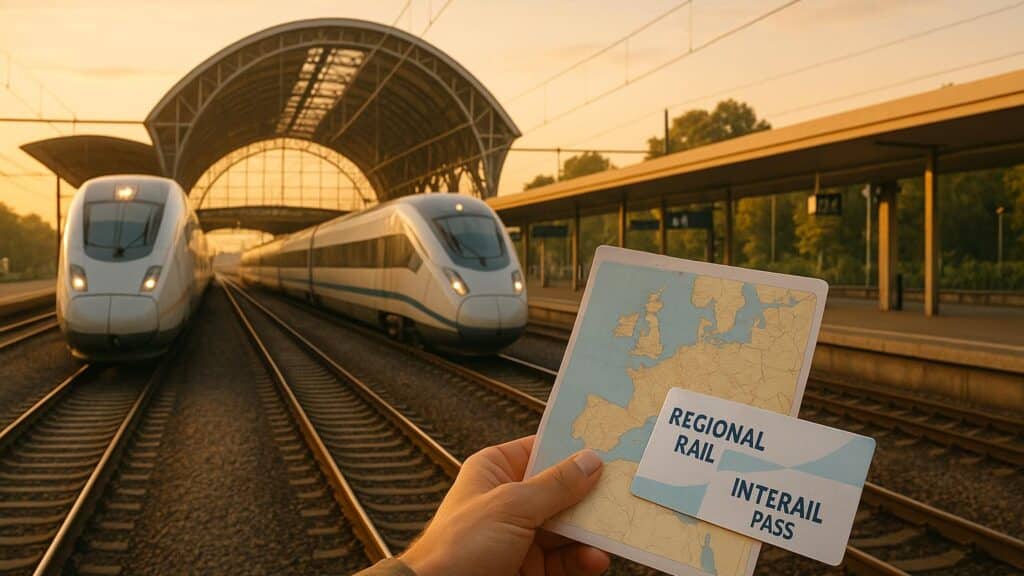



Traveling across Europe by train is one of the most iconic experiences for students and young travelers. The ability to hop between Paris, Amsterdam, Prague, and Rome without dealing with airport security or baggage fees makes rail travel incredibly appealing. But with dozens of pass options, national discount cards, and regional subscriptions available, figuring out which student train pass in Europe gives you the best value can feel overwhelming.
This guide breaks down everything you need to know about train passes for students in Europe. You’ll learn the difference between pan-European passes like Eurail and Interrail, discover national student cards in countries like France, Germany, and Italy, and understand exactly how to choose, buy, and use your pass to maximize savings.
Quick answer: best student train pass options in Europe
If you’re wondering which pass to buy, the answer depends on whether you’re backpacking across multiple countries or staying in one place for a semester. Students can choose between Interrail/Eurail youth passes for multi-country travel, national student passes from individual railways, and regional offers for daily commuting.
- Eurail Global Pass Youth (ages 12–27): Up to 25% off standard adult prices, valid in 33 European countries, ideal for non-European residents planning multi-country trips.
- Interrail Global Pass Youth: Same benefits as Eurail but designed for European residents; limited to 2 travel days in your country of residence.
- SNCF Carte Avantage Jeune (France): Around 49 EUR/year, gives 30% off TGV and Intercités fares for ages 12–27.
- TGV Max Jeune (France): Subscription around 79 EUR/month for unlimited TGV travel, ages 16–27.
- Deutsche Bahn BahnCard 25 Young (Germany): Discounted annual card giving 25% off train fares for travelers under 27.
- Renfe Abono Joven (Spain): Youth discounts on AVE and regional trains for residents under specific age limits.
- Italian regional student passes: Managed by each region for Trenitalia regional trains and local buses.
- In Europe, “student” benefits are often age-based (usually up to 25–27 years), not always tied to university enrollment—so you don’t necessarily need a student ID to qualify.
- If you’re planning multi-country backpacking (e.g., 3–4 weeks across France–Italy–Germany–Netherlands), choose Eurail or Interrail. If you’re mostly commuting in one country during a semester abroad, a national student discount card or subscription will serve you better.
What is a student train pass in Europe?
A student train pass refers to any rail pass, discount card, or subscription that offers reduced fares for students and young travelers across European rail networks. These products range from unlimited multi-country passes to simple discount cards that knock a percentage off each ticket purchase.
The main categories break down as follows:
Pan-European passes (Interrail/Eurail Global & One Country): These are time-limited products that let you ride multiple trains within the validity region without buying separate tickets for each journey. They work best for travelers visiting several countries over weeks or months.
National student cards: Products like SNCF Carte Avantage Jeune in France or Deutsche Bahn’s BahnCard don’t give free travel. Instead, they entitle you to a percentage discount (typically 25–30%) on each ticket you purchase within that country’s network.
Monthly or yearly student commuter subscriptions: Regional passes like TER subscriptions in France or Semestertickets in Germany cover unlimited travel on slower regional trains within specific zones, perfect for daily commuting between home and university.
Typical age ranges for youth and student eligibility vary by product:
- Eurail and Interrail Youth Pass: up to 27 years old
- SNCF Carte Avantage Jeune: ages 12–27
- Some regional cards extend eligibility up to 30 in certain countries
Pan-European passes rarely require proof of enrollment at a university—they’re based purely on age. However, some local commuter passes may require a student certificate or enrollment letter from your school.
Most student train passes are for second class travel. First class upgrades are possible but cost significantly more and often eliminate the student discount advantage. For budget-conscious travelers, second class across Europe offers perfectly comfortable seating and the best value.
Pan-European student train passes (Eurail & Interrail)
Eurail and Interrail are the main passes for backpacking around multiple European countries with youth discounts. Both systems work similarly, offering flexible travel days across a network of 33 countries, but they target different travelers based on residency.
The key difference in eligibility:
- Eurail is for non-European residents (travelers from the USA, Canada, Australia, India, etc.)
- Interrail is for European citizens or official residents
Both offer Youth Passes for travelers aged 12–27, providing approximately 20–25% off standard adult prices in second class. For example, if an adult pass costs 400 EUR, the youth version might be around 300–320 EUR for the same duration.
Passes cover travel in 33 countries including France, Germany, Italy, Spain, Switzerland, Netherlands, Austria, Czech Republic, Portugal, Belgium, Denmark, Sweden, Norway, Greece, and more. This makes them incredibly versatile for students wanting to explore multiple destinations in a single trip.
One critical point: seat reservations are separate and mandatory on many high speed trains, popular routes, and night trains. This is especially true in France (TGV), Italy (Frecciarossa), Spain (AVE), and on cross-border routes. The pass gives you the right to travel, but you’ll still need to pay for and book reservations on these trains.

Eurail & Interrail Global Pass for students
The Global Pass is your best option for multi-country routes where you want maximum flexibility. Think itineraries like Paris–Amsterdam–Berlin–Prague–Vienna–Budapest over 3 weeks, or a summer loop through Scandinavia and Central Europe.
Popular Global Pass durations for students include:
- 5 days in 1 month: Good for a focused trip hitting 4–5 major cities with a few rest days between
- 7 days in 1 month: The sweet spot for most 2–3 week trips, allowing flexibility for spontaneous detours
- 10 or 15 days in 2 months: Ideal for longer backpacking adventures or semester breaks
- Continuous options (1, 2, or 3 months): Unlimited travel every day, best for intensive exploration or working/studying while traveling
As of 2024, a Youth Global Pass for 7 days in 1 month typically costs around 280–350 EUR, though prices fluctuate based on season and promotions. Always check the official Eurail or Interrail website for current pricing.
A “travel day” is any calendar day from your first train until 23:59 local time. You can take as many trains as you want within that day, which is why grouping multiple city moves into single days matters when planning your itinerary.
Example itinerary using 7 travel days in 1 month:
- Day 1: Paris to Brussels (travel day)
- Days 2–3: Explore Brussels and day trip to Bruges
- Day 4: Brussels to Amsterdam (travel day)
- Days 5–6: Explore Amsterdam
- Day 7: Amsterdam to Berlin (travel day)
- Days 8–9: Explore Berlin
- Day 10: Berlin to Prague (travel day)
- Days 11–12: Explore Prague
- Day 13: Prague to Vienna (travel day)
- Days 14–15: Explore Vienna
- Day 16: Vienna to Munich (travel day)
- Days 17–18: Explore Munich
- Day 19: Munich to Paris (travel day)
This covers 6 countries with 7 travel days, leaving plenty of time to visit each city without rushing.
One Country Passes for students
One Country Passes work well for in-depth exploration of a single country. If you’re spending 2–4 weeks focused on Italy (Rome–Florence–Venice–Naples), Spain (Madrid–Seville–Valencia–Barcelona), or Sweden, these passes often provide better value than a Global Pass.
High-demand countries with popular One Country Passes include:
- Italy
- Spain
- France
- Germany
- Benelux (Belgium, Netherlands, Luxembourg combined)
- Switzerland
- Scandinavia (individual country passes for Norway, Sweden, Denmark, Finland)
The typical structure offers a fixed number of travel days (e.g., 3, 4, 5, or 8 days) within 1 month, valid only on that country’s national network.
One Country Passes are particularly valuable for students doing short language courses or Erasmus semesters who mostly stay in one country but want weekend trips to explore different regions. A France One Country Pass lets you visit Lyon, Marseille, Bordeaux, and Strasbourg without calculating individual ticket costs each time.
Keep in mind that some One Country Passes still require reservations on certain trains. Frecciarossa in Italy, AVE in Spain, and TGV in France all mandate seat reservations even with a pass. Budget an additional 10–35 EUR per reservation for these high-speed routes.
What’s included and what’s not with Eurail/Interrail
Understanding exactly what your pass covers helps you avoid surprises and plan your budget accurately.
What’s included:
- Unlimited train rides on eligible trains in participating countries on each travel day
- Valid on most national railways and many regional trains (TER in France, RB/RE in Germany, Regio in Italy)
- Mobile pass delivery and trip management through the official Rail Planner app
- Youth discounts on the base pass price for ages 12–27
- Some ferry routes at reduced rates (e.g., Greece to Italy)
What’s not included:
- Seat reservation fees for high-speed, international, and night trains (can add 10–50 EUR per journey)
- Local metros, most trams, city buses, and private tourist trains—only occasional discounts apply
- Accommodation costs, though some partner hostels and ferries offer discounts with your pass
- Fines if your pass or reservations are incorrectly filled out—always activate pass days properly before boarding
For European residents using Interrail, note that the Global Pass usually allows only 2 travel days in your country of residence: one to leave and one to return. This prevents the pass from being used as a domestic commuter ticket and encourages cross-border travel.
National student rail cards and subscriptions
If you plan to stay in one country for a semester or academic year, national passes and student cards often give better value than a pan-European pass. The math changes when you’re commuting to university three times a week instead of hopping between countries.
Each country’s railway company has its own scheme with different names, eligibility ages, and prices. These offers may change each academic year (e.g., 2024–2025), so always verify current conditions on official rail websites before purchasing.
Typical documentation required for national student products:
- Passport or national ID (proof of age)
- Sometimes a student card or proof of enrollment
- Local address for subscriptions in some countries
These products usually apply to trains inside the country, though some extend to a few cross-border destinations at reduced fares (e.g., France to Germany, France to Italy on specific routes).
France: TGV Max Jeune, Carte Avantage Jeune, TER student passes
France offers several well-developed student products, making it one of the best countries for young travelers to explore by train.
TGV Max Jeune:
This subscription costs around 79 EUR/month and targets travelers aged roughly 16–27. It provides unlimited travel on eligible TGV INOUI and Intercités trains with free reservations, primarily during off-peak times. The catch: there’s a minimum 3-month commitment, and ending early incurs a small cancellation fee. If you’re traveling frequently between cities like Paris and Lyon or Bordeaux, this pays for itself quickly.
SNCF Carte Avantage Jeune:
This annual discount card costs about 49 EUR per year (sometimes promotional pricing drops it to around 25 EUR). It gives 30% off many TGV INOUI and Intercités fares for ages 12–27, plus 25–50% discounts on TER regional trains depending on the region. The card also extends to some international destinations including Luxembourg, Germany, Italy, and Spain on specific routes. For occasional travelers, this is often the smartest purchase.
Regional TER student subscriptions:
Monthly or yearly passes for commuting typically cost 30–100 EUR/month depending on region and distance. These are perfect for daily travel between home and university (e.g., Lille–Arras, Lyon–Saint-Étienne, Bordeaux–Arcachon). No seat reservations are needed since they’re valid on slower regional trains rather than TGV. You can manage these through the SNCF app or purchase at station ticket offices.
Recommended combination for Erasmus students in France: Get a TER regional student pass for your daily commute, then add a Carte Avantage Jeune for weekend TGV trips to explore other cities.
Germany: BahnCard and youth/semester tickets
Deutsche Bahn offers multiple tools for young travelers, and many German students benefit from integrated university transport tickets.
BahnCard 25 Young:
This annual card gives 25% off both Flexpreis (flexible) and Sparpreis (advance purchase) fares. The young person price is significantly cheaper than the standard adult BahnCard 25—typically around 35–40 EUR for travelers under 27 compared to 60+ EUR for adults. It works on all DB long-distance trains including ICE high-speed services.
Super Sparpreis Young offers:
When available, these provide deeply discounted point-to-point tickets for travelers under a set age (usually 27) when booked in advance. Combined with a BahnCard 25, you can sometimes get tickets for as low as 13–15 EUR on routes like Berlin to Hamburg or Munich to Stuttgart.
Semesterticket:
Many German universities offer semester tickets integrated into enrollment fees. These cover regional trains (S-Bahn, RB, RE) within a federal state or region, plus local public transport like trams and buses. Students in Berlin, Munich, Hamburg, or Cologne often have excellent coverage. If you’re an international student, check your university’s “Mobilität” or transportation section for details.
Spain, Italy, and other national offers
Spain:
Renfe offers youth discounts through products like Abono Joven and specific youth cards giving reductions on AVE high-speed trains, Alvia, and regional trains. In Madrid and Barcelona metro areas, low-cost regional and Cercanías passes exist for residents under certain ages. For example, the Abono Transporte Joven covers extensive metro, bus, and Cercanías networks for young residents at heavily subsidized rates.
Italy:
Regional student passes are managed by each region (Lombardia, Lazio, Emilia-Romagna) and are often valid on Trenitalia regional trains and local buses. These work well for semester-abroad students commuting to university. For longer trips, watch for national promotions on Frecciarossa and Italo trains—booking 2–3 weeks in advance can secure fares as low as 20–30 EUR even on high-speed routes between Rome, Florence, and Milan.
Other countries with student schemes:
- Netherlands: OV-chipkaart-based student travel products, mostly for Dutch residents with specific university enrollment
- Austria: ÖBB Vorteilscard Jugend for travelers under 26
- Switzerland: SBB GA Travelcard for Youth and regional season tickets (expensive but comprehensive)
Foreign exchange students should check whether they’re eligible for local resident products. Some cards are restricted to citizens or long-term residents, while others open up after registering at a local address for a few months.
How to choose the right student train pass for your trip
The “best” pass depends on three factors: number of countries you’ll visit, trip length, and how often you’ll actually ride trains. There’s no universal answer, but a simple decision framework helps.
Multi-country backpacking in 2–8 weeks: Consider a Eurail or Interrail Global Pass. The flexibility to change plans and avoid booking each segment separately is worth the premium.
One-country exploration over 2–4 weeks: A One Country Pass or national long-distance discount card typically offers better value. You’ll use fewer travel days and can book cheaper advance tickets with your discount card.
Semester or year abroad with regular commuting: Regional or national student subscriptions plus occasional discounted tickets work best. A Global Pass makes no sense when you’re taking the same train three times a week.
Before purchasing anything, list your likely journeys (city pairs and frequency) and compare three scenarios:
- Sum of point-to-point advance tickets at regular youth prices
- Cost of a rail pass (Global or One Country) plus reservation fees
- Cost of a national discount card plus discounted tickets
The cheapest option varies dramatically based on your specific itinerary.
Assess your travel frequency and distance
Understanding your travel profile helps narrow down options.
Questions to ask yourself:
- Will I commute daily, travel weekly for long distances, or take occasional weekend city breaks?
- What’s the typical distance between destinations—100–200 km or 800–1,000 km?
Example personas:
Erasmus student in Berlin: Commutes to university daily (covered by Semesterticket), travels home to France once a month, occasional weekend trips to Prague or Hamburg. Best approach: Use the Semesterticket for local travel, buy advance Super Sparpreis tickets for monthly home visits, consider a Carte Avantage Jeune if home is in France.
Summer backpacker doing 10 cities in 20 days: Moving almost every other day, crossing 5+ countries. Best approach: Global Pass with 10 travel days in 2 months, book reservations early for high-speed routes.
Frequent short-distance trips usually favor regional subscriptions. Sporadic long-distance trips often favor discount cards combined with advance tickets. Global Passes become cost-effective when you plan to ride at least 5–7 long-distance trains within a month.
Use online “price your route” tools on national rail websites or the Rail Planner app to estimate costs before committing.
Compare costs and estimate savings
Let’s work through a real example to show how comparisons work.
Scenario: A student plans to travel Paris–Lyon–Marseille–Nice–Paris over 10 days.
| Option | Description | Card/Pass Cost | Ticket/Reservation Cost | Total Cost |
|---|---|---|---|---|
| 1 | Individual TGV tickets with Carte Avantage Jeune (49 EUR/year card) | 49 EUR | 140 EUR (tickets) | 189 EUR |
| 2 | France One Country Pass (4 days in 1 month, Youth) | 180 EUR | 40 EUR (4 × 10 EUR reservations) | 220 EUR |
In this case, the discount card plus individual tickets wins. However, if you added 2–3 more city hops (Bordeaux, Strasbourg, Lille), the pass becomes competitive.
Break-even calculation: Divide your pass cost by the average ticket price you’d pay. If a pass costs 280 EUR and average tickets cost 45 EUR, you need at least 6–7 major trips to break even. Factor in reservation fees, and the threshold rises.
Always check for seasonal promotions. Summer youth passes, back-to-school discounts, and flash sales can temporarily make certain options much cheaper.
How to buy and use a student train pass in Europe
Most passes can be purchased online, via official apps, or at larger stations. Some student products require in-person verification with identification.
Required Documents
Documents typically needed:
- Passport or national ID
- For some products, proof of age and student status (university card, enrollment letter)
- Digital photo if required for personalized plastic cards
Online Purchase Process
Online purchase process for Eurail/Interrail:
- Select your country of residence and confirm your age qualifies for the youth price
- Choose your pass type (Global vs One Country) and number of travel days
- Complete payment and receive your e-pass
- Download the Rail Planner app and load your pass
- Activate before your first trip
- Add each journey to your pass before boarding by selecting the date and route
National student cards like Carte Avantage Jeune, BahnCard, or Renfe youth cards can often be loaded onto apps or printed as plastic cards. You must present them alongside your ticket during controls—the card alone doesn’t let you travel.
Where to Buy Local/Regional Passes
Some local or regional student passes are sold only at station ticket offices or regional transport offices, especially at the start of each semester. Arrive early and bring all required documentation.
Reservations, supplements, and seat policies
In France, Spain, and Italy, seat reservations are mandatory on many long-distance trains even with a valid pass. You cannot simply board and sit down on TGV, AVE, or Frecciarossa services.
How to Reserve Seats
- Through national apps: SNCF Connect (France), Renfe app (Spain), Trenitalia app (Italy)
- Through Eurail/Interrail reservation services or partner agencies
- At station ticket counters or self-service machines
Reservation Costs
Specific examples of reservation costs:
- TGV reservations with a pass: typically 10–30 EUR depending on train and availability
- Night trains (Nightjet in Austria/Germany/Italy): couchette supplements start around 20 EUR, sleepers significantly more
- Eurostar (London–Paris/Brussels): Reservation fees can exceed 30 EUR for pass holders
Regional Trains Without Reservations
Many regional and local trains do not require reservations. TER in France, RB/RE in Germany, and Regio in Italy allow hop-on travel with a valid pass or ticket—just board, find a seat, and go.
Before purchasing reservations, check refund and exchange rules. Changes close to departure are often restricted or incur fees, which matters if your plans are flexible.
Extra tips to save money on student train travel
Combining a student train pass with smart booking strategies significantly reduces overall costs.
Plan High-Speed and Long-Distance Legs in Advance
Plan high-speed and long-distance legs in advance. Trains around Easter, summer holidays, and Christmas fill up quickly. Booking reservations 2–4 weeks ahead secures both availability and lower prices.
Mix Trains with Cheaper Alternatives
Mix trains with cheaper alternatives when it makes sense:
- Long-distance buses (FlixBus, Ouibus) often cost 50–70% less on expensive routes
- Carpooling services like BlaBlaCar work well in rural areas with poor rail coverage
- Budget airlines occasionally beat train prices on very long distances (Rome to Copenhagen, for instance)
Use Apps and Tools
Use apps and tools:
- Rail Planner (official Eurail/Interrail app): Compare routes, see reservation requirements
- SNCF Connect: French train bookings and real-time updates
- DB Navigator: German train schedules and mobile tickets
- Trainline and Omio: Cross-country comparisons (though sometimes with booking fees)
Planning Your Itinerary Around Your Pass
Travel flexibly. Off-peak and mid-week departures often have lower reservation fees and more seat availability. A Friday evening TGV costs more than Tuesday afternoon.
Build your itinerary to match the number of travel days on your Global or One Country Pass. Group city moves into specific days to avoid wasting pass days on short hops.
Strategy: Alternate travel days and city days. Instead of using three separate travel days for Milan–Florence, Florence–Rome, and Rome–Naples, use one travel day to go Milan–Florence–Rome (changing trains once) and another for Rome–Naples. That’s 2 travel days instead of 3.
Cluster destinations in the same region. Visiting Barcelona, Valencia, and Madrid together minimizes backtracking and extra reservations compared to zigzagging across the continent.
Consider buying separate cheap local tickets for very short distances (under 50–70 km). A 15 EUR regional ticket from Nice to Monaco saves using an entire travel day that could cover a 4-hour journey.
For cross-border journeys, check whether your pass covers both sides of the border. Some routes require a separate ticket for a short domestic section that your pass doesn’t include.
Using student discounts beyond the train
Many rail passes include extra benefits worth exploring:
- Discounts on ferries (e.g., Italy to Greece, Sweden to Denmark)
- Partner discounts on museums, city cards, and attractions
- Reduced rates on some bus services
Carry an International Student Identity Card (ISIC) or your university ID. These unlock additional discounts on attractions, hostels, and restaurants across Europe—separate from your rail pass benefits.
Some countries offer combined student travel cards covering trains, buses, trams, and metros in one package. In cities like Vienna, Amsterdam, or Barcelona, integrated transport passes can be cheaper than buying separate products.
Check hostel and hotel partnerships advertised on official Eurail/Interrail and national rail websites. Partner hostels occasionally offer 10–15% off with promo codes linked to your pass.
FAQ: common questions about student train passes in Europe
Do I have to be a full-time student to buy a Eurail or Interrail Youth Pass? No. Youth passes are based purely on age (12–27), not student status. You don’t need enrollment documents or a university ID.
What age counts as youth or student for train passes in Europe? Most pan-European passes use 12–27 (you must be under 28 on your first travel day). National cards vary: SNCF Carte Avantage Jeune covers 12–27, Deutsche Bahn young person products typically go up to 26, and some regional passes extend to 30.
Can I use my pass in my home country? For Interrail (European residents), you’re limited to 2 travel days in your country of residence—one to leave and one to return. Eurail is not valid in your country of residence at all since it’s designed for non-European visitors.
Is 1st class worth it for students? Usually not. First class upgrades eliminate much of the youth discount savings, and second class across Europe is comfortable for most journeys. Unless there’s a strong promotion or you have specific accessibility needs, stick with second class.
Can I share my student pass with a friend? No. All passes are personal and linked to your ID. Conductors check identification, and using someone else’s pass results in fines.
What if I need to cancel or change my pass? Many passes can be refunded before activation, usually with a small fee (10–15%). After activation, refunds are typically not possible. Reservations have their own separate change/refund policies, often more restrictive close to departure.
Are trains in Europe safe for students traveling alone? Yes, trains across Europe are generally very safe. Store your pass, ID, and valuables securely, especially on night trains. Consider a money belt or hidden pouch for peace of mind.
Should I always book reservations in advance? For high-speed trains (TGV, AVE, Frecciarossa, Eurostar), yes—these are mandatory and cheaper when booked early. For regional trains, reservations usually aren’t required or available; just board and find a seat.
Where should I verify current prices and rules? Always double-check the latest rules and prices for 2024–2025 on official Eurail/Interrail and national rail websites before purchasing. Prices, age limits, and terms change periodically.
Exploring Europe by train as a student is both affordable and incredibly rewarding. With the right pass in hand—whether a Eurail Global Pass for continent-wide adventures or a national student card for semester-long stays—you’ll unlock destinations from Amsterdam to Prague to Nice without breaking your budget.
Start by listing your must-visit destinations and estimating how often you’ll travel. Compare the cost of passes versus point-to-point tickets using the tools and strategies in this guide. Then book early, especially for high-speed routes, and download the Rail Planner app to manage your journey.
The platform awaits. Time to plan your trip and explore.