


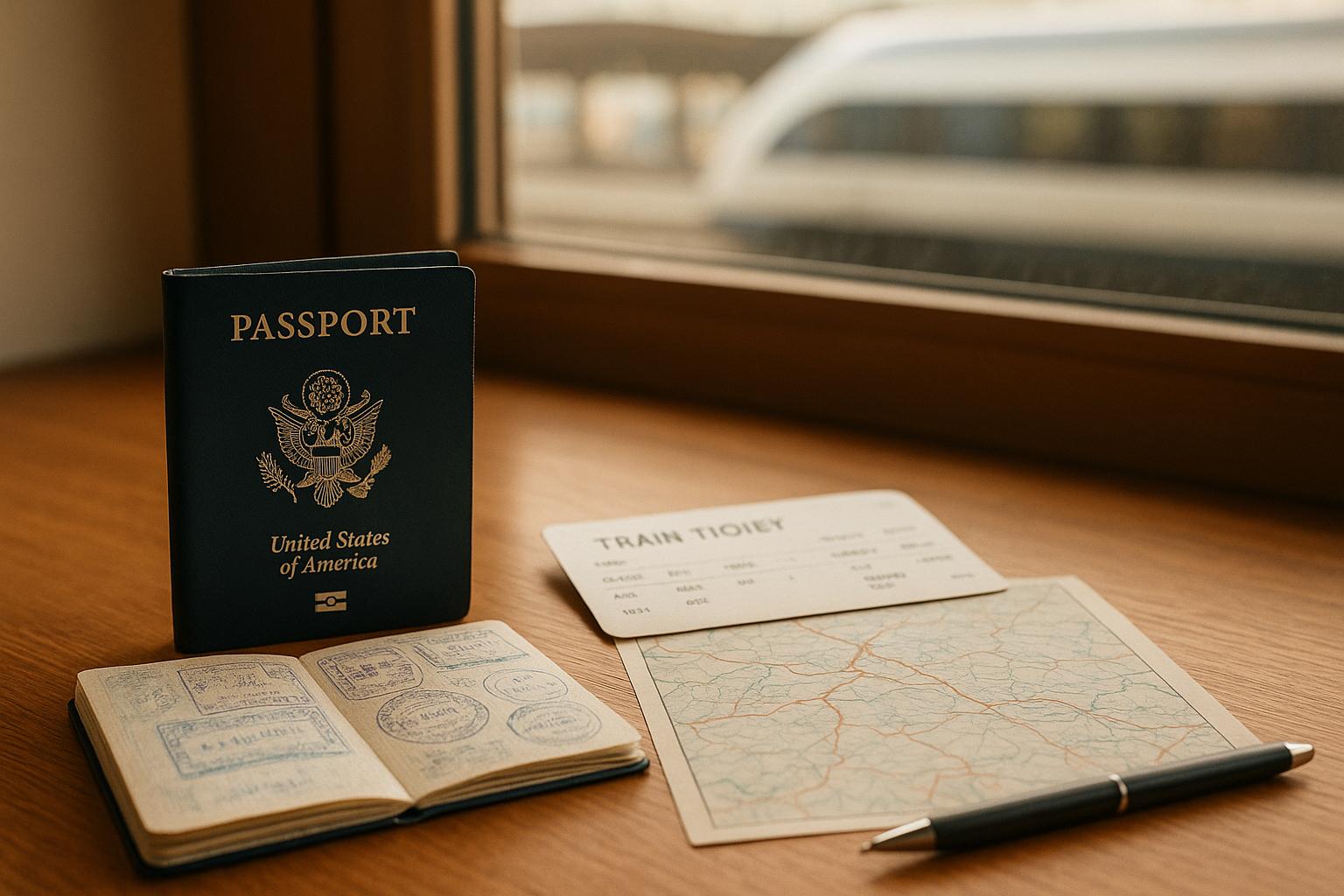
Traveling across multiple countries by train? Here’s what you need to know upfront:
- Passport: Ensure it’s valid for at least 6 months beyond your trip. U.S. passport renewal costs $130 + $35.
- Visas: Check visa rules for each country. U.S. travelers need an ETA for the UK ($21) and may need ETIAS for the EU starting in late 2026 (€7).
- Train Tickets: Digital tickets are common, but some routes require printed ones. Budget $5–$35 for seat reservations on high-speed trains.
- Proof of Accommodation: Carry booking confirmations or, if staying with friends, an invitation letter.
- Itinerary & Return Travel: Have a clear travel plan and proof of onward or return tickets.
- Backup ID: Bring a government-issued photo ID as a secondary form of identification.
- Discount Documentation: Seniors, students, and travelers with disabilities need valid IDs for discounts.
Key Tip: Always double-check entry rules for each destination, carry both digital and printed copies of documents, and stay organized to avoid delays or denied entry.
This guide ensures you’re fully prepared for smooth, hassle-free rail travel across borders. Keep reading for detailed tips and requirements.
Required Identification Documents
When traveling internationally by train, having the right identification documents is non-negotiable. These documents are your key to ensuring smooth border crossings, as officials need to confirm both your identity and your legal right to enter each country.
Valid Passport
A valid passport is your most important travel document. It serves as proof of your citizenship and identity, which is essential for crossing borders. For European travel, passport validity rules are particularly strict. According to official guidance: “Your passport should be valid for at least 6 months at the time of your entry to any country in the EU or the Schengen Area” [2]. So, double-check that your passport meets this requirement to avoid any complications.
For U.S. travelers, the cost of obtaining a new passport is $130, plus a $35 acceptance fee [1]. While this might feel like a steep expense, it’s a small investment compared to the potential hassle or costs of being denied entry. Keep in mind that processing times can vary, so if your passport is nearing expiration, apply for a renewal well in advance.
Visa Requirements
Travelers from the U.S. can visit most European countries without a visa for short stays, such as up to 90 days within a 180-day period in the Schengen Area, which covers 27 European nations [2]. However, the rules change when it comes to the United Kingdom. For short visits to the UK (up to 6 months), travelers who aren’t visa-exempt will need an Electronic Travel Authorization (ETA). This authorization costs approximately $21 per applicant and must be secured before your trip [3].
Looking ahead, the EU plans to introduce ETIAS (European Travel Information and Authorization System) by late 2026. This system will function similarly to the U.S. ESTA, requiring visa-exempt travelers to obtain pre-travel authorization. To stay updated on visa requirements for each stop on your itinerary, use the U.S. State Department’s “Learn About Your Destination” tool [5]. Keep in mind that neighboring countries may have differing entry rules, so it’s crucial to check each destination.
Government-Issued Photo ID
In addition to your passport, carrying a government-issued photo ID – like a driver’s license or state ID – is a smart move. This can serve as a backup identification document and is particularly useful during random checks in countries such as France, Belgium, the Netherlands, and Germany. For train travel between the U.S. and Canada, every passenger must present an original, valid ID that matches the reservation details [6].
To avoid any issues, store your backup ID separately from your passport. This precaution can be invaluable if you need assistance from your embassy during your travels.
Rail Tickets and Reservations
When traveling across multiple borders by train, having the correct tickets and reservations is as essential as carrying your passport. Whether you opt for point-to-point tickets or a rail pass, make sure your choice aligns with your travel plans.
Train Tickets (Paper or Digital)
Your ticket format should match your itinerary.
“As a rule of thumb, a pass is worth considering if you’re traveling by train on at least three days.” [7]
If your schedule is fixed, point-to-point tickets could be the better option. Mark Smith, founder of The Man in Seat 61, shares:
“If your travel plans are firm and dates are fixed, you don’t necessarily need a pass.” [11]
Digital tickets have become the standard. Most rail passes are now digital and can be loaded onto your mobile device through apps like the Rail Planner app [7][8]. While this makes travel more convenient, it also means you’ll need to keep your phone charged and ready for inspections.
That said, some situations still call for printed tickets or reservations. For example, certain train operators require printed documents for international routes outside the Schengen Area or for overnight trains [10]. Always verify the requirements of the train companies on your route to avoid surprises.
Seat reservations add another layer to your planning. Many high-speed trains mandate reservations – TGV trains in France are a good example, where reservations are compulsory [9]. If you’re traveling with a rail pass, don’t forget to activate it and budget $5–$35 for these mandatory seat reservations [12].
“Whether you’re traveling with a rail pass or not, it’s worth taking the time to figure out whether you need seat reservations on European trains – depending on the route and type of train, reservations can be critical…or a pointless hassle and expense.” – Rick Steves [12]
Backup plans can be a lifesaver. Even if you rely on digital tickets, consider having a printed copy or screenshots as a fallback. And if you’re using a rail pass, remember to activate it before your first trip [8]. For flexipasses, keep track of your travel days since each one counts toward your total allowance.
Keep your tickets and any required discount IDs handy for smooth inspections.
Discount Documentation
If you’re using discounted fares, ensure you carry the proper documentation to prove your eligibility. Many transit agencies require pre-qualification for these discounts [14].
- Senior travelers (65 and older) should carry a valid ID, such as a driver’s license, birth certificate, Medicare card, or any photo ID showing your birth date [14]. A Medicare card is particularly useful since it must be accepted as ID for half-fare at the time of boarding [13].
- Students need a current student ID that clearly shows their enrollment status to qualify for discounts [14]. Expired cards won’t be accepted.
- Travelers with disabilities should carry acceptable identification, such as a Medicare card, disabled veteran ID, or a physician’s letter [14]. Some transit agencies even provide specific ID cards for reduced fares [13].
For international travelers, policies can vary. Some rail operators honor foreign discount IDs, while others may issue temporary discount cards for visitors [13]. Always check with each operator beforehand to understand their rules.
To avoid delays during ticket inspections or border crossings, keep your discount documentation in the same place as your tickets and passport. Having everything organized and easily accessible can save you from unnecessary headaches.
Proof of Accommodation and Travel Plans
Once your tickets and reservations are sorted, make sure your accommodation details and overall travel plans are equally organized. Border officials often ask for proof of your travel purpose, which includes confirmed accommodations and evidence of your return or onward plans.
Accommodation Confirmations
Hotel or hostel booking confirmations are your go-to documents for proving where you’ll stay. Keep both digital and printed copies of these confirmations, ensuring they include your name, travel dates, property address, and confirmation number. Before your trip, double-check these details with the accommodation provider.
If you’re staying with friends or family, you’ll need an invitation letter signed by your host, along with proof of your relationship. For prepaid tours, ask your tour operator for a written confirmation. And since internet access can be unreliable at some border crossings, having printed copies of all these documents is a smart move. [15]
Detailed Travel Schedule
A well-organized itinerary helps demonstrate that you have clear plans and a definite purpose for your trip. This should include details like train routes, departure and arrival times, addresses of accommodations with the duration of each stay, and planned activities. Adding information about local transfers can further solidify your plans. Having this documentation ready can make border crossings smoother and reduce delays. [16]
Proof of Return or Onward Travel
Most countries require proof that you’ll leave before your visa expires. This can be a return train ticket or a confirmed reservation for onward travel. If you’re a flexible traveler, consider using refundable tickets or temporary bookings through services like OneWayFly.com or Top Onward Ticket. These options provide acceptable proof while giving you some flexibility.
If you arrive without proof and it’s requested, you might have to buy a ticket on the spot. Some countries, including New Zealand, the United Kingdom, the United States, Brazil, Indonesia, Costa Rica, Peru, and the Philippines, are known for enforcing this requirement. To avoid surprises, research the specific rules for each destination on your itinerary. [17][18][19]
Additional Requirements for Non-EU and UK Travelers
If you’re traveling from outside the EU, you might need more than just a passport and visa to enter certain countries. New electronic systems are reshaping how American and other non-European travelers navigate multiple destinations, especially during rail trips.
Electronic Travel Authorizations
For U.S. citizens planning to visit the United Kingdom for up to six months, an Electronic Travel Authorization (ETA) is mandatory. This authorization costs £16, remains valid for two years (or until your passport expires), and typically takes up to three working days to process. Applications can be submitted via the official GOV.UK website or the UK ETA app [23]. Keep in mind, while the ETA is essential, it doesn’t guarantee entry [24].
Meanwhile, the European Travel Information and Authorization System (ETIAS) is set to roll out in late 2026. This system will require U.S. travelers to obtain authorization before visiting 30 participating European nations. The fee is 7 euros (approximately $7.50), and the authorization will be valid for three years or until your passport expires [22]. ETIAS is expected to impact around 1.4 billion travelers from 59 visa-exempt countries [4]. As Andy J. Semotiuk explained in Forbes:
“Beginning next year, the era of simply showing up at passport control in certain countries – long enjoyed by many visa-exempt travellers – will come to a decisive end.” [21]
Additionally, the Entry/Exit System (EES) is scheduled to launch in October 2025. This system will require non-EU nationals traveling to the Schengen Area for short stays to provide biometric data, such as fingerprints and photographs, at external borders [22].
These electronic authorizations are supplementary to your passport and visa requirements when traveling to non-EU countries.
Extra Documentation for Non-EU Nationals
Beyond electronic authorizations, non-EU travelers may need to present additional documents to demonstrate their eligibility and travel intentions. For instance, if you’re visiting friends or family, it’s a good idea to carry an invitation letter along with proof of your relationship to your host. Accommodation confirmations are equally important, as officials may examine your travel purpose more closely.
Make sure your passport is valid for at least three months beyond your planned departure date from EU countries and was issued within the last 10 years [20]. You may also need to show recent bank statements or credit card records to prove you have enough funds for your trip, as some countries require financial evidence.
It’s worth noting that the Schengen Area includes 25 EU countries, along with Iceland, Liechtenstein, Norway, and Switzerland. However, EU visa rules don’t apply in Cyprus and Ireland [20]. To stay organized, keep both digital and printed copies of all your travel documents in a safe place, separate from your passport.
Conclusion: Stay Prepared for Smooth Travel
Having the right travel documents is non-negotiable for hassle-free multi-country rail journeys across Europe. Travel expert Fernando Blanco emphasizes this point clearly:
“When you’re traveling out of the USA, be it to Europe, on a cruise or just crossing the border by land into Canada or Mexico, ultimately, the onus for having proper travel documentation falls on the traveler.” [25]
This highlights the importance of staying proactive and organized with your travel paperwork.
The stakes are high when it comes to missing or incorrect documentation. Wally White, a seasoned traveler with over 100 countries under his belt, cautions that the lack of proper paperwork can lead to serious consequences like detention or denied entry. Real-life cases serve as stark reminders of how such oversights can result in extended delays or even emergency interventions. These scenarios underline the critical need to double-check all travel documents before embarking on your journey.
To ensure a smooth trip, keep a checklist that includes valid passports, necessary visas, confirmed accommodations, and a detailed itinerary. Make copies of your key documents, store them separately, and share your travel plans with someone you trust. Always verify entry and exit requirements for each destination using official resources, and consider signing up for travel advisory services to stay informed about any changes [26].
FAQs
What should I do if my passport expires within 6 months of my rail trip?
If your passport is nearing its expiration – specifically within 6 months of your planned rail adventure across multiple countries – it’s a good idea to renew it before you go. Many nations have rules requiring passports to be valid for at least 6 months beyond your travel dates. Not meeting this rule could mean being denied entry or facing unexpected travel headaches.
To keep your plans on track, take a moment to check your passport’s expiration date well ahead of time. This ensures you have enough time to complete the renewal process without stress.
What steps should I take to ensure I have the right train tickets and reservations for a multi-country rail trip?
To ensure your train tickets and reservations are in order for your trip, here’s what you need to do:
- Activate your mobile pass shortly before boarding each train. Doing this a few minutes ahead ensures it’s ready for inspection when needed.
- Keep your reservation details handy, either as a QR code or a PDF. For night trains, having a printed copy can make things much simpler.
- Be prepared to show both your valid pass and the corresponding reservation to inspectors whenever requested.
- In countries where ticket validation is required, make sure to validate your ticket before boarding to avoid any penalties.
By following these steps, you’ll set yourself up for a smooth and hassle-free train journey across different countries.
How do I apply for an Electronic Travel Authorization (ETA) or ETIAS for my rail trip?
To apply for an Electronic Travel Authorization (ETA) or ETIAS, head over to the official application portal. Make sure you have a valid passport and your basic travel details handy to fill out the online form. The application fee is €7 (around $7.50) for travelers between the ages of 18 and 70. Once you’ve submitted your application, most requests are processed quickly, and you’ll receive confirmation of your authorization shortly.
Since ETIAS is anticipated to launch in late 2026, travelers planning trips after this date should apply in advance to avoid any potential travel hiccups. Having your ETA or ETIAS sorted ahead of time will help ensure a hassle-free journey across Europe.