
Warsaw to Krakow by PKP Intercity: fastest trains take around 2 hours 20 minutes. Around 23 direct departures a day from Warszawa Centralna to Krakow Glowny. Advance fares from 60 PLN on EIC and IC services.
Key takeaways
- PKP Intercity runs the route with EIP Pendolino, EIC, and IC trains. Most departures are direct and take between 2h20 and around 3 hours depending on service type.
- Advance fares in 2nd class start from around 60-80 PLN on EIC and IC trains, rising to 120-180 PLN for standard tickets. EIP Pendolino promo fares start from around 80-120 PLN.
- Both Interrail and Eurail passes are valid on PKP Intercity. EIP seat reservations cost 43 PLN for pass holders; EIC and IC seat reservations cost 3 PLN. Both fees apply when bought at a PKP Intercity ticket office in Poland.
- Departures leave from Warszawa Centralna; arrivals at Krakow Glowny, a 10-15 minute walk from the Old Town.
- FlixTrain also operates the route at lower fares, with journey times of around 3h30-4h.
Warsaw to Krakow train: the basics
PKP Intercity runs the great majority of direct trains between the two cities. Services run from early morning until late evening. Journey times vary by service type: EIP Pendolino services reach Krakow in around 2h20-2h30 on the fastest departures, while EIC and IC trains typically take 2h30-3h.
The route covers approximately 290 km by rail. Around 23 direct trains run on a typical weekday, spread across the three PKP Intercity service categories. First departures from Warszawa Centralna usually leave around 05:00; the last trains depart around 21:30-22:00. Exact times change with timetable periods, so check the PKP Intercity website for your travel date.
For most travellers, an EIC or IC train is the right choice. The Pendolino is worth paying for when you need to be in Krakow as early as possible and promo fares make the price acceptable.
Timetables and frequency
Services run throughout the day, with combined departures every 30-60 minutes during peak daytime hours.
| Service type | Typical journey time | Notes |
|---|---|---|
| EIP (Express InterCity Premium, Pendolino) | ~2h20-2h30 | Fastest; compulsory reservation |
| EIC (Express InterCity) | ~2h30-2h45 | Good value; reservation recommended |
| IC (InterCity) | ~2h35-3h | More stops; cheapest standard tickets |
Timetables change between annual periods. Check your exact departure on the PKP Intercity website rather than relying on typical patterns.
Train operators and services on the route
PKP Intercity is the main operator. RegioJet runs its own distinct service on the same corridor. FlixTrain offers a budget option. These are three separate products with different trains, fares, and booking systems.
EIP (Express InterCity Premium) Pendolino
The EIP is PKP Intercity’s high-speed flagship. Compulsory seat reservations apply on all departures, included in the ticket price when you buy point-to-point, or 43 PLN separately for Interrail and Eurail pass holders when bought at a PKP Intercity ticket office in Poland. The Pendolino has air conditioning, power outlets at seats, a restaurant car, and 1st and 2nd class carriages.
EIC (Express InterCity)
EIC trains cover the route in around 2h30-2h45. Seat reservations are recommended but not always mandatory. Pass holders pay 3 PLN per seat reservation when bought in Poland. A restaurant car is available on most services.
IC (InterCity)
IC trains make more stops and take a little longer, but are often the cheapest option on the same day. Some IC trains show a mandatory reservation symbol (R) in the timetable; others are reservation-recommended only. Pass holders pay 3 PLN per seat reservation in Poland.
RegioJet
RegioJet runs its own Warsaw-Krakow trains with different rolling stock, different seating categories from PKP Intercity, and free hot drinks included. Fares are often competitive with PKP Intercity promo prices. Book through the RegioJet website or app.
FlixTrain
FlixTrain serves the corridor at lower fares, typically taking around 3h30-4h. More stops, slower overall, no separate classes. A reasonable choice if no promo PKP Intercity fares are available and timing is flexible. Book via the FlixTrain website or app.
Tickets, prices and how to book
PKP Intercity uses dynamic pricing. Fares depend on service type, seat class, availability category, and booking lead time.
Typical 2nd class one-way fares (PLN)
| Service | Promo fare | Standard fare |
|---|---|---|
| EIP (Pendolino) | from ~80-120 PLN | ~180-250 PLN |
| EIC / IC | from ~60-90 PLN | ~120-180 PLN |
Promo fares are tied to a specific train and are non-refundable. Standard fares allow changes or refunds within the ticket conditions. Weekend peak departures, particularly Friday evenings and Sunday afternoons, exhaust promo allocations quickly.
First class costs around 30-60% more than second class. On EIP, 1st class offers wider seats, a quieter carriage, and at-seat refreshment service on some departures.
PKP Intercity tickets go on sale up to 90 days before travel on the intercity.pl website and the eBilet app. Book early if you want a promo fare, as the cheapest allocations go first. Walk-up fares without a promo cost considerably more.
E-tickets with a QR code are the standard format. No printing is needed, though having a paper backup is useful if battery is a concern. Show the QR code alongside ID when the conductor checks.
Warszawa Centralna and Krakow Glowny
Most long-distance trains to and from Warsaw use Warszawa Centralna. Book this station unless your ticket specifies otherwise.
Warszawa Centralna is in the city’s business district, with direct access to Metro M1, trams, and multiple bus lines. Long-distance platforms are underground, beneath a central concourse. Left-luggage lockers cost around 20-50 PLN per day. Arrive 15-20 minutes before departure to locate your platform, as boards update about 10-15 minutes before the train leaves.
Warszawa Wschodnia and Warszawa Zachodnia handle some through services. Your ticket states the boarding station; check before travelling. Moving between Warsaw stations by SKM (rapid city rail) or tram takes around 10-15 minutes.
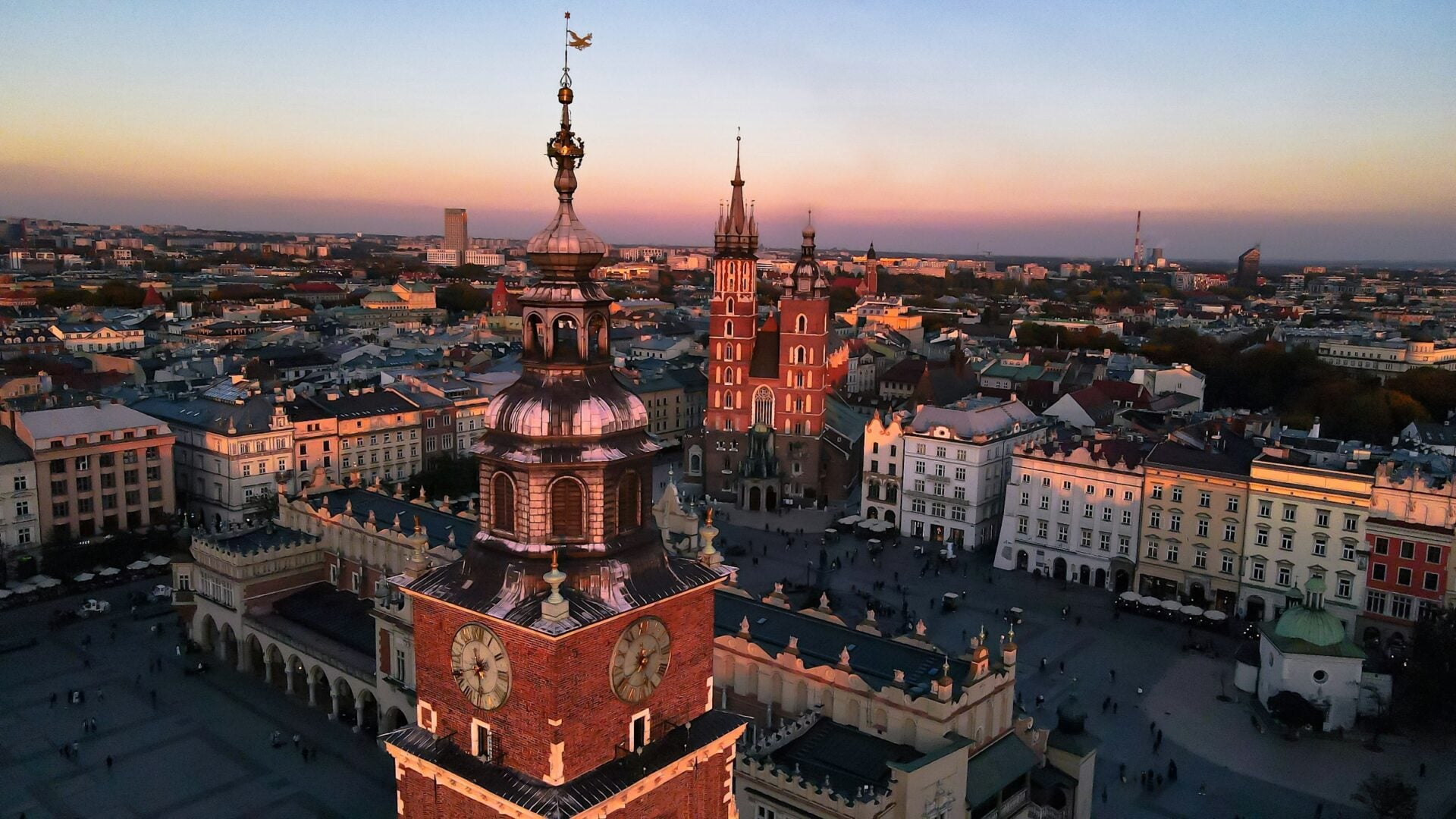
Krakow Glowny connects directly to the Galeria Krakowska mall and the city’s main bus station, just north of the Old Town. The walk to Rynek Glowny through the Planty park takes about 12-15 minutes. Tram lines 1, 6, and 8 give a quicker connection to Wawel and the southern parts of the city. The station has ticket offices, lockers, ATMs, and bilingual signage.
Seat reservations, classes and the onboard experience
Reservations are always compulsory on EIP Pendolino services. On EIC and IC, reservations are recommended and sometimes mandatory on specific departures (marked with an R in the timetable). When you buy a point-to-point ticket, the seat reservation is automatically included.
Second class has 2+2 seating, a mix of forward-facing and table-facing configurations, overhead luggage racks, and power outlets on most modern PKP Intercity carriages. First class uses a 2+1 layout with more legroom and quieter coaches.
Both classes have access to the restaurant car or bistro trolley on most services. Wi-Fi varies by train, so download anything you need offline before boarding.
Normal bags and suitcases travel without formal weight limits. Luggage racks sit at carriage ends; keep valuables with you.
Some IC and EIC services carry bikes with a separate reservation (around 10-20 PLN), subject to availability. EIP trains are more restrictive and generally do not take full-size bikes. Check the specific departure when booking. Folding bikes stored in a bag travel as normal luggage on all services.
Rail passes on the Warsaw-Krakow route
Both Interrail and Eurail passes are valid on PKP Intercity trains, including EIP, EIC, IC, and TLK services. The pass covers the travel cost, but a seat reservation is always required on top.
Pass-holder reservation fees (PKP Intercity ticket offices in Poland)
| Service | Reservation required? | Pass-holder fee |
|---|---|---|
| EIP (Pendolino) | Always mandatory | 43 PLN |
| EIC (Express InterCity) | Recommended | 3 PLN |
| IC (InterCity) | Mandatory on some, recommended on others | 3 PLN |
| TLK | Recommended | 3 PLN |
Domestic reservations can be bought up to 30 days in advance at PKP Intercity ticket offices or online via the intercity.pl pass-holder booking flow. Do not board an EIP service with just your pass, as you need the reservation before you board.
Is a pass worth it? For Warsaw to Krakow alone, usually not. An EIC advance ticket costs 60-90 PLN, while even a short Interrail pass costs considerably more. The pass starts to make sense when you are crossing several countries or making many journeys in a short window. If Krakow is one stop on a broader European trip, compare your pass cost against the total point-to-point fares for all planned legs.
Pass holders must carry the physical or digital pass alongside any seat reservation. Conductors check both.
Alternatives when direct trains are full or unavailable
Direct PKP Intercity services are the default. Alternatives are rarely needed but worth knowing.
FlixTrain serves the route at lower fares, around 3h30-4h journey time. Slower, more stops, no separate classes. Good if PKP Intercity promo fares are gone and timing is flexible.
RegioJet runs its own service with competitive fares. Different product from PKP Intercity, so check the RegioJet website for schedules and prices.
Regional rail combinations via Radom or Katowice take 5-7 hours and require separate Polregio tickets at around 50-100 PLN per leg. Only worth considering if all direct services are cancelled.
Long-distance coaches: FlixBus and similar operators take 4-6 hours, departing from peripheral coach stations. Cheaper than standard PKP Intercity fares, significantly slower.
Domestic flight: Warsaw Chopin to Krakow airport takes 50 minutes in the air. Door-to-door time, including check-in, security, and airport transfers at both ends, typically runs to 3-4 hours total, at 200-500 PLN. Worth considering only if you are already at the airport or combining with an international connection.
When at least one daytime PKP Intercity departure is running, the direct train remains the right choice.
Practical tips
- Book on intercity.pl or the eBilet app. Sales open 90 days before travel, when the cheapest promo allocations appear.
- Friday evening and Sunday afternoon departures fill quickly. If dates are fixed, book as early as the window allows.
- Platform numbers at Warszawa Centralna appear on the boards about 10-15 minutes before departure. Allow enough time to walk to the correct platform and find your carriage.
- Your e-ticket shows the carriage and seat number. Board the right carriage from the start.
- Air conditioning on EIP and EIC runs cool. A light layer helps on longer journeys.
- Conductors check both your ticket and ID. Have both ready.
Frequently asked questions
Do I need to print my ticket for the Warsaw to Krakow train?
Digital tickets on a smartphone are widely accepted on PKP Intercity trains. Keep the QR code clearly visible and have matching ID ready. Printing is not required when using a PKP Intercity e-ticket. Tickets from international booking platforms such as Trainline, Omio, or Rail.cc also work digitally - check your confirmation email for the format to show the conductor.
How early should I arrive at Warszawa Centralna?
Arriving 15-20 minutes before departure gives you enough time to find the correct platform and carriage, particularly if you do not know the station. There are no security checks. Regular travellers who know the station can arrive 10 minutes before without difficulty.
Is the Warsaw to Krakow train safe at night?
Yes. PKP Intercity trains are staffed throughout and well-used, including evening services. Standard personal security habits apply: keep valuables visible, choose a populated carriage. Services after 22:00 are less frequent but still staffed.
Can I take a bike on the Warsaw to Krakow train?
Some IC and EIC services have limited bike spaces, reserved and paid separately (around 10-20 PLN), subject to availability. EIP Pendolino trains are more restrictive and generally do not accept full-size bikes. Check the specific departure when booking. Folding bikes stored in a bag travel as normal luggage.
What happens if my train is delayed or cancelled?
Your ticket stays valid for the delayed train. For significant disruptions or cancellations, PKP Intercity staff at ticket offices can rebook you. Under EU rail passenger rights, delays of 60 minutes or more may entitle you to 25-50% of the ticket price as compensation. Keep your original ticket and any receipts for additional expenses.