
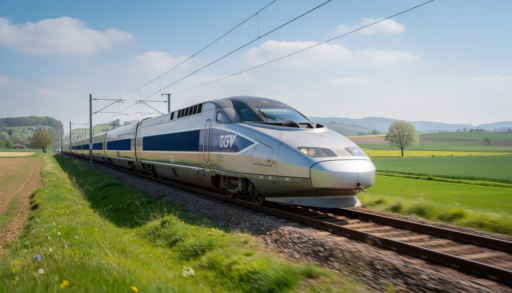
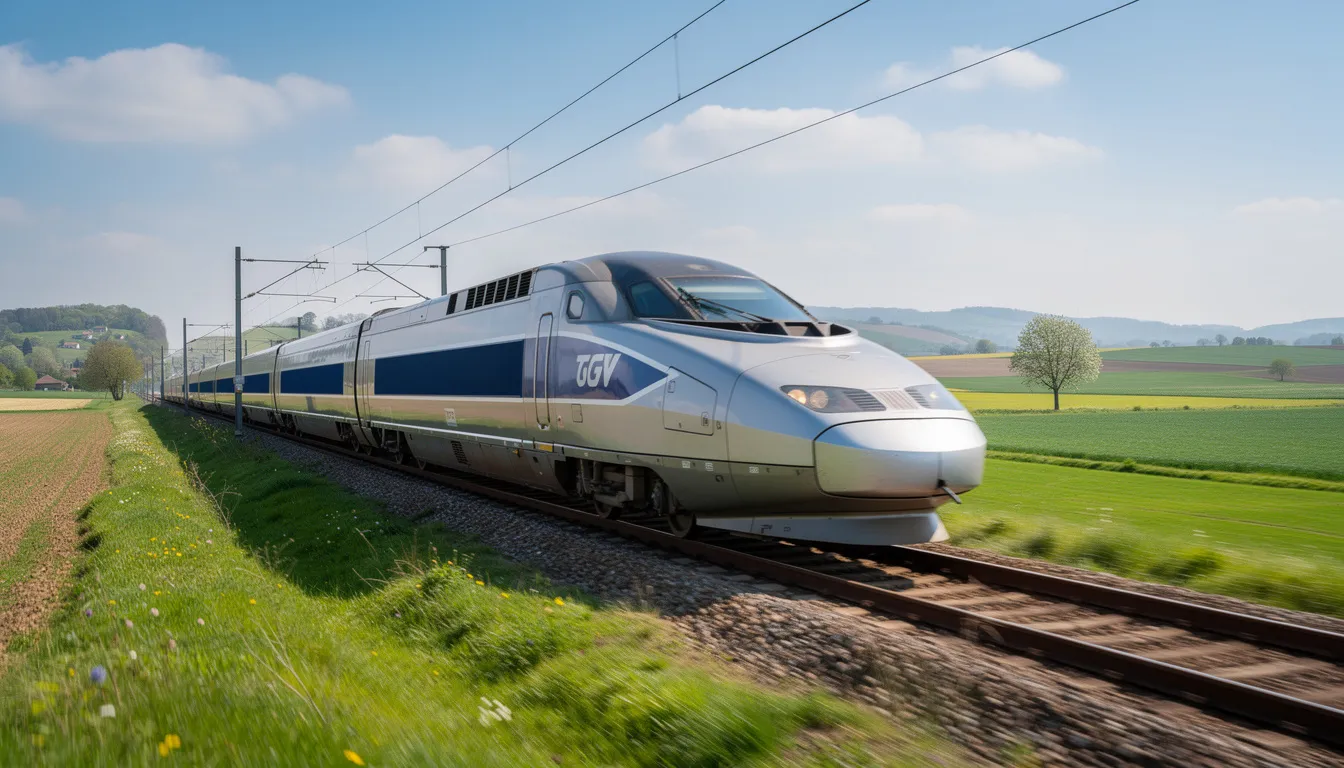
Introduction to the TGV high-speed train
The TGV, short for Train à Grande Vitesse (literally “high speed train” in French), stands as France’s flagship rail service and one of the most successful high-speed networks in the world. The TGV is France’s intercity high-speed rail service. Launched in 1981, this revolutionary system connects major French cities at speeds reaching 320 km h on dedicated high-speed lines known as LGV (Ligne à Grande Vitesse). The TGV was conceived at the same period as other technological projects such as the Ariane 1 rocket and Concorde supersonic airliner. The state-owned SNCF started working on a high-speed rail network in 1966. City-centre-to-city-centre travel with the TGV avoids lengthy airport commutes and security lines, offering travelers direct access to central urban areas.
So what makes the TGV so remarkable? The answer lies in a combination of engineering excellence, an extensive network, and an exceptional safety record spanning more than four decades. From its Paris hub, the TGV network reaches out across France to cities including Lyon, Marseille, Bordeaux, Lille, Strasbourg, Nantes, Tours, and Rennes. The system also extends beyond French borders, offering direct service to Belgium, Germany, Switzerland, Spain, Italy, and Luxembourg. TGV trains connect over 200 destinations across France and neighboring countries like Belgium, Germany, Italy, Spain, and Switzerland.
The TGV holds the world speed record for conventional wheeled rail travel. On 3 April 2007, a specially prepared TGV set achieved an astonishing 574.8 km/h on the LGV Est line. This was no ordinary commercial run—the train was modified and the overhead power systems enhanced specifically for the record attempt. The TGV was originally planned to be propelled by gas turbines, but switched to electric traction due to the 1973 oil crisis. Normal commercial maximum speed sits at a still-impressive 300–320 km h, which is more than sufficient to make rail competitive with air travel on many routes.
SNCF, France’s national railway operator, runs the TGV network under two distinct brands. The TGV has been rebranded as TGV inOui since 2017 to distinguish it from the low-cost Ouigo services. TGV inOui represents the premium service tier, offering enhanced comfort, connectivity, and onboard amenities. Ouigo is the low-cost high-speed rail service operated by SNCF, featuring a high-density one-class configuration. Ouigo provides a low-cost alternative on select routes, making high-speed travel accessible to budget-conscious travelers. Both services share the fundamental TGV technology but differ significantly in pricing structure and included amenities.
History and development of the TGV
The story of the TGV begins in the early 1970s, when French railways faced an existential challenge. Air travel and private cars were steadily eroding rail’s market share, and SNCF needed a bold response. The answer came in the form of a completely new approach to rail travel—purpose-built lines designed from scratch for high-speed operation.
Initial development actually explored gas turbine technology, inspired by the compact helicopter engines of the era. The 1973 oil crisis changed everything. Skyrocketing fuel prices made electric propulsion far more attractive, and the project pivoted decisively toward overhead wire power. By 1976, the French government had committed full funding to what would become the first high speed line, the LGV Sud-Est connecting Paris to Lyon.
On 27 September 1981, just months after President François Mitterrand’s inauguration, the first commercial TGV service departed from Gare de Lyon in Paris. The impact was immediate and transformative. Journey times between Paris and Lyon dropped from over four hours to just two hours. Within the first year, the line carried 10 million passengers, silencing skeptics who had questioned whether the French public would embrace high-speed rail. The Sud-Est fleet was built between 1978 and 1988 and operated the first TGV service from Paris to Lyon.
The network expanded rapidly in the following decades, with new TGV lines extending the reach of high-speed rail across France and into neighboring countries. The TGV Atlantique line opened in 1989, connecting Paris-Montparnasse to western France and Brittany. This expansion brought with it a new generation of trains and a spectacular demonstration of capability—on 18 May 1990, a TGV Atlantique set reached 515 km h, shattering the previous world record.
LGV Nord opened in 1993, dramatically reducing travel times on the Lille Paris route and creating the foundation for international services to Belgium, the Netherlands, and eventually the United Kingdom via the Channel Tunnel. The Eurostar service to London would become one of the most commercially successful international rail operations in Europe. The first Réseau (Network) sets entered service in 1993.
The early 2000s saw continued expansion of TGV lines. LGV Méditerranée reached full completion in 2001, extending high-speed running all the way to Marseille. The LGV Est européenne opened in 2007, finally bringing Strasbourg into the high-speed network and enabling direct services toward Germany. This line provided the venue for the 2007 world speed record attempt that pushed the boundaries of conventional rail technology.
More recent additions include the LGV Rhin-Rhône (2011) and LGV Sud Europe Atlantique (2017), the latter slashing Paris-Bordeaux travel times to just over two hours. The TGV concept has also influenced high-speed development worldwide, with Spain’s AVE and South Korea’s KTX drawing inspiration from French expertise. The introduction of the TGV Océane sets further modernized the fleet; the TGV Océane trains have an all-new interior and entered service in 2017.
A critical innovation came in the mid-1990s with the introduction of TGV Duplex trains. These double-deck sets increased capacity by approximately 45% without requiring longer platforms or more frequent services—a crucial advantage on congested routes like Paris–Lyon.
The TGV network in France carried 168 million passengers in 2025.
TGV technology and train design
The TGV’s technical architecture differs fundamentally from conventional trains. Each trainset consists of two power cars—essentially locomotives—positioned at each end, with articulated passenger carriages running between them. This arrangement places heavy traction equipment at the extremities, keeping the passenger accommodation lighter and reducing noise and vibration in the seating areas.
The articulated design uses Jacobs bogies, where adjacent carriages share a single truck at their connection point rather than each car having its own bogies at both ends. This configuration delivers several advantages. The train maintains exceptional stability at high speeds because the shared bogies cannot oscillate independently. In the event of a derailment, the articulated connection keeps carriages aligned rather than jackknifing, significantly improving crash safety. The design also reduces the total number of wheels and axles, lowering maintenance requirements and track wear.

On dedicated LGV infrastructure, TGV trains operate at commercial speeds of 300–320 km h. This requires specialized infrastructure including continuously welded rail, reinforced track beds, powerful overhead catenary systems delivering 25 kV AC power, and complete grade separation from road traffic. There are no level crossings on LGV lines—every intersection uses bridges or tunnels.
Signaling on high-speed sections relies on in-cab systems rather than traditional lineside signals. At 320 km h, drivers simply cannot read conventional trackside signals quickly enough. The TVM (Transmission Voie-Machine) system transmits speed limits and track conditions directly to the cab, with automatic braking intervention if the driver fails to respond appropriately. Newer trains also incorporate ERTMS (European Rail Traffic Management System), enabling seamless cross-border operations.
Safety features extend throughout the train design. Continuous automatic train control monitors speed constantly. The articulated construction keeps the train as a coherent unit even under stress. Braking systems combine regenerative electric braking with conventional disc brakes, providing redundant stopping capability. These systems have contributed to an exemplary safety record—no passenger fatalities have occurred in regular high-speed LGV operations since the 1981 launch.
Passenger comfort technology has evolved significantly over the decades. Modern TGV sets feature sophisticated suspension systems that smooth out track irregularities, comprehensive noise insulation, and effective climate control. Most current rolling stock includes onboard WiFi, power sockets at seats, and real-time journey information displays.
Main types and generations of TGV trains
The TGV fleet has evolved through several distinct generations, each designed for specific routes, power systems, and capacity requirements. Some are single-deck designs optimized for speed and frequency. Others are double-deck configurations built to maximize passenger numbers on heavily trafficked corridors. Understanding these types helps explain why your experience might differ between routes.
TGV Atlantique and Réseau
The TGV Atlantique units entered service around 1989, purpose-built for the new lines running southwest from Paris-Montparnasse toward Le Mans, Tours, Brittany, and the Atlantic coast. These trains represented a significant evolution from the original orange-liveried sets, with improved aerodynamics and more powerful motors enabling the dramatic 1990 speed record.
TGV Réseau trains followed in the mid-1990s, designed as versatile units capable of operating across multiple routes. These single-deck sets served on various domestic routes and some early cross-border services. With typical operational speeds of 300–320 km h, they established the template for reliable high-speed service that continues today. While newer generations are gradually replacing these trains operated on principal routes, Réseau sets remain in service on some lines.
TGV Duplex, Dasye, and Océane
The TGV Duplex revolutionized capacity when introduced in the mid-1990s. By going double-deck, SNCF increased seating by roughly 45% without lengthening trains or building longer platforms. The design proved ideal for busy domestic routes like Paris–Lyon–Marseille and Paris–Nice, where demand consistently outstripped single-deck capacity.
First-generation Duplex sets primarily serve domestic French routes. Later developments brought the Dasye variant (late 2000s) with multi-system electrical capability for international running, and the Océane sets from 2017. TGV Duplex trains now form the backbone of high-capacity service across the French network.
Océane sets debuted specifically for the upgraded Paris–Bordeaux line, featuring thoroughly modernized interiors. First-class passengers enjoy rotating seats, enhanced WiFi coverage, and contemporary design throughout. These represent the current standard for French high-speed comfort on principal routes.
Avelia Euroduplex (TGV 2N2)
The Avelia Euroduplex, also designated TGV 2N2, emerged in the late 2000s as a third-generation double-deck design. These trains entered commercial service from 2011, combining high capacity with international capability.
Numbered in the 800 series, Euroduplex sets are authorized for the full 320 km h commercial speed on LGV lines. Crucially, they incorporate compatibility with multiple signaling systems including ERTMS, enabling direct operation across borders into Spain, Germany, and Switzerland without locomotive changes. The Paris–Barcelona service, for instance, relies on these multi-system trains to navigate the different electrical and signaling standards along the route.
TGV M (Avelia Horizon)
SNCF ordered 100 TGV M trainsets in July 2018, with this new generation entering commercial service progressively from 2024. Marketed as Avelia Horizon, these trains represent a significant leap forward in efficiency and flexibility.
A typical 8-carriage TGV M set costs approximately €25 million and delivers around 20% lower energy consumption compared to current designs. The modular interior concept allows SNCF to reconfigure seating layouts during the train’s operational life—a first for TGV—adapting capacity and class ratios as demand patterns evolve.
Improved passenger space, enhanced accessibility features, and comprehensive digital services characterize the TGV M experience. These trains will progressively replace older generations through the 2030s, ensuring the TGV network remains at the forefront of high-speed rail technology.
TGV routes in France and Europe
TGV lines radiate outward from Paris to reach virtually every major French city, forming an extensive high-speed rail network that also connects to neighboring countries. The TGV network connects major cities across France, including Marseille, Lille, Bordeaux, Strasbourg, Rennes, and Montpellier. TGV operates domestic routes that connect cities such as Paris, Lyon, Marseille, and Bordeaux. Understanding the network geography helps with journey planning and sets realistic expectations about travel times and connections. TGV services also extend to neighbouring countries, including Italy, Spain, Belgium, Luxembourg, and Germany.
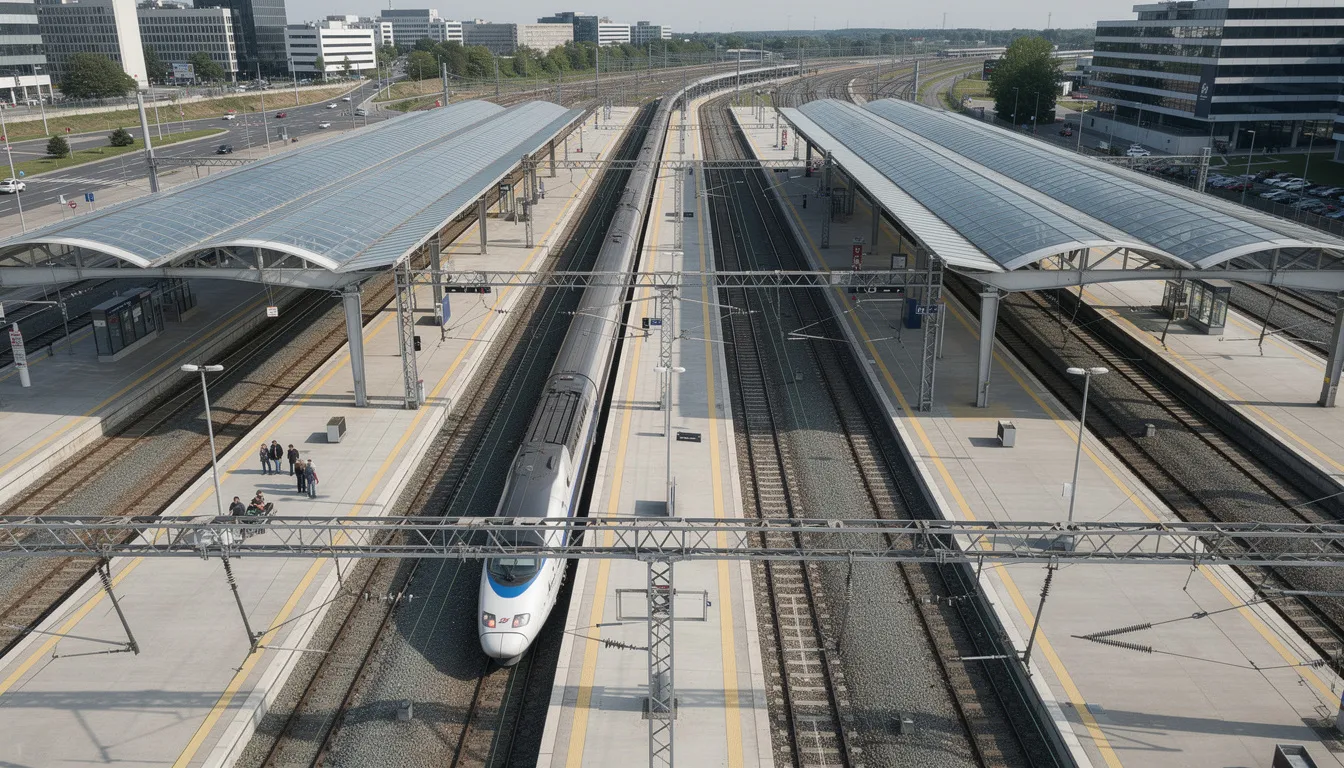
Northern routes center on the Lille Paris corridor, with journey times around one hour via LGV Nord. The TGV Nord-Europe line connects Paris to Lille and the English-Channel coast at Dunkerque, Calais, and Boulogne. From Lille Europe station, connections extend to Brussels, and the Eurostar continues to London through the Channel Tunnel. Services also reach cities in northern Germany, though journey times to destinations like Frankfurt often require routing via Brussels or Strasbourg.
Eastern routes follow the LGV Est toward Strasbourg, cutting travel times to approximately 1 hour 50 minutes from Paris. This line continues toward Germany, with direct TGV services reaching Frankfurt and Munich. Connections from Strasbourg also provide access to Switzerland via conventional lines.
Southeastern routes represent the original and busiest TGV axis. The TGV Méditerranée line connects Paris with the South and Southeast of France, serving cities like Lyon, Avignon, Aix-en-Provence, and Marseille. Paris–Lyon takes approximately 2 hours, making this corridor a genuine alternative to flying. Services continue to Marseille (around 3 hours from Paris), and some trains proceed along the Mediterranean coast toward Cannes and Nice, though this final section uses conventional tracks at lower speeds. From Lyon, routes branch toward Geneva, Lausanne, and Zurich via TGV Lyria services to Switzerland.
Southern routes now include direct connections to Spain. The Paris–Barcelona service takes around 6.5 hours, crossing the border at high speed on the recently completed LGV Perpignan–Figueras. Marseille–Barcelona services offer an alternative for those starting from southeastern France. Future improvements may reduce these journey times further.
Southwestern routes depart from Paris-Montparnasse toward Bordeaux St Jean, with the 2017 line opening cutting travel times to just over 2 hours. Services continue to Toulouse and eventually connect with Spanish networks. Branches also serve the Atlantic coast and destinations like Arcachon.
Western routes connect Paris to Brittany and the Loire Valley. The TGV Atlantique line connects Paris with Brittany and the west of France, serving cities like Le Mans, Tours, Nantes, Rennes, Quimper, and Brest. Rennes takes approximately 1 hour 30 minutes, with services continuing to Brest. Nantes is reachable in about 2 hours 15 minutes. These routes combine high-speed running on LGV Atlantique with conventional sections closer to their Atlantic destinations.
International connections extend the TGV reach significantly. The TGV operates a service between Paris and Milan, Italy. The TGV also connects Paris with Barcelona, Spain, through a direct train service.
| Destination | Route | Approximate Journey Time |
|---|---|---|
| Brussels (Belgium) | Via LGV Nord and Lille | ~1 h 20 min |
| Luxembourg | Direct from Paris | ~2 h 10 min |
| Geneva (Switzerland) | Via Lyon | ~3 h 10 min |
| Barcelona (Spain) | Via Montpellier | ~6 h 30 min |
| Milan (Italy) | Via Lyon and Chambéry | ~7 h |
| Frankfurt (Germany) | Via Strasbourg | ~3 h 50 min |
Some services—particularly toward destinations in north and south France not yet served by complete LGV routes—combine high-speed and conventional running. The scenic stretch along the Côte d’Azur between Marseille and Nice, for instance, offers spectacular Mediterranean views but at speeds well below TGV maximum.
TGV Inoui and services
TGV Inoui represents the premium high-speed rail service offered by SNCF, designed to deliver an extraordinary travel experience across France’s most popular routes. The name “Inoui,” meaning “unheard of” or “extraordinary” in French, reflects the elevated standards of comfort and service that set these trains apart. Launched in 2017, initially on the Paris–Bordeaux line, TGV Inoui services have since expanded to cover a wide range of high-speed routes, including connections from Paris to Lyon, Marseille, Strasbourg, and beyond.
Travelers choosing TGV Inoui benefit from refurbished trains featuring modern amenities such as free onboard WiFi, spacious seats with generous legroom, and increased luggage space. The interiors are designed for comfort, with quiet carriages, power sockets at every seat, and improved lighting. TGV Inoui services also offer enhanced accessibility and digital services, making it easier for passengers to stay connected and productive during their journey.
TGV Inoui trains operate on select high-speed lines, providing a superior level of service for both business and leisure travelers. Whether you’re heading from Paris to Bordeaux for a weekend getaway or traveling between major French cities for work, Inoui services ensure a smooth, comfortable, and efficient rail experience. With SNCF’s commitment to innovation and customer satisfaction, TGV Inoui continues to raise the bar for high-speed train travel in France.
Tickets, reservations, and travel classes
Every TGV journey requires a seat reservation tied to a specific train number, departure time, and assigned carriage and seat. Unlike many conventional rail services where you can hop on any train with a valid ticket, TGV reservations are mandatory and non-transferable between trains.
Booking windows typically open 3–4 months before travel, though exact availability varies by route and season. SNCF operates dynamic pricing similar to airlines—early bookings capture the lowest fares, while last-minute purchases pay premium prices. The difference can be substantial: advance Paris–Bordeaux tickets might start around €20–25, while the same journey booked the day before could cost €100 or more.
Main booking channels include:
- SNCF Connect (official SNCF website and app)
- Rail Europe and other authorized international resellers
- Ticket machines at French stations
- Staffed counters at major stations like Gare de Lyon
First class offers 2+1 seating across the carriage width, providing more legroom, larger tables, and a generally quieter environment. Power sockets are standard at all seats, and WiFi coverage tends to be more reliable. The spacious seats include adjustable headrests and more substantial armrests.
Second class uses 2+2 seating, which remains comfortable by international standards but with a denser layout. Modern TGV sets provide power sockets throughout, though some older rolling stock may have fewer outlets. WiFi is available on TGV inoui services and most newer trains.
There’s no airport-style check-in for TGV travel. Passengers can board their train right up until departure, though arriving 10–15 minutes early is sensible for finding your seat and stowing luggage. Platform assignments typically appear on departure boards 15–20 minutes before the train leaves.
Eurail and Interrail pass holders can use TGV services but must pay a reservation fee (currently around €10–20 for domestic routes, higher for some international trains). Quota restrictions limit available seats for pass holders on popular services, making advance booking essential during peak periods.
Fares and discounts
TGV fares are dynamic and can vary significantly depending on the route, class of service, and how far in advance you book your tickets. Generally, the earlier you reserve, the better the price—tickets for popular routes like Paris to Nice or Paris to Lyon can start as low as €25 for a one-way journey if booked several months ahead. TGV tickets are typically available up to three months in advance, and securing your seat early is the best way to access the lowest fares.
SNCF offers a range of discounts to make high-speed travel more accessible. Youth travelers, seniors, and groups can benefit from special reduced rates, and periodic promotions are available through the official TGV website and mobile app. TGV Inoui services, with their premium amenities and enhanced comfort, are priced at a higher tier, reflecting the superior onboard experience. However, even on Inoui services, early booking and flexible travel dates can help you find competitive fares.
For the best deals, use the TGV website or app to compare prices across different departure times and classes. Keep an eye out for flash sales and special offers, especially during off-peak periods. Whether you’re traveling for business or leisure, planning ahead ensures you get the most value from your TGV journey.
Onboard experience: seating, luggage, and facilities
Stepping aboard a TGV, you’ll immediately notice the quiet, climate-controlled environment. High-speed running on well-maintained track produces remarkably smooth travel—far less vibration than conventional trains or aircraft. At 300 km h, the French countryside becomes a flowing panorama rather than a blur.
Seating arrangements vary slightly between train types, but the general principle remains consistent. First class provides 2+1 seating with comfortable seats featuring substantial legroom and fold-down tables. Second class offers 2+2 configuration with narrower but still adequate seats. Both classes include a mix of forward-facing airline-style rows and “carré” arrangements where four seats face each other around a shared table—ideal for families or groups traveling together.
Seat selection during booking allows passengers to express preferences for window or aisle, quiet carriage, or specific configurations. Traveling with young children? Family spaces on TGV Duplex trains offer extra room and are positioned near convenient facilities.
Luggage allowance on TGV services is generous compared to air travel. Each passenger may bring two larger items plus hand luggage, with no formal weight restrictions. Bags must be manageable without assistance and clearly labeled with your name and contact details. Storage options include overhead racks, spaces between seat backs, and larger luggage areas at carriage ends. On double-deck Duplex sets, lower-deck seating often provides easier access to end-of-car luggage spaces.
Most medium and long-distance TGV trains feature a bar car serving drinks, snacks, sandwiches, and simple hot dishes. Full restaurant cars are not standard—the café-bar represents the typical catering option. Some inoui services offer at-seat meal delivery in first class, bookable in advance through the SNCF app.
Bicycle transport requires advance planning. Non-folding bikes are accepted only on specific TGV services where dedicated spaces can be reserved. Routes and availability vary—check during booking whether your intended service offers bike spaces. Folding bicycles, when properly bagged, typically travel as standard luggage without additional reservation.
Accessibility provisions include wheelchair spaces, accessible toilets, and low-floor boarding in designated carriages. Passengers requiring assistance can arrange support through SNCF’s accessibility service, ideally booking at least 48 hours before travel. Staff at major stations like Paris Gare de Lyon or Lille Europe can provide guidance and physical assistance as needed.
Travel tips and information
When preparing for your TGV trip, it’s important to be aware of the luggage allowance: each passenger is permitted up to two large suitcases plus one piece of hand luggage, with no strict weight limit as long as you can handle your bags yourself. Make sure your luggage is clearly labeled and stowed in the designated racks above your seat, between seat backs, or in the larger storage areas at the ends of carriages. On TGV Duplex trains, lower-deck seating often provides easier access to these luggage spaces.
If you’re planning to travel with a bicycle, note that non-folding bikes that haven’t been disassembled and bagged are not allowed on TGV Duplex trains, but are accepted on other TGV services where dedicated bike spaces can be reserved in advance. Folding bikes, when properly bagged, count as standard luggage and can be brought on board without special arrangements.
While TGV trains do not feature full restaurant cars, most offer a bar car where you can purchase snacks, sandwiches, hot and cold drinks, and light meals. Some TGV services provide at-seat catering, but meals must be ordered in advance—simply enter your train number (not the departure time) from your ticket when placing your order online. This ensures your meal is delivered directly to your seat during the journey.
TGV trains operate on both high-speed and conventional lines, connecting a wide range of destinations across France and neighboring countries. Whether you’re traveling to a major city or a regional hub, the TGV’s extensive network and frequent departures make it easy to plan your trip and enjoy a seamless rail experience.
Safety record, protests, and special uses of the TGV
The TGV’s safety record stands as one of the most impressive achievements in modern transport history. Since commercial services began in 1981, regular high-speed LGV operations have caused no passenger fatalities. Given that the network now carries well over 100 million passengers annually across thousands of daily trains, this record reflects the fundamental soundness of the system’s design philosophy.
This safety stems from deliberate infrastructure and engineering choices. LGV lines are completely grade-separated, with no level crossings where road vehicles might intrude. Continuous fencing prevents unauthorized access. In-cab signaling removes the possibility of drivers missing trackside signals at high speed. The articulated train design keeps carriages aligned even under extreme stress, preventing the jackknifing that causes casualties in conventional train derailments.
Despite this operational excellence, the TGV network remains vulnerable to external events. On 26 July 2024, a coordinated arson attack targeted infrastructure across multiple LGV lines, severing fiber-optic cables essential for signaling. The resulting disruption cancelled or delayed hundreds of TGV and Eurostar services, affecting an estimated 250,000 travelers on one of the busiest travel days of the summer. The incident demonstrated that while the trains themselves are remarkably safe, the network depends on vulnerable fixed infrastructure.
Environmental and community concerns have generated significant opposition to TGV expansion over the decades. Protests against LGV Méditerranée in the 1990s raised concerns about landscape impact and agricultural disruption. More recently, the proposed Turin–Lyon high-speed link has faced sustained opposition in both France and Italy, with activists citing concerns about tunnel excavation through potentially hazardous geological formations, including areas with asbestos and uranium deposits.
Noise remains a contentious issue for communities along high-speed lines. Trains passing at 300+ km h generate substantial sound, prompting installation of acoustic barriers in sensitive areas and speed restrictions near residential zones. Despite mitigation efforts, some residents continue campaigning against noise levels they find unacceptable.
The TGV network demonstrated unexpected flexibility during the COVID-19 pandemic. In March–April 2020, SNCF converted several TGV trainsets into mobile intensive care units. These hospital trains, equipped with around a dozen ICU beds and staffed by approximately 50 medical personnel each, transferred critically ill patients from overwhelmed hospitals in the Grand Est region to facilities in western France with available capacity. The smooth, vibration-free ride at high speed proved ideal for transporting patients who could not tolerate the turbulence of helicopter evacuation.
Since 2017, SNCF has reorganized its high-speed branding around TGV inOui for premium service and Ouigo for low-cost travel. This reflects both competition from low-cost carriers and changing passenger expectations around connectivity, comfort, and pricing transparency. The TGV remains central to French railways and continues adapting to meet evolving travel demands across the network’s extensive reach into France, Belgium, Germany, Switzerland, Spain, and beyond.
Whether you’re planning a quick Paris–Lyon business trip or a leisurely journey through the south of France, the TGV network offers a compelling combination of speed, comfort, and reliability that few transport alternatives can match. Book early, arrive a few minutes before departure, and settle into your seat as France unfolds outside your window at 320 km h.
Environmental impact of the TGV
The TGV stands out as one of the most environmentally friendly ways to travel long distances in France and across Europe. As a high speed train network powered by electricity, the TGV produces zero direct emissions during operation, significantly reducing its carbon footprint compared to air travel or car journeys. The expansion of the TGV network has encouraged millions of travelers to choose rail over flights, especially on routes like Paris–Lyon and Paris–Bordeaux, further decreasing overall emissions.
Innovations such as the TGV Duplex have made the network even more energy efficient, allowing more passengers to travel with less energy per person. SNCF continues to invest in sustainable practices, from recycling and waste reduction on board to sourcing renewable energy for train operations. The TGV’s commitment to eco-friendly travel extends to promoting sustainable tourism, enabling visitors to explore France and neighboring countries while minimizing their environmental impact.
By choosing the TGV, travelers support a cleaner, greener future for transportation. The ongoing modernization of rolling stock and infrastructure ensures that the TGV remains at the forefront of sustainable high-speed rail, setting an example for rail networks worldwide.
Key takeaways
The TGV is more than just a high speed train—it’s a symbol of French innovation and a benchmark for modern rail travel. With its extensive network, cutting-edge technology, and a variety of services including the luxurious TGV Inoui and the high-capacity TGV Duplex trains, the TGV offers something for every traveler. Whether you’re journeying between iconic cities, exploring the French countryside, or venturing into neighboring countries, the TGV provides a fast, comfortable, and reliable way to travel.
From the moment you board, you’ll experience the benefits of spacious seats, smooth rides, and efficient service that have made the TGV a favorite among millions. The network’s commitment to sustainability and customer satisfaction ensures that your trip is not only enjoyable but also environmentally responsible.
As you plan your next journey—be it a business trip, a family holiday, or a grand tour of Europe—consider the TGV for its unbeatable combination of speed, comfort, and convenience. With frequent departures, competitive fares, and connections to major cities and regions, the TGV remains the ideal way to discover the beauty and diversity of France and beyond. Let your next adventure begin on board a TGV, and experience firsthand why this high speed train network continues to set the standard for rail travel.