


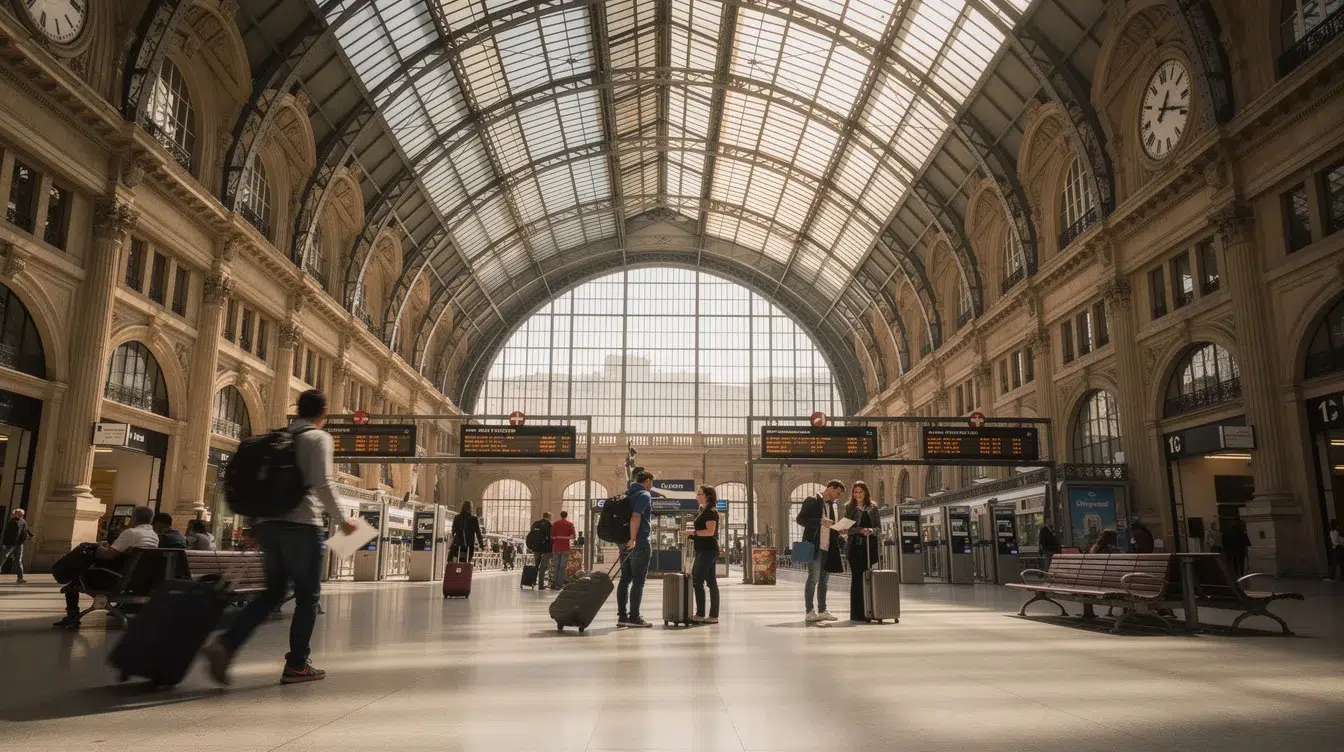

Amsterdam to Paris train in a nutshell
The fastest train from Amsterdam to Paris takes approximately 3 hours and 15 minutes, whisking you from Amsterdam Centraal till Paris Gare du Nord on a direct Eurostar high speed train. Most journeys clock in around 3 hours 20 to 3 hours 30 minutes, making rail the quickest way to travel between these two capitals when you factor in city center departures and arrivals.
Eurostar trains (formerly branded as Thalys) run this route frequently, with around 16 trains running daily between the two cities. The first train typically departs around 06:10, while the last train leaves Amsterdam around 20:10. Direct services operate roughly 8 to 10 times on weekdays, with slightly fewer options on weekends.
Train tickets from Amsterdam to Paris can start from as little as €35 when booked in advance, making early planning worthwhile. Wait until the last minute, though, and you’ll face average prices around €184 if purchased on the day. One-change options via Brussels exist using IC trains and TGV/Eurostar connections, but these stretch the journey to 4–6 hours. For pure door-to-door speed between city centres, the direct train beats flying once you add airport transfers, security queues, and boarding time into the equation.
Översikt över rutten: avstånd, varaktighet och frekvens
The rail journey from Amsterdam to Paris covers roughly 430 to 530 kilometres depending on the exact routing, with Eurostar using dedicated high-speed lines through the Netherlands (HSL-Zuid), Belgium (HSL 4), and northern France (LGV Nord). These tracks allow average speeds exceeding 200 km/h on key segments.
Eurostar operates direct high-speed services from Amsterdam to Paris, with some trains also stopping at Amsterdam Zuid or Schiphol Airport before continuing south. The Eurostar train service from Amsterdam to Paris makes limited stops at key stations including Schiphol Airport, Rotterdam Centraal, and Brussels Midi before arriving in Paris. That means you’ll cross three countries—Netherlands, Belgium, France—without border formalities under Schengen rules.
On average, train journeys from Amsterdam to Paris take around 4 hours and 21 minutes when you factor in services with multiple stops or one-change itineraries. Here’s how journey times break down:
- Fastest direct: About 3h 15–3h 25m (limited daily departures)
- Typical direct: 3h 30–3h 38m (most Eurostar services)
- One-change via Brussels: 4–6+ hours (IC to Brussels, then TGV/Eurostar onward)
Direct Eurostar frequencies are densest from late morning through mid-afternoon, with fewer evening departures available.
Timetables and daily schedules (example days in 2026)
For a typical spring weekday in April or May 2026, here’s what a journey start from Amsterdam might look like. These train times are indicative and subject to seasonal adjustments or track works:
Sample Amsterdam → Paris departures (weekday, spring 2026):
- 06:10 → arrives Paris 09:45 (3h 35m)
- 07:10 → arrives Paris 10:43 (3h 33m)
- 08:10 → arrives Paris 11:40 (3h 30m)
- 10:10 → arrives Paris 13:42 (3h 32m)
- 12:10 → arrives Paris 15:48 (3h 38m)
- 13:10 → arrives Paris 16:48 (3h 38m)
- 15:10 → arrives Paris 18:46 (3h 36m)
- 17:10 → arrives Paris 20:45 (3h 35m)
- 20:10 → arrives Paris 23:39 (3h 29m)
The fastest connection of the day typically hovers around 3h 15–3h 25m, though this varies by schedule. Southbound Paris to Amsterdam patterns run symmetrically, so if you’re planning a day trip or return rail journey, you’ll find similar durations heading back.
Weekend schedules may see the first train depart at 06:10 and the last train around 20:34. Holiday periods like Easter or summer can shift departure slots by 10–20 minutes due to track maintenance or increased demand. Always check current times for your exact departure date—the NS website and Eurostar’s platform show live timetables.
Ticket types and classes on the Amsterdam–Paris route
Eurostar offers three classes of service: Eurostar Standard, Eurostar Plus, and Eurostar Premier, each providing different levels of comfort and amenities. Let’s break down what each travel classes includes.
Eurostar Standard (second class)
In Eurostar Standard class, passengers can enjoy comfortable seating, free WiFi, and a selection of drinks and snacks available for purchase in the onboard café-bar. This is the go-to choice for budget-conscious travellers who still want a smooth ride. Your eurostar ticket includes:
- Reserved comfortable seats with decent legroom
- Free wifi (reliability varies, particularly in tunnels)
- EU power outlets at most seat pairs
- Access to the eurostar café bar for hot and cold drinks and snacks
- Generous luggage allowance: 2 large items (up to 75 cm) plus 1 small item of hand luggage
Eurostar Plus (premium economy style)
Eurostar Plus class includes all the amenities of Standard class, plus a light meal served at your seat on certain routes, providing a more comfortable travel experience. You’ll find:
- Extra legroom and quieter coaches
- Light meal or snacks at your seat (select services)
- Same luggage rules as Standard
- Priority for onboard catering service
Eurostar Premier (first class)
Eurostar Premier class offers the highest level of service, including priority boarding, access to exclusive lounges, and complimentary meals and drinks served at your seat. Business travellers and those celebrating a special trip often choose this ticket type for:
- Spacious first class seating with room to work or relax
- Hot meals and cold drinks included
- Lounge access at Amsterdam Centraal (NS International Lounge) and Paris Gare du Nord
- Free access to dedicated check-in areas
Flexibility tiers
Beyond class, your eurostar ticket comes in flexibility tiers:
- Non-flex: Cheapest option, limited changes, no refunds
- Semi-flex: Moderate fees for date/time alterations
- Fully flexible tickets: Full refunds and unlimited changes, but 2–3x the base price
If your plans are locked in, non-flex delivers the best value. Business travellers with shifting schedules should consider flexible tickets despite the premium.
Prices and how to get cheap Amsterdam–Paris train tickets
Prices for train tickets from Amsterdam to Paris can vary significantly depending on the time of day, route, and class booked, with early booking often leading to lower prices. Here’s what to expect in 2026:
- Advance promos (2–4 months out): €35–€45 one-way in Standard
- Typical bookings (30 days out): €70–€130
- Last-minute or peak: €150+ (sometimes €180–€200)
The cheapest ticket price for trains from Amsterdam to Paris is approximately $41 (around €38), while the average ticket price is around $166 (roughly €150). Same-day purchases can spike to €184 or more.
What drives the paris cost up or down?
- Booking horizon: Earlier is cheaper—best prices for Eurostar-biljetter can be achieved by booking 3–6 months in advance
- Day of week: Tuesday–Thursday typically undercuts Friday–Sunday fares
- Time of day: Midday departures often cheaper than morning rush or Friday evening trains
- Class and flexibility: Premier and flexible tickets cost significantly more
- Holidays and events: Avoid Koningsdag (April 27), Bastille Day (July 14), and school holiday weeks
- Train load factor: Dynamic pricing means popular trains fill at higher prices
Tips for cheap train tickets:
- Book as soon as schedules open (usually 3–6 months ahead)
- Opt for midweek, midday departures
- Compare the NS website, SNCF Connect, and Eurostar.com—occasional glitches or promos differ between platforms
- Consider the slower IC + TGV route via Brussels if you have time; it can save €10–20 but adds 1–2 hours
Child and youth discounts:
- Under 4: Travel free on an adult’s lap (no seat)
- Ages 4–11: Roughly 75% off when accompanied by an adult
- Ages 12–25: Youth discounts of 20–30% on select fares
Watch for day tickets or promotional periods when train companies release special offers.
How and where to book Amsterdam–Paris train tickets
Ready to buy train tickets? Here are your main channels:
Official platforms:
- NS International: Dutch national rail’s international arm; buy tickets from €35, full after-sales support
- SNCF Connect: French national rail; useful for onward French connections
- Eurostar.com: Primary site for direct amsterdam paris services
Third-party aggregators:
- Rail Europe, Trainline, Omio—multi-language interfaces, combined itineraries across train companies, but may add 5–10% markups
Physical ticket offices:
- Amsterdam Centraal main hall has NS International desks and machines for those who prefer paper tickets
Tips för bokning:
- Tickets for Eurostar are typically released 3 to 6 months in advance—set a calendar reminder to grab promos
- E-tickets and mobile QR codes work for boarding; paper is optional
- Seat reservations are compulsory on Eurostar and included in your fare—you’ll get an assigned coach and seat
- For IC legs (if booking a one-change route), reservations are often optional
Compare across sites before confirming. A five-minute check can reveal price differences of €10–20 on the same train.
Stations: Amsterdam Centraal, Schiphol, Rotterdam and Paris Gare du Nord
Amsterdam Centraal
Amsterdam Centraal is the main train station for departures to Paris, located in the heart of Amsterdam and well connected by metro, tram, and bus services. If you’re staying near amsterdam’s canals, it’s likely a short tram ride away.
Faciliteterna inkluderar:
- Left-luggage lockers (roughly €10–15 per day)
- Cafés, supermarkets, and fast food in the main hall
- NS International desk for ticket queries
- NS International Lounge for Eurostar Premier passengers
Eurostar platforms typically sit on the station’s western side, often in the mid-teens (e.g., platforms 14–15), though exact assignments vary. Passengers are advised to arrive at Amsterdam Centraal at least 20–30 minutes before departure for boarding checks. Allow extra time at rush hours or if you’re hauling heavy luggage.
Schiphol Airport and Rotterdam Centraal
Some Eurostar services stop at Schiphol Airport shortly after leaving Amsterdam—handy if you’re flying in and heading straight to Paris. Rotterdam Centraal follows, useful for travellers staying in South Holland.
Paris Gare du Nord
Paris Gare du Nord is the arrival station for trains coming from Amsterdam, and it is one of the busiest railway stations in Europe, serving over 200 million passengers annually. It sits in central Paris with excellent onward connections:
- Métro lines 4 and 5
- RER B (direct to Charles de Gaulle airport in about 30 minutes) and RER D/E
- Buses and taxis outside the main exits
- Eurostar lounges for Premier passengers
- Luggage storage, food outlets, and accessibility services
When you arrive, scan the departure boards for your platform—doors typically close 2–5 minutes before departure, so don’t linger if you’re catching an onward train to the Eiffel Tower area or beyond.
Onboard experience: seating, luggage, Wi-Fi and food
Seating and comfort
Eurostar trains provide comfortable seating with ample legroom, and passengers can bring two pieces of luggage and one small item of hand luggage without weight limits, as long as they can carry them. Seats are allocated, so you’ll know your coach and seat number before boarding. Families can request adjacent seats when booking.
Bagage
Eurostar trains are equipped with free Wi-Fi, at-seat power sockets, and a generous luggage allowance, allowing passengers to travel comfortably and stay connected during their journey. Specifically:
- 2 large items (up to 75 cm each)
- 1 small item of hand luggage
- No strict weight limit—just be able to lift bags yourself
- Strollers, carry-on instruments, and similar items usually fit within this allowance
Stow large bags in the overhead rack or at designated luggage racks at carriage ends. Keep valuables close.
Wi-Fi and power
Free wifi is available throughout the train, though internet connection can drop in tunnels between Belgium and France. Most seat pairs have at least one EU power outlets socket, so you can charge devices during the journey.
Food and drinks
Passengers can enjoy a variety of food and beverage options on board, including snacks and light meals available for purchase in the onboard café-bar. Here’s the breakdown by class:
- Standard: Visit the café bar for sandwiches (€5–10), hot and cold drinks (€3–5), and snacks. You’re welcome to bring your own food aboard.
- Plus: A light meal served at your seat on some services, plus Standard amenities
- Premier: Hot meals and drinks included, served at your seat, plus lounge access
The onboard catering team circulates regularly in premium coaches. Guide dogs and assistance dogs travel free in all classes, and small dogs may be permitted in carriers.
Tillgänglighet
Eurostar provides step-free boarding at platforms, pre-bookable assistance, wheelchair spaces, accessible toilets, and baby changing facilities. Contact Eurostar’s accessibility team when booking if you need support boarding or during the journey.
Alternatives to the direct high-speed train (slower trains, bus and flights)
Sometimes the direct Eurostar sells out or fares spike. Here’s how other options stack up:
Slower rail via Brussels
If you need to change trains, the typical routing is:
- Amsterdam Centraal → Brussels (Bruxelles-Midi) by IC or high-speed (about 2 hours)
- Brussels → Paris by TGV or Eurostar (about 1.5 hours)
- Total: 4–6+ hours depending on connection times
Ticketing can be split between Dutch IC (often no reservation needed) and Belgian/French high-speed (reservation required, €10–30). This can undercut direct fares by €10–20 but eats into your day.
Långdistansbussar
Operators like FlixBus and BlaBlaCar Bus run Amsterdam–Paris routes:
- Advance fares: €19–€30 one-way
- Journey time: 7–9 hours depending on traffic
- Comfort: Basic seating, limited legroom, rest stops
Buses suit budget travellers with time to spare. They’re not ideal for a quick day trip.
Flights
Schiphol Airport to Paris CDG or Orly takes about 1h 15m in the air. But factor in:
- Getting to Schiphol (20–30 min from city center)
- Check-in and security (1–2 hours)
- Boarding and taxi (30–45 min)
- CDG to central Paris (30–45 min)
- Total door-to-door: 4–5 hours
Airfares range €40–€200 depending on season and booking time. Flying mainly makes sense if you’re connecting to a long-haul flight.
Miljöhänsyn
High-speed rail emits roughly 10–20g CO₂ per passenger-kilometre versus 150–250g for short-haul flights. If carbon footprint matters, the train from amsterdam wins handily.
When each mode makes sense:
- Direct Eurostar: Best for speed, comfort, and city center access
- IC + TGV via Brussels: When directs are sold out or overpriced
- Buss: Lowest budget, flexible schedules, time isn’t critical
- Plane: Connecting to onward long-haul flights from CDG
Rail passes on the Amsterdam–Paris route: Interrail and Eurail
Både Interrail (för personer bosatta i Europa) och Eurail-pass (for non-European residents) are valid on the Amsterdam–Paris rail segment. But here’s the catch: you can’t just hop on a Eurostar with your pass alone.
Reservationer och tillägg
On Eurostar high-speed services, pass holders must pay compulsory seat reservations and supplements per journey. Typical 2026 costs run:
- Standard: €20–€25 per journey
- Plus/Premier: €25–€35 per journey
- Quota limits: Pass-holder seats are capped, so book early—especially in summer
On slower IC trains between Amsterdam and Brussels, Interrail and Eurail pass holders can often ride with no reservation or a low-cost fee. However, the onward TGV or Eurostar from Bryssel till Paris still requires a paid reservation (€10–€30).
Is a rail pass worth it?
Let’s compare for a single Amsterdam–Paris round trip:
- Point-to-point advance fares: €70–€100 (round trip, booked early)
- 4-day Interrail-kort + reservations: ~€200 pass + €60 reservations = €260+
For a single journey from amsterdam to paris, point-to-point tickets are usually cheaper. A rail pass delivers better value if you’re combining multiple international journeys within western europe—say, Amsterdam → Paris → Lyon → Barcelona over a week.
Quick value check:
- List all your planned trains
- Add up point-to-point advance fares
- Add pass cost + all required reservations
- Compare totals
If the pass saves money and simplifies booking, go for it. If you’re only doing the amsterdam paris round trip, skip the pass and buy tickets directly.
Practical journey logistics: check-in, security and documents
Unlike the Eurostar to London, the Amsterdam–Paris route stays within Schengen, so there’s no airport-style security or passport control. Here’s the streamlined process:
Before you board Eurostar:
- Arrive at Amsterdam Centraal 20–30 minutes before departure
- Check platform screens in the main hall for your train’s platform
- Head to the correct platform—Eurostar often departs from tracks 14–15 on the western side
- Show your valid ticket (mobile QR or printed) when boarding
- Find your assigned coach and seat
Doors close 2–5 minutes before departure, so don’t cut it too close.
Documents you’ll need:
- EU/Schengen citizens: Valid passport or national ID card
- Non-EU travellers: Passport with any required visas, plus proof of onward travel if applicable
Random security checks can happen, but they’re quick. There’s no airline-style queuing.
Tips for families and groups:
- Board early to secure overhead rack space near your seats
- Keep tickets and IDs handy for each traveller
- Agree a meeting point on the platform if anyone gets separated in busy stations
- Strollers fold and fit in luggage areas; request assistance if needed
For a good trip, build in buffer time rather than sprinting for your train.
When to travel: seasons, crowds and reliability
Peak periods to avoid (unless you plan ahead):
- Påskveckan
- July–August summer holidays
- Major events in Amsterdam or Paris (King’s Day, Bastille Day, fashion weeks)
- Jul och nyår
During these windows, fares can spike 50–100%, and trains fill quickly. If you must travel peak, book 3–6 months ahead.
Best times for value:
- Tuesday–Thursday, outside school holidays
- Shoulder seasons (early spring, late autumn)
- Midday departures rather than Friday evening or Sunday afternoon
Punctuality and disruptions
High-speed trains on this route run roughly 85–90% on time. Delays of 10–30 minutes can occur due to:
- Winter storms or summer heat affecting tracks
- Maintenance works (often overnight but sometimes daytime)
- Congestion at Brussels hub
If you’re catching an onward flight from Paris or have tight connections, build in at least 60–90 minutes of buffer, especially in winter or on busy travel days like Fridays and Sundays.
Summary: choosing the best Amsterdam–Paris option for you
The direct Eurostar delivers the smartest combination of speed, comfort, and convenience for most travellers. At 3 hours 15 to 3 hours 30 minutes city centre to city centre, it beats flying once you factor in airport time. Advance fares from around €35–€40 make it budget-friendly if you plan ahead, while Eurostar Premier satisfies those who want lounge access, hot meals, and first class space.
If direct trains are sold out or overpriced, the IC + TGV route via Brussels adds flexibility—just accept the 4–6 hour journey time. Buses work for the truly budget-conscious with time to spare, while flights mainly make sense for onward long-haul connections.
Rail pass holders can use Interrail or Eurail pass on this route, but remember the €20–€35 reservation supplement per Eurostar journey. Passes shine when you’re stringing together multiple destinations across western europe; for a single amsterdam paris return, buying tickets directly is usually cheaper.
Whatever you choose, book early, travel midweek if you can, and arrive at the train station with time to spare. From amsterdam’s canals to the boulevards of Paris, this rail journey ranks among the smoothest in Europe—no passport queues, no security theatre, just a comfortable seat and the scenery of three countries rolling past your window. Check train times, compare your options, and paris leave awaits.