


If you’re searching for the thalys train, here’s what you need to know: since October 2023, those distinctive red höghastighetståg now operate under the eurostar name. The routes haven’t changed, the trains look the same, and the service remains excellent – it’s just the branding that’s different. Let’s walk through everything you need to plan and book your journey with confidence.
Quick facts: what “Thalys” is today
Thalys was the red high-speed train network connecting major cities across western europe for nearly three decades. Since 1 October 2023, it operates under the Eurostar brand – sometimes called “Eurostar Red” to distinguish it from the London services.
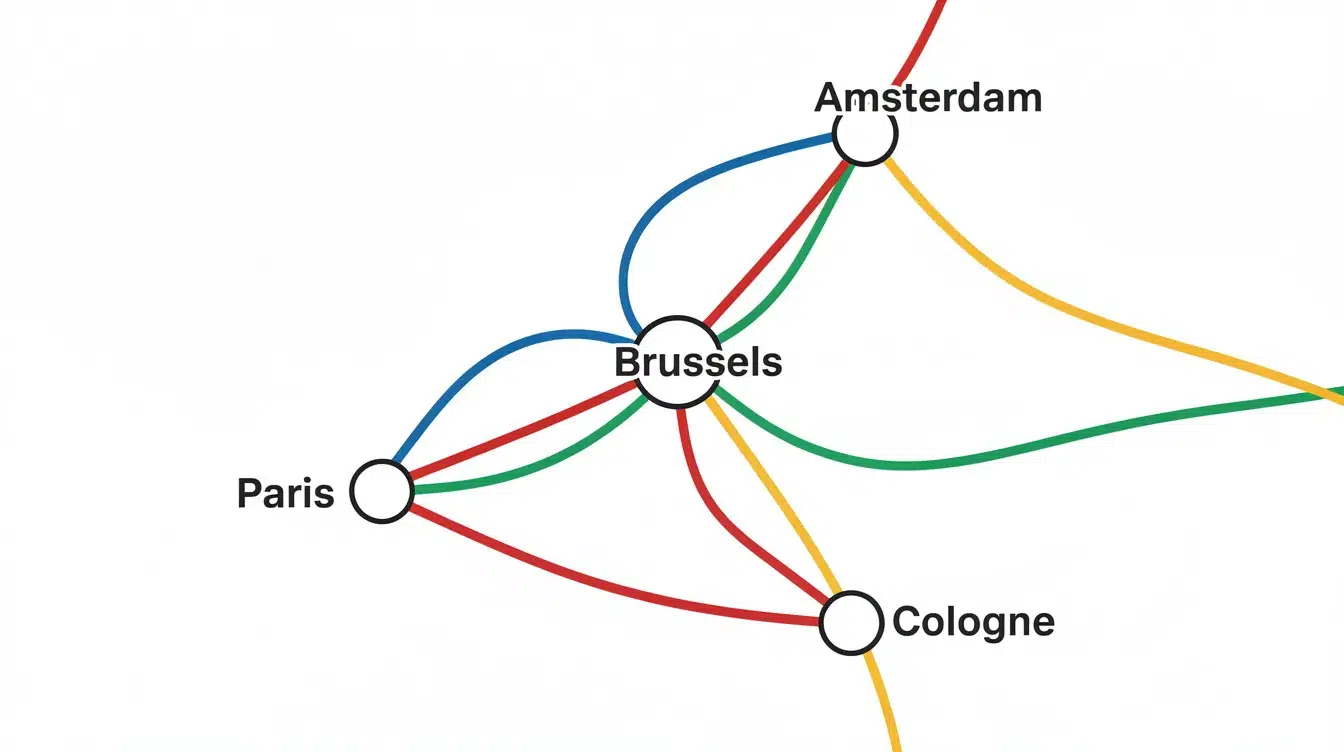
The thalys routes are unchanged. Direct connections still link Paris, Brussels, Amsterdam, Rotterdam, Antwerp, Liège, Aachen, and Cologne, plus seasonal Alps services in winter. For planning and booking, you’ll see “Eurostar” on tickets and at stations, but most people still search for “Thalys train” when looking for these services.
This guide focuses on mainland Eurostar services (the former Thalys network covering paris brussels amsterdam and Germany), not the London–Paris/Brussels Tunnel services which have different check-in and border controls.
Core corridor at a glance:
- Paris Gare du Nord
- Brussels-Midi/Brussel-Zuid
- Antwerp-Centraal
- Rotterdam centrum
- Amsterdam Centraal
- Plus: Liège-Guillemins, Aachen, Köln Hbf
Background: from Thalys launch to the Eurostar merger
The network emerged from a Franco-Belgian high-speed project in the 1990s. On 4 June 1996, the first Thalys-branded train departed Paris, reaching Brussels in two hours and seven minutes and Amsterdam after four hours and 47 minutes – slower than today because high-speed lines were still under construction.
Key dates:
- 1996: Commercial services start linking Paris, Brussels, Amsterdam, and Cologne using Alstom TGV-style trains
- December 1997: Belgium’s HSL 1 high-speed line opens, cutting Paris–Brussels to about 1h25
- 2009: Dutch HSL-Zuid opens, improving Amsterdam journey times
- 2015: Thalys restructured as an independent operator headquartered in Brussels
- 2020: Green Speed project confirmed – plan to merge Thalys med Eurostar
- 2022: Formal merger creating one eurostar group across five countries
- 2023: Rebranding begins; red trains now carry the eurostar name
The fleet still consists of 27 Alstom TGV-tåg, and over its lifetime the railway carried more than 155 million passengers. The loyalty scheme thalys world has been integrated into Club Eurostar, and services like lounges and free wifi were retained or enhanced.
Network overview: where the former Thalys trains run
Think of this network as a fast, city-centre-to-city-centre alternative to flying within north-western Europe. You arrive at central stations, not distant airports – and there’s no security queue eating into your day.
Core international routes:
- Paris ↔ Brussels: Almost all trains non-stop on the high-speed line
- Paris ↔ Amsterdam: Via Brussels, Antwerp & Rotterdam
- Paris ↔ Cologne: Via Brussels, Liège & Aachen
- Brussels ↔ Amsterdam/Rotterdam: Direct services without going via Paris
Typiska restider:
- Paris–Brussels: about 1h22–1h25
- Paris–Amsterdam: around 3h20
- Paris–Cologne: about 3h20–3h25
- Brussels–Amsterdam: roughly 1h50–2h00
Seasonal services:
- Vinter: Eurostar Snow (successor to thalys neige) runs to the french alps – Chambéry, Albertville, Moûtiers, Aime-La-Plagne, Bourg-St-Maurice – from roughly December to April
- Summer: Historical thalys sun / eurostar sun services to destinations in south France (Marseille, Avignon) may operate depending on the year
Some trains call at secondary stops. Check current timetables for specifics on airport stations and smaller cities served.
Ticket classes and what you get on board
Eurostar (formerly thalys) offers three travel classes, and every train ticket includes compulsory seat reservation. No standing, no scrambling for seats.
Standard (2:a klass):
- 2+2 seating layout with modern, comfortable seats
- Free Wi-Fi and power sockets at most seats
- Access to café-bar or trolley service only – no complimentary food
- Cheapest fares often “Mini” type: non refundable, limited changes
- More flexible Standard fares available with partial refundability
Plus (1st class, no meal):
- 2+1 seating for extra space and a quieter atmosphere
- Recommended for leisure travellers wanting more comfort
- Free Wi-Fi, power sockets, larger seats
- Access to Eurostar lounges at certain stations (Amsterdam, Rotterdam, sometimes Brussels)
Premier (top 1st class):
- 2+1 seating with the most legroom, quieter cars
- At-seat meal service included – hot or cold dishes depending on time of day, plus drinks
- Access to lounges in major hubs: Paris Gare du Nord, Brussels-Midi, Amsterdam Centraal
- Most flexible tickets: usually fully refundable and exchangeable up to departure
Every class has reserved seating, luggage is not weighed, and there’s no separate “business-only” train – just different comfort and flexibility levels within the same service. Names and fine print may evolve, but the three-tier structure remains consistent.
How and where to book: websites, apps and rail passes
Advance booking is essential. All seats are reservable, and the cheapest fares sell out first. Let’s break down your options.
Main booking channels:
- Eurostar website (eurostar.com) and app: Primary source, no booking fee, lets you choose exact trains, seats and classes
- SNCF Connect (France): For journeys combining Eurostar with French domestic TGV/TER
- SNCB/NMBS International (Belgium): For itineraries from Belgian cities
- NS International (Netherlands) and deutsche bahn / DB Navigator (Germany): For connections from Dutch or German cities to the high-speed core
- Pan-European retailers (Trainline, Rail Europe): Useful when combining multiple operators; small booking fee applies
Booking horizon and pricing:
- Tickets usually open around 4 months before departure (sometimes 3–6 months)
- Dynamic pricing: fares start low and increase as trains fill
- Cheapest “Mini” fares are restrictive but ideal for fixed plans
Rail pass validity:
- Most Interrail/Eurail passes do NOT include free travel on Eurostar
- A mandatory seat reservation and pass holder supplement is required
- Quotas exist per train – book early during peak periods
- Check Eurostar’s “pass holder” section for current rules
Advance-purchase guidance:
- Peak periods (Christmas markets, summer Fridays, school holidays): book tickets 2–3 months in advance
- Quieter mid-week trains: 2–4 weeks ahead often yields reasonable fares, but not guaranteed
Typical fares on key city pairs
Prices vary by date, demand, and class. These are approximate one-way fare ranges for Standard class – verify close to your travel date.
Standard class ballpark fares:
- Paris-Bryssel: €29–€35 advance Mini deals up to €120–€140 for fully flexible
- Paris-Amsterdam: €35–€40 up to €150–€160 on busy days
- Paris–Cologne: €35–€45 up to €150–€160
- Brussels–Amsterdam: €25–€30 up to €90–€110
Higher classes:
- Plus typically costs 20–60% more than equivalent Standard on the same train
- Premier can be significantly higher – sometimes double Standard – but includes meals, lounges, and full flexibility
Value tips:
- Travel outside rush hours (mid-morning, early afternoon, mid-week) for better prices
- Booking returns doesn’t automatically give discounts – each leg is priced separately
- Consider mixing classes: Standard outbound, Plus return
- Kids, youth, and senior fares may exist; confirm current age limits
On-board experience: seats, Wi-Fi, luggage and catering
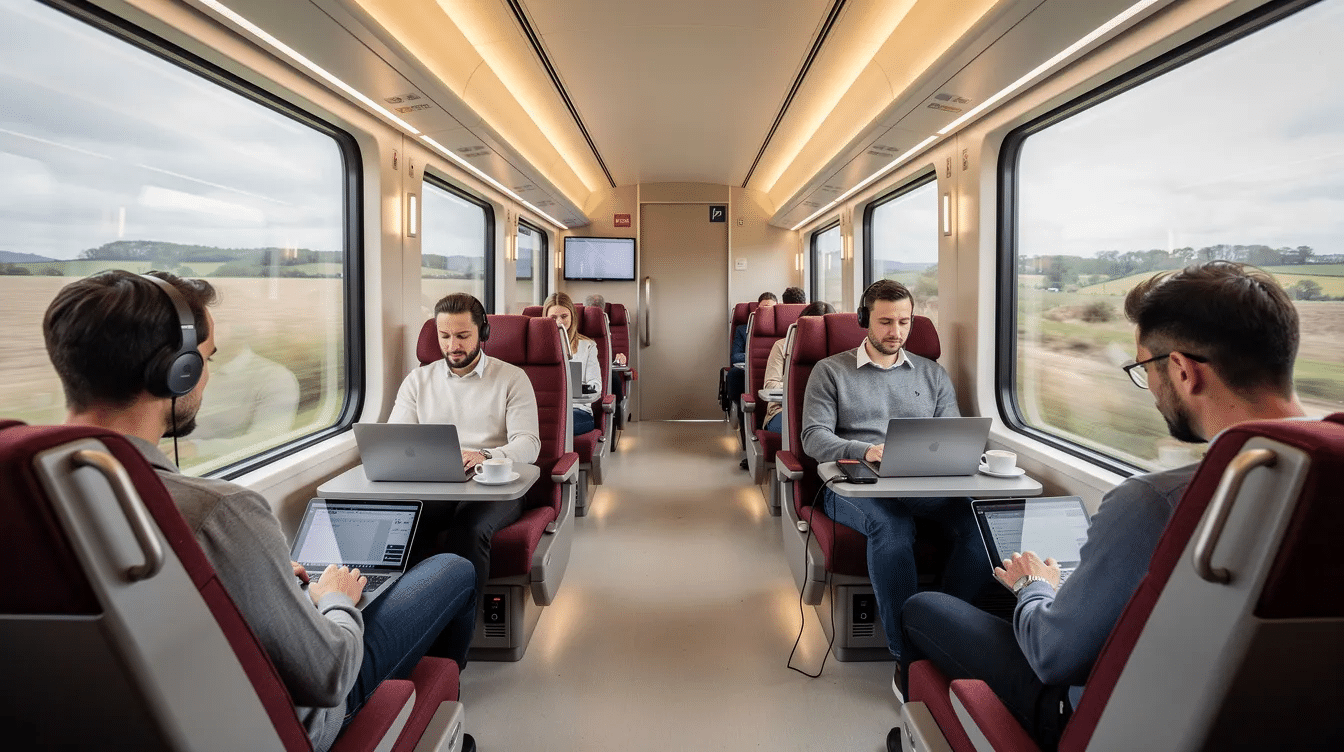
Modern high speed train travel with comfortable seating, connectivity, and a quieter experience than flying. Here’s what to expect when you board.
Seating and layout:
- 2+2 in Standard, 2+1 in Plus/Premier
- Refurbished “Ruby” interiors on most sets: red and grey colour scheme, improved lighting
- Tables for 4 available; some “duo” face-to-face arrangements in higher classes
Anslutningsmöjligheter och strömförsörjning:
- Free wifi for all classes – good for browsing, email, light streaming
- Individual or shared power sockets (EU standard) at most seats
- Bring a multi-plug or USB adapter if you have multiple devices
Bagage:
- No formal weight limits, no check-in – carry bags on board
- Overhead racks for small suitcases and backpacks
- Larger racks at carriage ends for big cases
- Label your luggage and keep valuables close when storing bags away from your seat
Catering:
- Café-bar car (or vending machines/trolley on some sets) offers drinks, snacks, sandwiches – paid separately in Standard/Plus
- Premier includes at-seat food service: continental breakfast, light meals, wine and soft drinks
- Vegetarians, vegans, and those with dietary needs should check menu options and bring backup snacks
Other practicalities:
- Air conditioning throughout – temperatures can feel cool, so pack a light layer
- Quiet atmosphere compared with planes; phone calls allowed but keep them considerate
- Bicycles: folding bikes usually fine if bagged; full-size bikes subject to quotas and conditions (check Eurostar bike policy)
Key departure stations and how to use them
A quick station-by-station guide for first-time users.
Paris Gare du Nord:
- Eurostar (ex-Thalys) trains depart from upper-level platforms, clearly signed
- Arrive 30–40 minutes before departure to find your platform, grab food, and board without rush
- Facilities: ticket machines, counters, cafés, pharmacies, ATMs
- Metro/RER connections: lines 4 & 5, RER B & D
- Eurostar lounges for eligible passengers on a dedicated mezzanine near departure area
Brussels-Midi / Brussel-Zuid:
- Main international hub for both Paris and Amsterdam/Cologne services
- Arrive 20–30 minutes early; platforms are long and can be busy
- Domestic connections: frequent InterCity trains to Brussels-Central, Ghent, Bruges, Antwerp, Liège
- Facilities: shops, supermarkets, luggage lockers, information desks
- Lounges and Eurostar areas signposted for international services
Amsterdam Centraal:
- High-speed trains use specific tracks; signage shows “Eurostar” or train number
- Arrive 20–30 minutes ahead; compact station but busy with commuters
- Tram, metro, and ferry connections just outside
- Eurostar lounge for eligible passengers with Wi-Fi, drinks, workspaces
Generic station tips:
- Check departure boards for train number as well as destination – multiple services may leave close together
- Print or save digital tickets offline; station Wi-Fi can be patchy
- Families and travellers with reduced mobility: arrive earlier to request assistance
Comparing Eurostar (ex-Thalys) with flying and national trains
For paris brussels and onward to Amsterdam or Cologne, high-speed rail is usually the most convenient – and often the fastest – city-centre option.
Versus flying:
- Door-to-door time favours trains: no airport transfers, shorter security, central station arrivals
- More generous luggage norms, less waiting – boarding starts ~15–20 minutes before departure
- Lower CO₂ emissions per passenger compared with short-haul flights
Versus separate tickets on national/intercity trains:
- Slower IC trains via borders can be cheaper but take 1.5–2× longer
- Eurostar gives reserved seats, guaranteed direct connections, simpler ticketing
- Rail pass holders can use regional trains to avoid reservation fees – at the cost of time and extra changes
Tumregel: For direct links between Paris, Brussels, Amsterdam, Rotterdam, Antwerp, Liège, Aachen, and Cologne, Eurostar (the same company now operating what was formerly thalys) delivers the best blend of speeds, comfort, and total travel time. Alternative modes – low-cost airlines, long-distance buses, slower trains – make sense primarily for very tight budgets or off-corridor journeys.
With clear travel classes, transparent pricing, and straightforward online booking, you can plan your trip across countries served by this network with confidence. Head to eurostar.com to check current timetables and fares, book early for popular routes, and enjoy the ride.