



Lithuania’s rail system has come a long way from its 19th-century origins. Today, modern trains connect the country’s major cities—Vilnius, Kaunas, and Klaipėda—while international routes reach Warsaw, Kraków, and Riga. Lithuania’s railway network is considered the most modern among the Baltic states and spans a total length of 1,868.8 km as of 2021. Whether you’re a first-time visitor or a seasoned traveler exploring the Baltic countries, understanding how trains work in Lithuania will save you time, money, and hassle.
This guide covers everything you need to know: from domestic routes and ticket booking to Eurail passes and the ambitious Rail Baltica project that’s reshaping the region’s rail future. Lithuania’s railways connect to the wider world, but recent geopolitical events, such as the war in Ukraine, have influenced some international train services, including changes to routes between Vilnius and Moscow.
Overview of trains in Lithuania
Lithuania has a modern, fast-improving rail system linking Vilnius, Kaunas, Klaipėda, and international destinations such as Warsaw, Kraków, and Riga. The network has undergone significant modernization in recent years, with new trains, upgraded infrastructure, and improved passenger services making rail travel increasingly attractive.
LTG Link is the main passenger operator, managing most domestic and international routes. The majority of long-distance services start from Vilnius railway station, which opened in 1862 and has been rebuilt and modernized several times since.
What to Expect from a Lithuanian Train Journey
-
Trains are generally punctual, clean, and comfortable
-
Free Wi-Fi and power sockets are available on main intercity routes
-
Air-conditioning is standard on modern rolling stock
-
Fares are often cheaper than intercity buses for equivalent routes
-
Journey times between major cities are competitive with road travel
Compared to buses, trains offer more legroom, quieter cabins, and the ability to move around during your journey—making them the preferred choice for many travelers.
Key domestic train routes in Lithuania
Most travelers use trains to move between Vilnius, Kaunas, Klaipėda, and Šiauliai. These routes form the backbone of the Lithuanian rail network and serve millions of passengers annually.
Main Domestic Connections
-
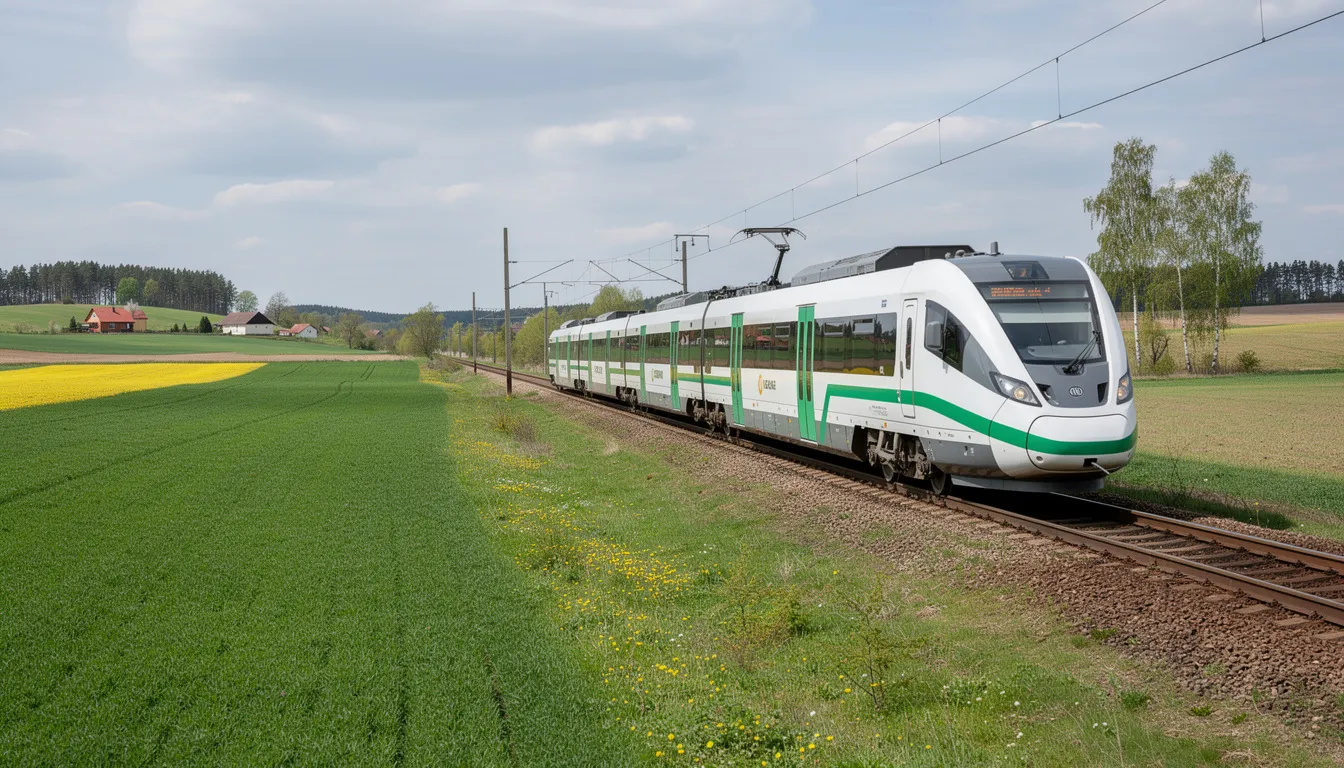
Vilnius–Kaunas route: With a length of 104 km, this is Lithuania’s busiest rail corridor, popular with commuters and day-trippers alike. Journey time is approximately 1 hour 05 minutes to 1 hour 20 minutes. Up to 18–20 departures per day on weekdays. Operated primarily with modern Škoda EJ575 electric units and Pesa trains.
-
Vilnius–Klaipėda route: The main long-distance domestic route, with a length of 376 km and a journey time of approximately 4 hours 10 minutes to 4 hours 25 minutes. Usually 3–4 departures per day, with the morning train (05:22 departure) being particularly popular in summer. Operated with Pesa diesel multiple units. This is the key route for reaching the Baltic coast and Curonian Spit. During summer, bus transfers are available from Klaipėda to Nida and Palanga.
-
Vilnius–Šiauliai route: Approximately 2 hours 15 minutes to 2 hours 40 minutes. Used for connections toward Riga and for visiting the famous Hill of Crosses (short bus or taxi link from Šiauliai station).
-
Kaunas–Klaipėda and Šiauliai–Klaipėda services: These routes connect inland Lithuania with the seaside, offering alternatives to traveling via Vilnius. Useful for travelers coming from the west or north of the country.
Sample Departure Times (Vilnius–Klaipėda)
-
05:22 (early bird, often sells out in summer)
-
10:15
-
14:30
-
18:45
Times are indicative—always check current timetables on ltglink.lt before travel.
Reservations, tickets and LTG Link
Tickets for all Lithuanian train services can be purchased through LTG Link’s website (ltglink.lt), the mobile app (available on iOS and Android), or at station ticket offices across Lithuania. The booking process is straightforward, and English language support is available. Booking early is important to secure availability and better prices, especially on popular routes.
How to Buy Tickets
-
Create an account on ltglink.lt or open the LTG Link app.
-
Select your route and travel date.
-
Choose your seat.
-
Complete payment.
-
Receive an e-ticket to display on your phone—no need to print.
Buying tickets online or in the app is usually slightly cheaper than purchasing at the station due to service fees.
Mandatory Reservations
-
Advance seat reservations are required for some first-class domestic services and all international routes, including Vilnius–Riga–Valga and the Vilnius–Poland connection (Vilnius–Mockava–Białystok–Warsaw–Kraków), due to high demand.
-
Reservations are mandatory for international train routes from Vilnius, including to Riga and Warsaw.
-
For busy domestic routes like the early-morning Vilnius–Klaipėda, booking in advance is strongly recommended—seats can sell out days ahead during summer.
Refunds and Changes
-
Standard LTG Link tickets typically allow one time change before departure.
-
Refunds are possible with a fee (usually around 10%) if cancelled in advance.
-
Conditions vary by fare type, so check the specific terms when booking.
Seasonal Promotions
LTG Link regularly runs campaigns offering significant discounts. Past examples include a “LIEPA” code for 40% off Saturday travel in July. Check the LTG Link campaigns page for current offers—you can save substantially by timing your travel right.
Indicative Fares (2nd class, as of early 2024)
-
Vilnius–Kaunas: approximately €6–8
-
Vilnius–Klaipėda: approximately €18–24
Prices vary based on departure time and how far in advance you book.
International trains from Lithuania
Lithuania is linked by rail with Poland and Latvia, providing gateways to the wider European railway network including Germany, Czechia, and beyond. International rail travel from Vilnius has become increasingly practical for those wanting to explore Europe by train.
Vilnius–Warsaw–Kraków IC Connection
-
This through service uses a combination of Lithuanian stock and a Polish train with comfortable, air-conditioned Polish IC coaches offering amenities such as power sockets and Wi-Fi.
-
The train crosses the Lithuanian-Polish border at Mockava, where a gauge break is handled without passengers needing to change trains.
-
Journey time from Vilnius to Warsaw is approximately 7 hours and costs around €29; Vilnius to Krakow takes around 10–11 hours.
-
Reservations are mandatory for these international routes. This route operates with through tickets that can be purchased on ltglink.lt. First class on Lithuanian trains includes drinks and snacks for sale.
Vilnius–Riga–Valga Route
-
Operated by LTG Link diesel units, this service typically runs as a through connection without requiring a transfer.
-
Travel time from Vilnius to Riga is roughly 4 hours 15 minutes to 4 hours 30 minutes.
-
This is a daily connection that allows travel to Tallinn with one change at Valga, where passengers can connect to Elron trains serving Tartu and Tallinn in Estonia.
Onward European Connections
-
From Warsaw, direct trains run to Berlin, Vienna, Prague, Bratislava, Budapest, and other major cities.
-
For example, travel from Vilnius to Berlin typically involves an overnight stop in Warsaw, with fares starting at €15.90.
-
This makes Vilnius a viable rail gateway to Western and Central Europe for travelers who prefer train over plane.
Important Note
Timetables and border-crossing conditions can change due to infrastructure works, seasonal adjustments, or geopolitical factors. The war in Ukraine has affected train services and travel options between Vilnius and Moscow, with disruptions due to sanctions and the conflict in Ukraine. Always verify current schedules before travel at ltglink.lt and the Polish operator PKP Intercity.
Interrail & Eurail passes in Lithuania
Lithuania is fully included in both Interrail (for European residents) and Eurail (for non-European visitors) pass schemes, making it straightforward to incorporate Lithuanian trains into a broader European rail adventure.
Interrail Lithuania One Country Pass
-
Offers unlimited travel on consecutive or flexible days within Lithuania. Ideal for intensive rail touring between Vilnius, Kaunas, Klaipėda, Šiauliai, and regional lines.
-
Current price bands (approximate):
-
Youth (up to 27): from €59 for 3 days
-
Adult: from €79 for 3 days
-
Senior (60+): from €71 for 3 days
-
Interrail/Eurail Global Pass
-
Valid in 33+ European countries including Lithuania.
-
Perfect for journeys spanning multiple countries such as Tallinn–Vilnius–Warsaw–Berlin on a single pass.
-
Particularly good value if you’re connecting through three countries or more.
Pass Validity and Reservations
-
Passes cover both domestic and international LTG Link services.
-
A separate seat reservation is required on some routes, including Vilnius–Riga–Valga and the Vilnius–Poland IC connection.
-
Reservations can be booked directly on ltglink.lt or through Eurail partner agencies.
Discounts and Family Travel
-
Standard reductions apply for youth (up to 27), seniors (60+), and children.
-
Families benefit from “kids travel free or reduced” policies under most pass schemes.
-
Children under 4 travel free; those aged 4–11 typically receive substantial discounts.
Trains, comfort and onboard experience
Riding Lithuanian trains today is a pleasant experience, especially on the main intercity routes. Modern rolling stock dominates the busiest corridors, while some regional lines use older but refurbished equipment.
Main Train Types in the Fleet
-
Škoda EJ575 electric units: Introduced in 2022, these serve the electrified Vilnius–Kaunas route. Fast, quiet, and comfortable with modern interior design.
-
Pesa 730M diesel units: Workhorses on routes like Vilnius–Klaipėda and Vilnius–Riga. Reliable with good comfort levels for medium-distance travel.
-
Upcoming Stadler FLIRT electric trains: Expected to enter service from around 2025 as electrification expands across the network.
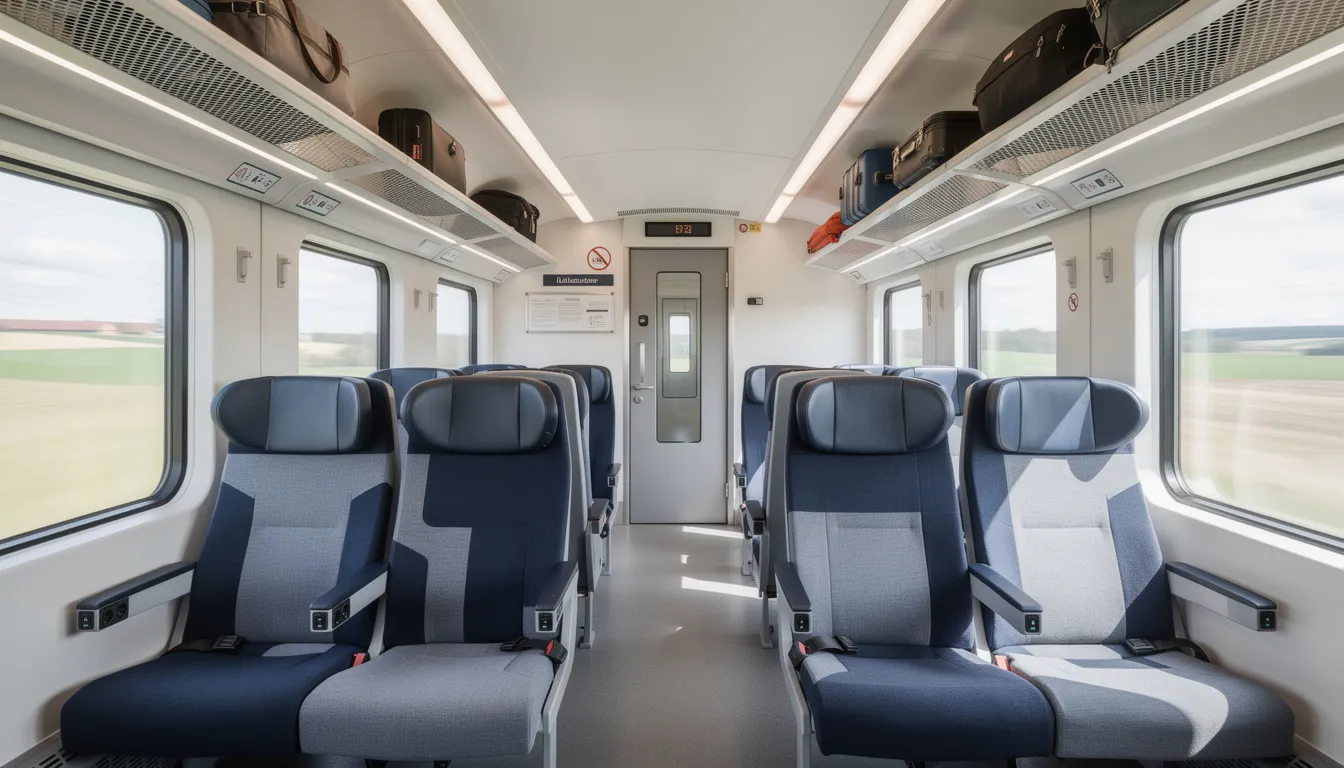
Onboard Amenities
-
Free Wi-Fi on most intercity trains
-
Power sockets at each pair of seats
-
Air-conditioning
-
Clean toilets
-
Overhead luggage racks
-
Trolley service or small buffet offering drinks, snacks, and coffee—with the usual selection of bars and light refreshments
First Class vs Second Class
-
First class offers extra legroom, quieter carriages, and sometimes complimentary water or snacks.
-
The price difference is typically 30–50% higher than second class.
-
For journeys under two hours, most travelers find second class perfectly adequate.
Accessibility Features
-
Many newer units feature low-floor entry, designated wheelchair spaces, priority seating, and bicycle storage.
-
Passengers with reduced mobility should request assistance in advance through LTG Link—staff can arrange boarding help at staffed stations.
Rail infrastructure, history and future projects
Lithuania’s railway history stretches back to the Russian Empire era, and the network is now undergoing a major transformation toward European standards. Understanding this context helps explain both current limitations and exciting developments ahead.
Early History
-
Construction of the first railway line began in 1859 as part of the Saint Petersburg–Warsaw railway.
-
The first train arrived in Vilnius from Daugavpils on 17 September 1860.
-
The first commercial operation began between Kaunas and Eydtkuhnen in East Prussia on 11 April 1861, initially serving 21 stations.
-
The greatest expansion of the railway happened during 1857–1914, when nearly two thirds of the network was constructed.
-
Trams also played a role in Lithuanian rail history, with historical tram operations in cities and ongoing discussions about modern urban tramways as part of the country’s evolving transit infrastructure.
Current Railway Network
-
Approximately 1,900+ km of track, historically using broad gauge (1,520 mm) inherited from imperial times.
-
About 10–15% of the network is currently electrified, but major projects are underway to increase this share significantly by the early 2030s.
-
The first electric train began service on 29 December 1975 after the electrification of the Vilnius–Kaunas line.
Rail Baltica Project
-
A new standard-gauge high-speed line capable of 249 km/h for passenger trains, connecting Warsaw–Kaunas–Vilnius–Riga–Tallinn.
-
Construction in Lithuania began in 2020, and as of 2023, project completion is scheduled for 2030, with some sections expected to start services in 2028.
-
Key sections are planned to be completed in phases, marking significant milestones for the project.
-
Expected benefits include Vilnius–Kaunas travel time of approximately 38 minutes and dramatically faster access to Poland and the rest of Europe.
European Standard Gauge Conversion
-
Following 2022 EU proposals and recent geopolitical shifts, Lithuania has a long-term strategy to migrate key corridors from broad to standard gauge.
-
This fifth major gauge change in the country’s history will improve interoperability with neighboring EU countries.
Heritage Narrow-Gauge Railway
-
The historic narrow-gauge line (750 mm) in the Aukštaitija region operates tourist services during summer months.
-
Running from the Panevėžys area, this cultural heritage railway offers themed rides on historic rolling stock—a charming glimpse into Lithuania’s rail past.
-
The narrow gauge railway was declared a heritage railway in 1996.
Following the independence restoration in 1991, Lithuania began gradual modernization of its railway network.
Connections with airports, ports and neighbouring countries
Trains in Lithuania integrate smoothly with airports, Baltic Sea ferries, and cross-border transport, making multimodal travel straightforward for international visitors.
Vilnius Airport Rail Link
-
A quick shuttle ride of approximately 7 minutes connects Vilnius main station with Vilnius Airport station.
-
Departures run several times per hour during daytime (typically every 10–15 minutes in peak periods).
-
The fare is remarkably low—around €0.90–1.00.
-
This makes the train the fastest and cheapest transfer option for arriving and departing passengers.
Klaipėda Seaport Access
-
Trains from Vilnius to Klaipėda or Kaunas to Klaipėda bring you to the port city, from where ferries depart for Kiel in Germany and Karlshamn in Sweden.
-
Klaipėda train station is a short bus or taxi ride from the ferry terminals—allow 15–20 minutes for the transfer.
Rail Links to Poland
-
Via Mockava/Šeštokai toward Białystok and Warsaw, this route forms Lithuania’s primary standard-gauge connection with the EU rail network.
-
The cross-border service makes it possible to travel from Vilnius to major European cities without flying.
Rail Links to Latvia
-
Two main corridors serve Latvia—via Šiauliai–Joniškis–Jelgava and the direct Vilnius–Riga–Valga line.
-
Service frequency and exact routes may vary based on ongoing infrastructure works and Rail Baltica construction phases.
-
The Vilnius–Riga connection remains the most practical option for most travelers heading north.
Practical tips for travelling by train in Lithuania
This final section serves as a quick checklist for smooth train journeys across the country. Keep these tips in mind when planning your trip.
-
Buy early for peak dates: Summer weekends, public holidays (around 11 March, 6 July, 15 August), and Friday evenings see high demand. Seats on popular trains like the 05:22 Vilnius–Klaipėda can sell out days ahead. Book as soon as your plans are confirmed.
-
Use the LTG Link app: The official app provides real-time platform information, delay notifications, seat reservations, and QR-code tickets. Avoid third-party resellers that charge extra fees—ltglink.lt and the app always offer the best prices.
-
Station etiquette: Arrive 10–15 minutes before departure. Check departure boards (displayed in Lithuanian and English at major stations). Smaller stations may have limited staff and facilities, so have your ticket ready on your phone.
-
Luggage and bikes: Luggage limits are generally generous for personal bags and suitcases. Bicycle spaces are limited and often require a small supplement ticket—book in advance if cycling is part of your plan. Store bags in overhead racks or designated luggage areas.
-
When trains are full: If your preferred service is sold out, consider long-distance buses (companies like Lux Express run parallel routes), car-sharing services, or adjusting your route via Kaunas or Šiauliai. Sometimes a different departure time solves the problem.
-
Download timetables offline: Network coverage can be patchy in rural areas. Screenshot or save your ticket and route map before boarding, especially for journeys to smaller destinations.
Lithuanian railways have evolved from their 19th-century origins into a modern, efficient transport system connecting the country internally and linking it to Europe. With Rail Baltica on the horizon, travel times will shrink further, and integration with the continental network will only improve.
Whether you’re commuting between Vilnius and Kaunas, heading to the coast at Klaipėda, or embarking on a cross-border journey to Warsaw or Riga, trains offer a comfortable, affordable, and scenic way to explore Lithuania and beyond.
Head to ltglink.lt, download the app, and start planning your journey.