

Did you know? Train travel in Europe is one of the safest and most convenient ways to explore the continent. But staying safe and keeping your belongings secure requires some preparation and awareness.
Here’s what you need to know:
- Stay Alert: Pickpockets target distracted tourists. Keep your valuables hidden, use a money belt, and avoid leaving bags unattended.
- Plan Ahead: Arrive early, study station layouts, and know your platform in advance to avoid confusion and reduce stress.
- Secure Your Belongings: Use luggage locks, keep essentials (passport, tickets) in a small daypack, and store larger bags where you can see them.
- Watch for Scams: Be cautious of distractions like spills or unsolicited help. Only buy tickets from official sources.
- Use Station Security Features: Major hubs have CCTV, security personnel, and emergency help points. Smaller stations may lack these, so stay extra vigilant.
Quick Tip: Always save emergency numbers like Europe’s 112 and station-specific safety contacts on your phone.
How to Navigate Crowded Train Stations
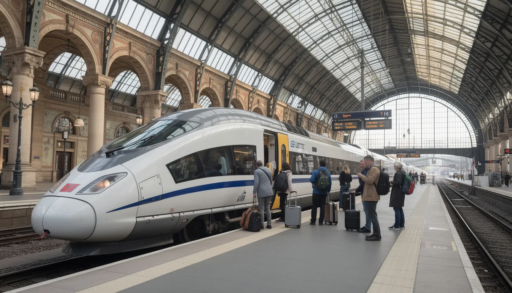
European train stations can feel chaotic, especially during peak hours. The trick to handling these bustling hubs is preparation and staying aware of your surroundings. Unlike airports, train stations often have fewer security checks, so it’s important to move with purpose and remain alert.
Reading Station Layouts and Signs
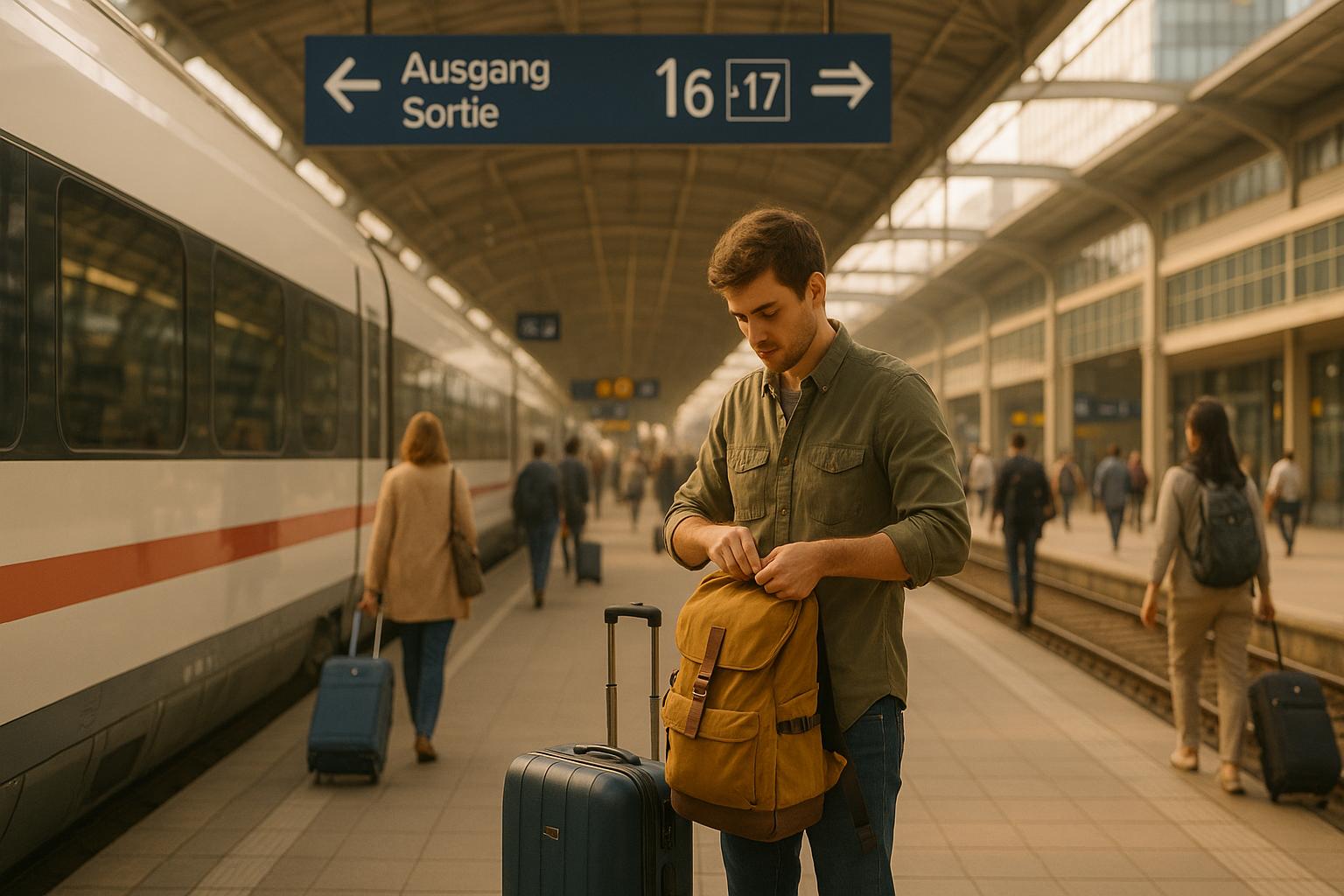
Arriving early is key – plan for at least 30 minutes before your departure, and allow extra time for services like Eurostar. Keep in mind that departure platforms are usually announced only 10–20 minutes before the train leaves. Use this waiting time to familiarize yourself with the station layout. Smaller digital boards near entrances or information desks can often be easier to read than the large central boards [3].
Pay attention to your train number rather than just the destination, as several trains might head to the same city throughout the day. Some stations even display carriage layouts on departure boards or platform signs, showing where to stand for your specific coach [3].
“Take five minutes the night before to familiarise yourself. It’ll save time and reduce stress when you’re navigating the station with bags in tow.”
– Mihaela Claudia Puscas [3]
Apps like Rail Planner can provide real-time updates, but it’s smart to carry a printed copy of your ticket as a backup. If you’re unsure about directions, don’t hesitate to ask station staff.
Once you’ve got the layout down, shift your focus to staying safe in the crowd.
Staying Safe in Crowded Areas
Busy train stations are prime spots for pickpockets. Keep your valuables completely out of sight – if there’s nothing visible to steal, you’re already ahead. Important documents like passports and tickets are best stored in a money belt worn under your clothing [4][2].
Walk confidently and avoid looking lost or distracted, as thieves often target people who seem unsure. Plan your route in advance, keep your phone tucked away when possible, and avoid stopping abruptly in busy areas to check maps or tickets [4].
Be cautious of unusual distractions or commotions. Pickpockets often work in teams, creating scenes to divert attention while an accomplice targets your belongings [2]. If something feels off, stay focused and keep moving.
Travel light to stay agile. A small backpack or daypack for essentials, worn in front of your body, can make you less vulnerable [4][2]. Never leave your bag unattended, even for a moment [2].
Carry a small amount of cash in an easily accessible pocket for quick purchases, but keep the majority of your money and important documents secured in your money belt. Photocopy key documents and store the copies separately from the originals [2].
Traveling During Rush Hours
Navigating rush-hour crowds requires extra planning. Use your knowledge of the station layout to position yourself strategically on platforms. Many stations have signs marked with letters (A, B, C) that correspond to train car positions. Standing in the right area can help you board efficiently when the train arrives [3].
Stay alert during these busy times. The crowded environment can increase the risk of theft or accidents, so avoid stopping in walkways to check your phone or ticket. Keep moving with purpose to minimize potential issues [2].
How to Secure Your Luggage and Belongings
Once you’ve figured out how to navigate train stations, the next priority is keeping your luggage and valuables safe. Whether you’re storing bags temporarily, traveling between destinations, or waiting for long periods, having a solid plan for securing your belongings can make your journey much smoother. While luggage theft on trains isn’t common, taking a few smart precautions can help you travel with confidence.
Using Luggage Storage Options
Many major train stations across Europe provide luggage storage services, either through automated lockers or staffed left-luggage offices [5]. Look for signs featuring a suitcase with a key – these indicate self-service lockers. Some stations even let you reserve lockers online, which can be a lifesaver during peak travel times.
Here’s a quick look at typical locker prices in major European train stations:
| Station | Small Locker | Medium/Large Locker | Duration |
|---|---|---|---|
| London St Pancras | $9.50 (3 hours) | $19 (24 hours) | Up to 24 hours |
| Paris stations | $6 | $8.50–$10.50 | Up to 48 hours |
| Brussels Midi | $7 | $10–$15 | Up to 24 hours |
| Amsterdam Centraal | $11 | $16–$22 | First 24 hours |
| German stations | $4.50 | $6.50 | Per 24 hours |
While these storage options are perfect for non-essentials like clothing or souvenirs, always keep high-value items – like electronics, jewelry, or passports – with you. If you’re staying at a hotel, check if they offer luggage storage after checkout. This can be a convenient and budget-friendly alternative.
Protecting Valuables and Important Items
For your most important belongings, a small daypack or pouch that stays with you at all times is a must. Pack essentials like your passport, train tickets, wallet, phone, and any electronics in this bag.
When you board the train, try to store larger luggage in the overhead rack across the aisle from your seat so it’s always within view. On overnight trips, consider securing your bags with a cable lock to prevent them from being moved. Adding a unique tag or marker to your luggage can also help avoid mix-ups.
To protect against electronic theft, use RFID-blocking wallets or sleeves for your credit cards and passport. It’s also a good idea to have photocopies or digital backups of key documents, just in case.
Safety During Long Waits and Layovers
If you’re stuck waiting at a station for an extended period, stick to well-lit, busy areas and choose seating where you can easily keep an eye on your bags. Always lock your luggage, even if you’re just stepping away briefly for a snack or restroom break. A TSA-approved cable lock (about $24) can deter opportunistic thieves, though no lock is foolproof.
Be wary of strangers offering unsolicited help with your bags or directions – some scammers work in pairs to distract you while targeting your belongings. For overnight layovers, avoid leaving valuables out in the open. Instead, use a money belt or hidden pouch for cash and important items. If possible, invest in a portable travel safe (around $20) for added security.
Make it a habit to check your belongings whenever you change locations to ensure nothing gets left behind. If you’re working on a laptop or phone in public, consider using a privacy screen (around $29) to prevent others from snooping on your screen. And always keep your devices charged to minimize reliance on public charging stations.
How to Stay Alert and Avoid Common Risks
Once your belongings are secure, the next step is staying vigilant in Europe’s bustling train stations. These locations are often hotspots for pickpockets and scammers, but staying alert doesn’t mean you need to be paranoid. It’s all about building smart habits that let you enjoy your journey while staying safe. The trick is recognizing potential threats early and knowing how to respond when something feels off.
Spotting and Preventing Scams
Scams in European train stations tend to follow familiar patterns, often preying on tourists who appear distracted or unsure of their surroundings. For example, at Milan’s Centrale station, scammers have been known to attach bracelets to travelers and then demand payment. In Rome Termini, a spilled coffee distraction is a common ploy, with thieves reportedly stealing around 15 phones every day [9].
“If a bargain seems too good to be true…it’s too good to be true.” – Rick Steves [8]
Impersonation scams are another tactic. At Paris Gare du Nord, scammers pretending to be ticket inspectors often target American Express users, claiming issues with tickets or imposing nonexistent fines. Similarly, at Frankfurt Main Station, fake tourist police have been known to flash counterfeit badges and conduct fake security checks. Always confirm the credentials of anyone claiming to be an official by consulting station personnel [9].
Unsolicited help is another red flag. At Madrid Atocha, some travelers have been charged over $100 for a short walk with their luggage. Politely decline any offers of assistance you didn’t ask for [7].
Distraction techniques are also common. If someone spills something on you, immediately check your belongings [8]. Be wary of loud commotions or arguments nearby, as these are often staged to divert your attention while accomplices target your valuables. At Barcelona Sants station, scammers may try to sell you what appear to be valuable gold rings, only for you to discover they’re cheap gold-plated copper [9].
To avoid ticket scams, always purchase tickets from official sources like ticket machines or counters. Unofficial sellers may offer fake or discounted tickets, which could leave you stranded or facing fines [7].
The best defense is to stay aware of these tactics while focusing on your surroundings.
Staying Aware of Your Surroundings
Remaining aware in busy stations doesn’t have to feel overwhelming. A little preparation can go a long way. Plan your route ahead of time to minimize confusion and avoid looking lost.
“Staying alert and aware of your surroundings is the most important way to stay safe on public transit.” – Caroline Morse Teel [11]
Limit how often you check your phone, and if you need to, step aside to do so. If you’re wearing headphones, keep the volume low or use only one earbud so you can stay tuned in to what’s happening around you [10][11].
Choose where you wait wisely. Stick to well-lit, busy areas where station staff are visible. On platforms, stand back from the edge and position yourself to see both the trains and the people around you [11][12]. If you’re seated, pick a spot where you can leave quickly if necessary.
Trust your instincts. If someone invades your personal space or makes you uncomfortable, move away. If you feel like someone is following you, head to the nearest staffed area or security point [10][13]. Pay attention to suspicious behaviors, like individuals repeatedly bumping into you or groups that seem to be coordinating – it’s better to be cautious than caught off guard [13].
This level of awareness not only keeps you safer but also helps you act quickly when needed.
Getting Help When You Need It
Knowing how to get help can make all the difference if something does happen. Most European train stations have uniformed staff, security personnel, and police officers available to assist.
If you suspect you’ve been targeted, check your belongings immediately [13].
“As soon as someone knocks into you, especially if it’s really hard, you’re being set up. That’s the distraction. Awareness is all you need.” – Jane Lee Holmes [13]
If you feel threatened, draw attention by shouting, “Help, Police! Get Security!” Scammers often rely on avoiding attention, so this can be enough to deter them.
Look for official help points like information desks, security offices, or emergency call stations. These are typically well-marked and staffed during operating hours. They can verify the legitimacy of anyone claiming to be an official and help you report any incidents.
If you see someone else being targeted, alert station authorities instead of intervening directly.
If you’re targeted, avoid physical confrontation. Your safety is far more important than your belongings. Focus on getting to a secure area and providing authorities with a detailed description of the suspect [14].
Finally, report any incidents as soon as possible. Even if nothing was stolen, reporting scams helps station security identify problem areas and prevent future issues.
Station Security Features Across Europe
Understanding station security in Europe is an important part of travel planning. Security measures can vary significantly depending on the station’s size, location, and the type of trains it serves. Let’s take a closer look at what to expect at major hubs, smaller stations, and how security differs across countries.
Security Features at Major Stations
Large train stations in Europe are equipped with comprehensive security systems designed to handle high passenger volumes. CCTV coverage is a key feature, especially in countries like Germany. Deutsche Bahn, for instance, has upgraded its surveillance capabilities with over 27,000 security cameras, covering 80% of passengers after a US$96 million investment [15].
The impact of such surveillance is clear. In Belgium, SNCB reported 8,704 requests for CCTV footage in 2023, with offenses recorded in 86% of cases [16].
Security personnel play a critical role as well. At major stations, you’ll find uniformed staff, transport police, and private security guards patrolling platforms and concourses. Emergency systems are also widely available, including call points, help desks, and information stations. As Jörg Radeck, Deputy Head of the German Police Union, puts it:
“Being visible and present is how we make prevention work” [18].
Some stations go a step further with access control measures. For example, Eurostar services require airport-style security checks, including passport control, because the UK is not part of the Schengen Area [1]. Similarly, Spain mandates luggage x-rays for all high-speed train passengers [17].
Each country’s approach differs, but major hubs generally prioritize visible policing and advanced technology to ensure safety.
Security Differences by Country and Region
Beyond major stations, security measures can vary widely depending on the country or region. In the Schengen Area, routine passport and security checks are rare [17]. However, exceptions exist. Eurostar services, for example, enforce stringent airport-style checks for passengers traveling between the UK, France, Belgium, the Netherlands, and Germany [1].
Countries like Germany and France have adopted distinct strategies. Germany has heavily invested in surveillance technology, while France has focused on increasing security for specific routes, such as Thalys trains [15]. Spain, on the other hand, maintains consistent luggage screening for high-speed services [17].
The philosophy behind security also differs. Jörg Radeck notes:
“We have to be careful not to put our free civil society at risk by implementing more and more technical measures” [18].
In border regions, additional measures may be in place during heightened migration or security concerns. For instance, during the 2015 migration crisis, Deutsche Bahn reported 270,000 unauthorized entries at railway premises and transported over 170,000 refugees in special trains between September and November [19].
Interestingly, some stations use ticket gates primarily for validation rather than security purposes [17]. This underscores the emphasis on visible policing over physical barriers in many parts of Europe.
What to Expect at Smaller Stations
Smaller train stations in Europe offer a more limited range of security features compared to the major hubs. CCTV coverage may be sparse or entirely absent, and regular security patrols are uncommon. Emergency assistance is also more restricted, with some stations staffed only part-time or not at all during off-peak hours.
Travelers should be aware that lower foot traffic at smaller stations can increase risks like pickpocketing, as there are fewer witnesses to deter such incidents [2]. If you’re planning to store luggage at a smaller station, check in advance to ensure storage facilities are available.
Staffing at these stations can vary. Some may provide assistance during peak hours, while others rely on automated systems. While smaller stations often serve close-knit communities where locals might be willing to help, it’s wise not to depend solely on local assistance. Always have a backup plan for emergencies and keep important contact numbers saved on your phone.
As Rüdiger Grube, former Deutsche Bahn chief, once remarked:
“Even more sophisticated security measures for such acts of violence cannot be ruled out completely” [15].
Ultimately, your personal vigilance is your best defense, whether you’re at a bustling city hub or a quiet rural station.
Key Safety Tips for European Train Travel
Traveling through European train stations can be an enjoyable experience, but staying safe requires preparation, awareness, and a few smart habits. By combining a good understanding of your surroundings with practical measures, you can protect both yourself and your belongings.
Start by planning ahead to navigate stations with confidence. Before you arrive, take a moment to study a map of the station to locate ticket counters and train platforms [1]. Knowing where you’re headed helps you move purposefully and reduces the chances of falling victim to scams or theft.
Once you’re familiar with the station layout, focus on keeping your belongings secure. Always place your luggage on the overhead rack directly across from your seat, where you can keep an eye on it [6]. If you’re traveling overnight, use a security cable to lock your bags to the luggage rack [6]. Real-life examples show that inattentiveness, especially while sleeping, can lead to theft.
Protecting your personal items requires a layered approach. Use a money belt tucked under your clothing to secure essentials like passports and cash, and carry a smaller bag for valuables that stays with you at all times. Mobile payment options can also help reduce the need to handle cash or cards [20]. These strategies, combined with station security features, can help ensure a safer journey.
Stay especially alert when trains stop at stations, as these moments can be prime opportunities for pickpockets. If the train becomes crowded, keep a close watch on your purse and pockets [1]. Always be cautious of strangers offering unsolicited help with your bags or directions [6].
Emergency preparedness is another key safety step. Save important numbers on your phone before traveling. For example, in the Netherlands, you can contact NS safety services at +31613181318 if you feel unsafe [22]. In life-threatening situations anywhere in Europe, dial 112 immediately [21]. An NS spokesperson advises:
“It’s best to save it on your phone as soon as possible so that you can use it immediately when you need it… Of course, we hope that will never be the case, but if you feel unsafe it is better to be able to raise the alarm as soon as possible” [22].
Finally, adopt the mindset shared by Rick Steves:
“Don’t travel fearfully – travel carefully” [20].
Make it a habit to double-check your belongings before leaving any station or train. Most crimes targeting tourists are nonviolent, so staying vigilant and prepared can go a long way [20].
FAQs
What are some common scams at European train stations, and how can I avoid them?
Traveling through European train stations can be exciting, but it’s also a hotspot for scams that rely on distraction. A classic trick involves someone offering you a “free” bracelet or small souvenir. Once you accept, they demand payment. Another common tactic is unsolicited help – someone might offer assistance with a ticket machine or your luggage, only to ask for money or even attempt to steal something. And, of course, crowded areas are prime hunting grounds for pickpockets.
To protect yourself, follow these tips:
- Politely decline offers of help from strangers.
- Keep your belongings close and always within sight.
- Store your passport and other valuables in a secure, hidden spot – like a money belt or inside pocket.
- Use locks or cables to secure your luggage, especially in busy stations.
- Stay alert and aware of your surroundings at all times.
Being cautious and prepared can go a long way in avoiding these scams and ensuring a smooth journey.
What are the best ways to protect your luggage and valuables in busy European train stations?
To protect your luggage and valuables in busy European train stations, make sure to use durable locks or secure your bags to stationary objects like luggage racks. Keep essential items, such as your passport and wallet, in zipped compartments or crossbody bags that you wear in front for easy access and added security. Never leave your belongings unattended, not even for a second, especially in crowded areas or on train seats.
If you want extra security, think about using anti-theft backpacks or pouches with hidden zippers. Staying alert and aware of your surroundings is one of the best ways to prevent theft in these bustling environments.
What should I do if I feel unsafe or face an emergency at a train station in Europe?
If you ever feel unsafe or face an emergency at a train station in Europe, it’s important to stay calm and act swiftly. Look for station staff or train crew – they’re equipped to handle emergency situations and can provide immediate assistance. Many stations also feature clearly marked emergency buttons or intercoms that connect you directly to help.
If you can’t find assistance right away, reach out to local emergency services by dialing the appropriate number for the country you’re in – 112 works in most European countries. Some train operators also provide safety hotlines or discreet text services; check for signs or notices around the station for more details.
Trust your instincts. If something doesn’t feel right, head to a well-lit, busy area and stay alert until help arrives.