

Planning a trip across Spain and wondering how to get between cities quickly and comfortably? The AVE Spain train is your answer. This flagship high-speed rail service has transformed intercity travel in Spain since 1992, offering fast connections between major destinations at speeds that rival short-haul flights.
This guide is for travelers planning to explore Spain by train, whether you’re a first-time visitor or a frequent rail user. Choosing the right high-speed train can save you time, money, and stress while traveling between Spain’s top destinations.
In this comprehensive guide, you’ll learn everything you need to know about riding Renfe trains on the AVE system—from booking tickets and understanding fare types to choosing the right class and navigating stations like Madrid Atocha and Barcelona Sants.
Introduction to AVE Trains
You’ll want to know about AVE trains – they’re Renfe’s crown jewel and your ticket to zipping across Spain like you’ve got places to be. The AVE name stands for Alta Velocidad Española, which translates to Spanish High-Speed. The name “AVE” is also a clever play on words, as “ave” means “bird” in Spanish, and these trains absolutely live up to that swift symbolism. AVE trains are operated by Renfe, the national Spanish train company. When you’re booking the fastest option in Renfe’s lineup, you’re looking at speeds that’ll hit 350 km/h – that’s 217 mph of pure Spanish engineering. If you’re the type who doesn’t like watching scenery crawl by, AVE’s your move.
Let’s say you’re plotting routes between Madrid and Barcelona, or maybe you’re chasing that sunny coastline in Malaga or Valencia – even diving into Seville’s vibrant culture scene. Here’s where AVE trains become your travel ally:
- Three classes to pick from
- Departures running throughout the day
- A system designed to get you there smooth and fast
You won’t spend half your trip figuring out schedules or settling for uncomfortable seats. The whole setup’s built around one simple idea: getting you between Spain’s most exciting cities without the usual travel headaches.
AVE Spain train at a glance
AVE stands for Alta Velocidad Española, which translates to “Spanish High Speed” and also means “bird” in Spanish—a fitting name for a service that whisks passengers across the country at remarkable speeds. Launched in 1992 on the Madrid–Seville corridor ahead of the Seville Expo, Spain’s high speed rail network has grown into Europe’s longest, spanning nearly 4,000 km of dedicated track.
AVE high speed trains operate at commercial speeds up to 310 km/h (193 mph), with some models certified for 350 km/h under testing conditions. This means journeys that once took five or six hours by conventional rail now take less than half that time.

Here’s what makes the AVE Spain train essential for travelers:
- Speed matters: Madrid–Barcelona takes about 2 hours 30 minutes, while Seville Madrid runs around 2 hours 15 minutes non-stop
- Central hub design: Madrid serves as the network’s heart, with Puerta de Atocha-Almudena Grandes handling southern and eastern routes, while Chamartín covers northern destinations
- Key terminals: Barcelona Sants, Valencia Joaquín Sorolla, Málaga María Zambrano, and Seville Santa Justa connect Spain’s most popular destinations
- International reach: Cross-border services now link Barcelona Lyon and Madrid Marseille via dedicated high-speed infrastructure into France
- Operated by Renfe: The Renfe AVE train service remains Spain’s premier intercity option, though private operators like Ouigo and Iryo now share some corridors
- Environmental edge: High speed trains emit roughly 90% less CO₂ per passenger than short-haul aviation
Main AVE routes and timetables
The AVE network connects over 40 major cities across Spain, with new routes and international extensions continuing to expand the system. Timetables shift seasonally, so always verify exact departure times before your trip.
The popular AVE routes fan out from Madrid to virtually every corner of the country. Most services run at least hourly during peak daytime hours on flagship corridors.
Flagship Domestic Routes and Typical Fastest Journey Times
- Madrid–Barcelona via Zaragoza, Lleida, and Camp de Tarragona: approximately 2 hours 30 minutes, departures at least every hour during daytime
- Madrid–Seville via Córdoba: approximately 2 hours 15–30 minutes non-stop
- Madrid–Málaga via Córdoba: approximately 2 hours 40 minutes
- Madrid–Valencia: approximately 1 hour 50 minutes
- Madrid–Alicante: approximately 2 hours 20 minutes
- Barcelona–Málaga via Córdoba: approximately 5 hours 40 minutes
- Barcelona–Seville via Madrid or direct via Córdoba: varies by routing
International AVE Routes to France
- Barcelona Lyon: Renfe service launched July 2023, running several times per week with journey times around 5 hours
- Madrid Marseille: Travels via Zaragoza, Barcelona, Girona, and Figueres, connecting Spain’s capital to southern France
- Limited weekend patterns: Many France services focus on Friday–Monday departures, especially in the first years of operation
Sample Journey Times on Popular AVE Spain Train Routes
Understanding approximate travel times helps you plan your trip effectively. Here are typical fastest times on the most traveled corridors:
- Madrid–Barcelona: Around 2 hours 30 minutes at speeds up to 310 km/h, pure AVE services plus low-cost Avlo options on the same infrastructure
- Madrid–Seville: Approximately 2 hours 15–30 minutes, one of the original AVE routes still serving millions of passengers annually
- Madrid–Málaga: About 2 hours 40 minutes, connecting the capital to the Costa del Sol
- Madrid–Valencia: Roughly 1 hour 50 minutes, making day trips between these cities entirely practical
- Barcelona–Lyon: Around 5 hours on Renfe’s international service, crossing into France via the Figueres–Perpignan tunnel
- Madrid–Marseille: Approximately 7 hours depending on stops, offering a comfortable alternative to flying
- Madrid–Alicante: About 2 hours 20 minutes, popular with both tourists and business travelers
- Barcelona–Seville: Around 5 hours 30 minutes depending on routing
Actual departure times depend on the specific date, with weekday and weekend schedules differing, plus seasonal variations in summer and winter.
Planning Your Journey
Planning your AVE journey? You’re in luck – Spain’s built a network that actually makes sense. Picture this: you can zip from Seville to Madrid, then connect straight through to Barcelona, all on trains that don’t mess around. There’s even that slick Barcelona–Lyon run if you’re thinking bigger. Madrid sits at the heart of it all – your launching pad to Valencia’s beaches, Seville’s charm, or Malaga’s coast. The beauty? You can string together Spain’s greatest hits without breaking a sweat.
How to Check Timetables
- Scan timetables online at Renfe.com, Trainline, or Omio.
- Check digital boards at any major station for up-to-date departure times.
- Timetables are updated seasonally, so verify your travel date.
Where to Buy Tickets
- Book tickets on Renfe’s website from home.
- Visit the ticket desk at the station for in-person service.
- Use self-service machines at stations for quick purchases.
Tips for Booking Early
- Book early to snag better prices and your pick of seats, especially on busy routes like Madrid–Barcelona.
- Advance booking often means significant savings compared to last-minute purchases.
- Promotional fares sell out quickly on popular departures.
Once you’re rolling, you’ll get free WiFi that actually works, power outlets for your gear, and seats that don’t punish your back. Whether you’re chasing deals or catching flights, these high-speed beauties connect you to Spain’s top spots without the usual travel headaches.
Tickets, reservations, and fares
AVE is a fully reserved service—every train ticket includes a specific seat assignment, and reservation is mandatory. The simplest way to make a train ticket reservation is online. You cannot simply hop on with a general ticket as you might on some European regional trains. When booking your AVE Spain train, be sure to secure your seat in advance.
Key Pricing Facts
- AVE trains are operated by Renfe, the national Spanish train company
- Advance booking saves money: Early purchase can cut fares by 50% or more compared with buying at the ticket desk on departure day
- Dynamic pricing: Like airlines, AVE fares fluctuate based on demand, date, and time
- Cross-border promotions: France–Spain journeys start from around €19–€29 when booked early (e.g., Lyon–Barcelona or Marseille–Madrid)
- Domestic deals: Madrid–Barcelona and Madrid–Valencia tickets can drop to €20–€35 on promotional sales
- Premium fare travelers pay more for flexibility: Expect to spend 40–100% more for fully flexible tickets with included meals
How to Make AVE Spain Train Reservations
You have several options for booking your journey, each with different advantages:
- Renfe.com and Renfe app: The official source for Spanish domestic and international fares, available in multiple languages.
- International retailers: Trainline, Rail Europe, Omio, and Rail Ninja often display the same fares with user-friendly interfaces and customer support in English.
- Station ticket counters: Available at major stations like Madrid Puerta de Atocha, Barcelona Sants, and Seville Santa Justa, though queues can be long.
- Self-service machines: Touch-screen kiosks at stations accept cards and dispense tickets quickly.
- Phone booking: Renfe offers telephone reservation lines for both Spanish and international callers.
If you’re traveling with an Interrail or Eurail pass, you still need a separate paid seat reservation for AVE. Book these through pass-holder reservation tools online or at Spanish railway station counters.
- Have your passport or ID ready when booking, as passenger names appear on tickets and may be checked on board—especially on international routes to France.
- Digital tickets via PDF or mobile QR code are widely accepted.
Fare Types: Básico, Elige, Prémium Explained
Understanding these three fare families helps you choose the right balance of price and flexibility for your journey.
- Básico: The cheapest option for standard class seating, offering no changes or refunds in most cases. Seat selection costs extra (around €8 on some routes), and adding pets typically isn’t available. Best for travelers with fixed plans who want the lowest price.
- Elige fare: Available in both Estandár (standard class) and Confort (first class), this mid-tier option provides more flexibility with changes allowed for a fee (often around 20%) and cancellations possible with a 30% penalty on many international routes. Seat selection is cheaper (around €5), and pets can often be added for approximately €10 on eligible services.
- Premium fare: Reserved for Confort class travelers who want maximum flexibility, including free changes and some coverage if you miss your train (subject to conditions). Includes hot meal service at your seat when catering operates, and small pets usually travel free within weight and cage limits.
Classes on AVE Spain trains
AVE trains operate with two primary seating classes, each offering a comfortable ride across Spain’s high-speed network.
The physical classes are:
- Estandár (Standard / 2nd class): The default choice for most travelers
- Confort (1st class): Upgraded space and service for those wanting extra comfort
Both classes feature:
- Air-conditioning
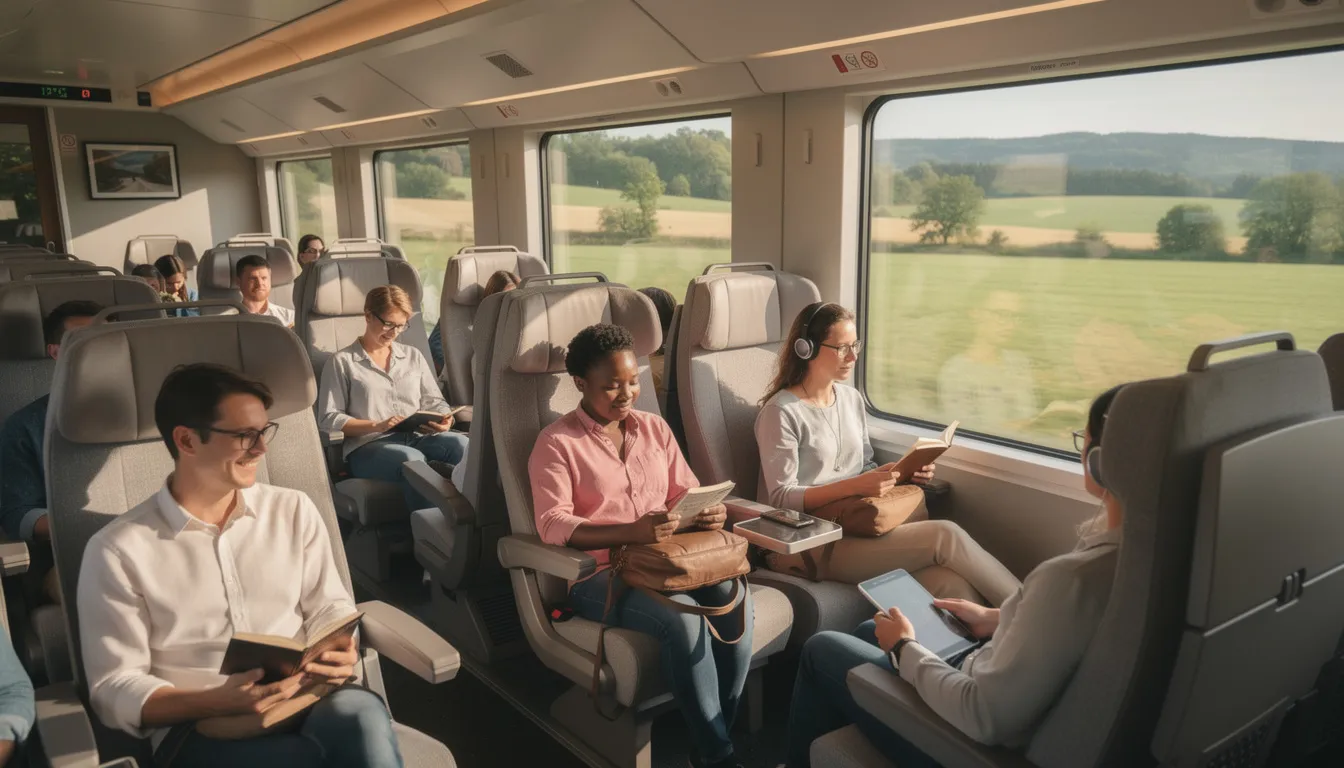
- Padded reclining comfortable seats
- Overhead luggage racks
- Access to the cafe-bar or trolley service where available
- Free WiFi through PlayRenfe
- Power sockets at seats on most modern AVE trains
The fare families (Básico, Elige, Prémium) overlay these classes, creating different service levels within each physical seating type.
Estandár (Standard / Economy) Class Features
- 2+2 layout: Most coaches arrange seats in pairs on either side of the aisle
- Reclining seats: Padded seats with adjustable backs and fold-down tables for working or dining
- Power outlets: USB and standard European sockets at most seats keep devices charged
- Free WiFi: Connect to PlayRenfe on compatible services for browsing and messaging
- Luggage storage: Overhead racks plus larger spaces at coach ends accommodate bags of various sizes
- Individual reading lights: Control your lighting without disturbing neighbors
This class seating suits both budget-conscious travelers and those who simply don’t need extra space. For journeys like Madrid–Barcelona or Madrid–Valencia, standard class provides excellent value.
Confort (First Class) and Premium Seating Features
- Wider seats and extra legroom: Often arranged in 2+1 configuration (except some newer S106 sets with 2+2)
- Quieter atmosphere: Fewer passengers per coach means a more relaxed environment
- Complimentary refreshments: Hot and cold drinks plus snacks included on many services
- Newspapers and digital press: Stay informed during your journey
- Upgraded service: Attentive staff, especially for Premium fare holders
- Sala Club access: Renfe’s lounges at selected stations (Madrid, Barcelona, Valencia, Málaga, Seville) welcome many first-class and Prémium passengers
Confort is ideal for business travelers or anyone wanting more space on longer runs like Barcelona–Madrid–Marseille.
Other Branded Products: Avlo and Select-Style Options
Beyond traditional AVE, you’ll encounter other high-speed options on the same infrastructure:
- Avlo: Renfe’s low-cost high-speed brand launched in 2021, operating on routes like Madrid–Zaragoza–Barcelona–Figueres. Avlo uses similar track and high speeds but offers single-class, higher-density seating with fewer extras—think budget airline of the rail world.
- Select terminology: Some booking platforms use terms like “Select,” “Select Comfort,” or “Premium Class” to describe combinations of seating and fare features:
- Select / Economy = comfortable 2+2 seating with WiFi and power
- Select Comfort / 1st = 2+1 seating with extra legroom and enhanced amenities
- Premium Class = top tier with lounge access and in-seat catering
Naming varies across booking sites, but Renfe’s underlying terminology remains Estandár vs Confort plus the three fare families.
Onboard services and facilities
AVE Spain trains are designed for comfortable long-distance travel, with modern interiors and consistent amenities across most services.
WiFi and Power
- Free WiFi: PlayRenfe connectivity in most coaches for browsing, email, and messaging
- Power sockets: Standard European outlets and USB ports at each or most seats
Food and Drink
- Cafe-bar car: Most AVE trains include a bistro selling drinks, snacks, sandwiches, and sometimes hot dishes
- Trolley service: Attendants pass through coaches on some routes
- Passengers can bring their own food and non-disruptive beverages. Many travelers pick up supplies at station shops before boarding.
Luggage and Storage
- Overhead racks above seats for smaller bags
- End-of-coach racks for larger luggage
- Typical limits: up to 3 items per passenger with combined dimensions around 180 cm and total weight up to approximately 25 kg
Traveling with Children on AVE
- Children under 4 years often travel free without their own seat but require a zero-fare ticket for the journey
- Discounted fares available for older children on many routes
- Families can request adjacent seats where availability permits
Accessibility Features on AVE
- Step-free access at most stations and onto trains
- Dedicated wheelchair spaces in designated coaches
- Accessible toilets on board
- Free ATENDO service from Renfe provides dedicated assistance for passengers with reduced mobility—reservation recommended at least 24–48 hours in advance
Family-Friendly Amenities
- Some stations offer kids’ corners and family waiting areas
- Changing tables available in accessible toilets
- Priority boarding sometimes offered for families with young children
Practical travel tips for AVE Spain trains
A few advance preparations make your AVE journey smoother:
- Arrive early: Get to the railway station at least 30 minutes before departure. All AVE services at major hubs like Madrid Atocha and Barcelona Sants require baggage X-ray screening.
- Carry ID: Names on tickets may be checked on board, especially on international routes to France. Bring your passport or national ID card.
- Check platform screens carefully: Multiple high-speed services (AVE, Avlo, Alvia, Ouigo) can depart close together. Confirm your train number and platform.
- Understand your ticket: Look for “Coche” (coach number) and seat number. Platform markings show where each coach stops for efficient boarding.
- Download tickets in advance: Have your PDF or mobile QR code ready. Station WiFi can be unreliable when you need it most.
Luggage, Bikes, Pets, and Security
- Standard luggage rules:
- Up to 3 pieces per passenger permitted
- Total dimensions (length + width + height) around 180 cm maximum
- Total weight typically up to 25 kg
- Staff rarely weigh bags but can enforce limits if luggage appears excessive
- Bicycles:
- Folding or dismantled bicycles in a case or bag under approximately 180 cm total dimensions are generally allowed
- Full-size, assembled bicycles are not accepted on standard AVE services
- Check current Renfe rules before travel as policies evolve
- Small pets and dogs:
- Small pets (dogs, cats, ferrets, small birds) up to 10 kg are welcome in carriers measuring approximately 60 × 35 × 35 cm
- One pet per passenger maximum
- In Confort class with Prémium fare, pets typically travel free
- In Estandár, pets often cost around 25% of the human fare
- Dogs must remain in carriers throughout the journey
- Security screening:
- All bags pass through X-ray at main AVE stations
- The process generally moves quickly—allow extra time during peak hours
- Avoid prohibited items (sharp objects, flammable materials) as with airport security
AVE train types: S100, S102/S112, S103, S106
When you book an AVE ticket, you’re reserving space on one of several train series, each with distinct engineering heritage and interior layouts.
While you don’t typically choose a specific train type when booking, knowing what to expect helps you anticipate the travel experience. Enthusiast resources and booking site seat maps sometimes reveal which series operates your departure.

AVE S100 – The Original 1992 Madrid–Seville Workhorse
- Heritage: Based directly on France’s TGV design, these trains inaugurated the Madrid–Seville line in 1992
- Speed: Operates at up to 300 km/h on suitable infrastructure
- Current deployment: Primarily serves Seville–Madrid, plus some international services to France depending on timetable periods
- Interior: Traditional high-speed coach layout with Estandár and Confort classes, luggage racks by doors and overhead, quiet and comfortable ride
- Capacity: Around 400 passengers across eight cars in articulated power-car configuration
AVE S102 and S112 – The “Pato” Talgo Sets
- Design: Articulated carriages with one wheelset per joint, plus a distinctive “duck-bill” nose earning the nickname “Pato” (duck) from Renfe staff
- Routes: Dominates Madrid–Alicante services, plus many Madrid–Málaga and Madrid–Seville departures
- Speed: Reaches approximately 300 km/h on dedicated high-speed track
- Passenger features: Comfortable seating in both classes, cafe-bar car, notably smooth ride thanks to Talgo articulation technology
- Meal service: On some S112 services, Prémium fare passengers receive included meals (like breakfast on morning departures) served at the seat
AVE S103 – Siemens Velaro for Madrid–Barcelona and Beyond
- Builder: Siemens, closely related to Germany’s ICE3 Velaro platform
- Primary route: The heavily-trafficked Madrid–Barcelona corridor, covering 621 km in about 2 hours 30 minutes
- Additional services: Madrid–Málaga, Barcelona–Andalucía routes
- Speed capability: Designed for 350 km/h, typically operates at up to 310 km/h commercially
- Features: Estandár and Confort classes, cafe-bar and vending options, luggage space near doors and overhead, modern interior with clear information screens
- Capacity: Up to 439 seats depending on configuration
AVE S106 – Talgo Avril for New High-Capacity Routes
- Entry into service: Began commercial operation May 2024, initially on Madrid–Galicia routes with expected expansion to other corridors
- Controversial interior: Extra-wide car bodies allow 2+3 seating in Standard class for higher capacity; even Confort class uses 2+2 rather than traditional 2+1, meaning first class may feel busier than on older AVE sets
- Design: Articulated layout with power cars at each end, engineered for future speeds above 300 km/h
- Modern amenities: Contemporary lighting, WiFi, and power outlets throughout all coaches
- Role: Addresses growing demand by increasing passenger capacity on expanding routes
Choosing Your Travel Option
When you’re picking your travel setup on AVE high-speed trains, you’ve got solid choices that’ll match how you like to roll.
- Standard Class: Comfy seats, free WiFi, and snacks from the onboard café – great value for most trips.
- Elige Fare: More flexibility to switch or cancel your ticket for a fee, plus a cold meal tray included.
- Premium Fare: Confort seating (first class), hot meals included, access to Sala Club lounges at select stations, and the ability to hop different trains without extra charges.
Other flexible options and thoughtful touches:
- AVE trains welcome your small pets – dogs, cats, birds – as long as they’re under 10 kg and fit in a carrier that’s 60 × 35 × 35 cm max.
- Got a bike? Pack it down and case it up to 180 cm long, and you’re good to go.
With these flexible options and thoughtful touches, AVE makes it easy to dial in your journey exactly how you want it – whether you’re flying solo, wrangling family, or bringing along your furry friend or wheels. Pick the class and fare that clicks with your travel style, and you’ll cruise smooth across Spain’s high-speed network.
Why choose the AVE Spain train instead of flying or driving?
For most intercity journeys within Spain, the Renfe AVE train offers compelling advantages over alternatives:
Time Comparison
- Madrid–Barcelona by AVE takes approximately 2 hours 30 minutes city-center to city-center
- Flying the same route requires 4–5 hours when including airport transfers, security, and boarding—plus potential delays
- Driving covers 620 km in 6+ hours with fuel costs, tolls, and fatigue
Comfort Advantages
- More legroom than most low-cost carrier seats
- Freedom to walk around, visit the cafe-bar, and stretch during the journey
- Power outlets and free WiFi enable productive work or entertainment streaming
- No liquid restrictions or shoe removal
Environmental Benefits
- AVE high speed trains emit roughly 90% less CO₂ per passenger-kilometer than short-haul flights
- Rail represents one of the lowest-carbon transport options for intercity travel in Europe
Practical Advantages
- High frequency on busy routes means more flexibility to choose travel times
- Reliable punctuality rates above 95% on most corridors
- Easy connections to local metros and cercanías trains in Madrid and Barcelona
- Stations in city centers eliminate airport transfer logistics
When Flying Might Win
- Destinations not served by AVE
- Promotional airfares below €15–20 (rare on popular routes)
- Connections requiring multiple train changes
For routes like Madrid–Barcelona, Madrid–Seville, or Madrid–Valencia, AVE delivers the smart choice for most travelers seeking speed, comfort, and sustainability.
Key takeaways
- AVE trains operate as Spain’s flagship high-speed service, connecting major cities at speeds up to 310 km/h
- Book early through Renfe.com or platforms like Trainline to secure the best fares
- Understand the three fare types—Básico, Elige, and Prémium—to match your flexibility needs
- All tickets include mandatory seat reservations; no walk-on travel permitted
- Arrive at stations 30 minutes early for security screening
- Consider Confort class for longer journeys or when you want extra space and included refreshments
Whether you’re planning a quick day trip from Madrid to Valencia or a cross-border adventure from Barcelona Lyon, the AVE Spain train transforms what could be hours of airport hassle or highway driving into a smooth, productive, and genuinely enjoyable journey.
Start checking schedules and fares on Renfe.com or your preferred booking platform—and book early to lock in promotional prices for your Spanish adventure.