

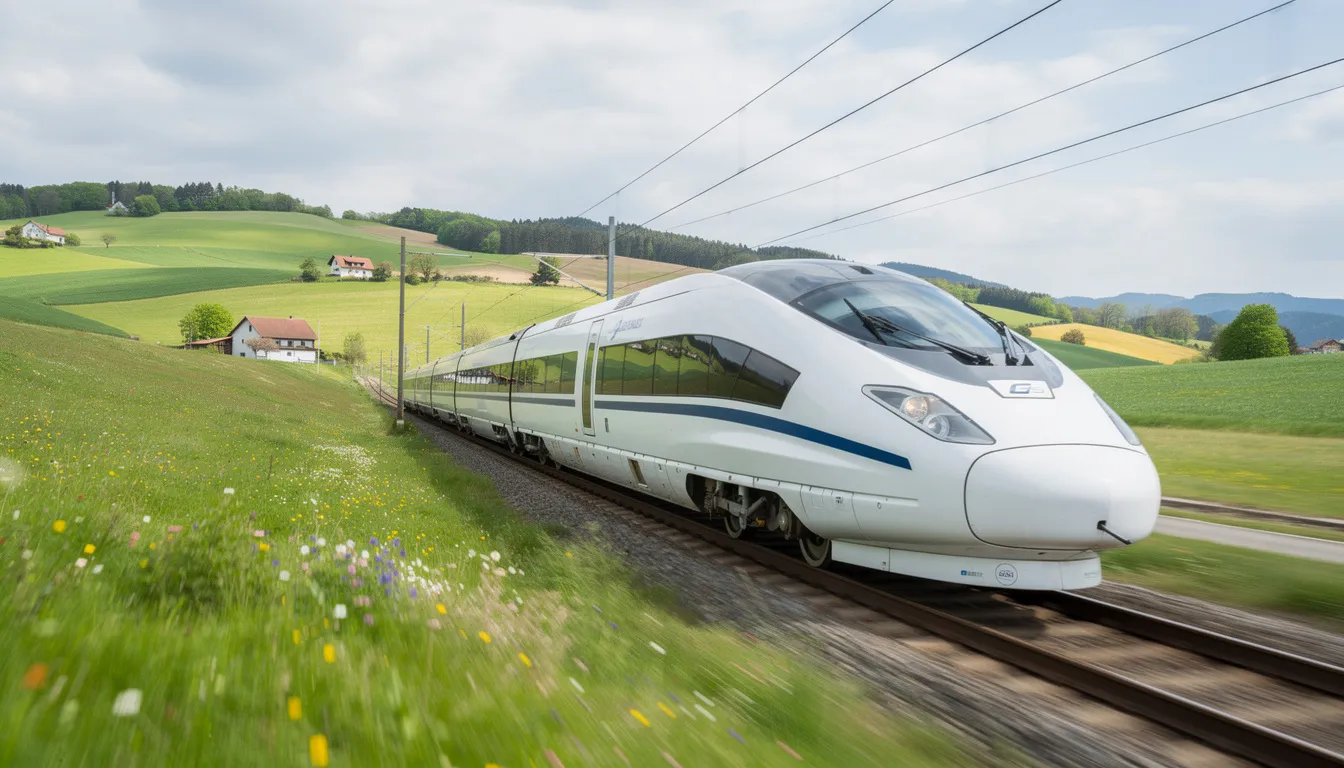
Planning to travel across Europe and want to zip between cities without the airport hassle? This guide is for travelers planning to use high-speed trains across Europe, whether for business or leisure. Here, you’ll find everything you need to know about riding high-speed trains—commonly referred to as “Europe bullet trains”—from booking strategies to the fastest routes connecting major capitals.
High-speed rail offers a fast, comfortable, and sustainable alternative to flying or driving between European cities. The term “bullet train” originated from Japan’s Shinkansen, known for its bullet-like nose and speed. In Europe, the phrase “Europe bullet train” is often used to describe modern high-speed rail options that operate at similar speeds and use dedicated tracks. High-speed rail (HSR) has developed in Europe as an increasingly popular and efficient means of transport, transforming how people move across the continent.
Whether you’re eyeing a Paris-to-London dash or dreaming of a Madrid-to-Barcelona sprint, understanding how European high-speed trains work will transform how you plan your next adventure.
Overview of Europe’s bullet trains
When travelers talk about the “Europe bullet train,” they’re referring to the modern high-speed trains that rival Japan’s famous Shinkansen. While the term “bullet train” originally refers to Japan’s Shinkansen, in Europe it is commonly used to describe modern high-speed trains that operate at similar speeds and use dedicated tracks. European high-speed trains operate at speeds often exceeding 186 mph (300 km/h) and utilize dedicated tracks, just like the Japanese bullet train.
These sleek services—TGV in France, ICE in Germany, AVE in Spain, Eurostar through the Channel Tunnel, and Frecciarossa in Italy—have fundamentally changed how people move across the continent. High-speed rail (HSR) has developed in Europe as an increasingly popular and efficient means of transport.
Current top commercial speeds reach up to 320 km/h, with typical journeys dramatically cutting travel times compared to conventional rail or driving. Paris to Lyon takes roughly 2 hours, Madrid to Barcelona clocks in at about 2.5 hours, and London to Paris runs approximately 2 hours and 15 minutes through the iconic undersea tunnel.
These trains connect major cities and business hubs across Europe—London, Paris, Brussels, Amsterdam, Berlin, Madrid, Milan, Rome, and dozens of other cities in between. For large distances under 600 km, they’re genuinely competitive with short-haul flights when you factor in airport security, boarding, and city-center access.
Key facts at a glance:
| Feature | Details |
|---|---|
| Top speeds | 250–320 km/h on dedicated high-speed lines |
| Rail passes | Most high-speed trains included in Eurail/Interrail passes (reservations often required) |
| City-center service | Direct city-center-to-city-center service, avoiding airport transfers |
| Onboard amenities | Wi-Fi, power outlets, and dining options on most services |
| Seat reservations | Mandatory on many routes, especially cross-border |
Flagship services to know:
| Train Service | Countries Served | Top Speed |
|---|---|---|
| TGV INOUI | France, Belgium, Switzerland, Germany | 320 km/h |
| ICE | Germany, Austria, Switzerland, Belgium, Netherlands | 300 km/h |
| Frecciarossa 1000 | Italy | 300–360 km/h |
| AVE | Spain | 310–320 km/h |
| Eurostar | UK, France, Belgium, Netherlands | 300 km/h |
| Railjet | Austria, Germany, Switzerland, Hungary | 230 km/h |
How fast are bullet trains in Europe?
In European Union technical terms, “high speed” typically means lines designed for speeds between 250 and 350 km/h, with actual operating speeds ranging from 200 to 320 km/h depending on the route and infrastructure. This distinction matters because trains travel at different speeds on dedicated new tracks versus upgraded existing tracks.
On purpose-built high-speed lines—like those in France and Spain—trains regularly cruise at their maximum capabilities. On upgraded conventional lines, like many in Germany and Sweden, you’ll see speeds closer to 200–250 km/h as the infrastructure wasn’t originally designed for faster operation.
Speed comparison of major services:
- TGV (France): 320 km/h on LGV lines
- AVE (Spain): 310–320 km/h on dedicated tracks
- Frecciarossa 1000 (Italy): Design speed of 360 km/h, operates at 300 km/h
- ICE 3 (Germany): 300 km/h on new lines like Cologne-Frankfurt
- Eurostar/Thalys: 300 km/h through France and Belgium
- X2000 (Sweden): 200 km/h on upgraded conventional lines
For context, the French TGV holds the world rail speed record of 574.8 km/h, set during a 2007 test run—though that was purely experimental, not something passengers experience. Real-world high-speed travel maxes out around 320 km/h commercially, which still means covering ground faster than most highway speed limits allow for cars.
The difference between new high-speed lines and upgraded legacy tracks is significant. Spain’s AVE network runs almost entirely on dedicated infrastructure, enabling consistent top speed performance. Germany’s ICE system, by contrast, blends 37% dedicated high-speed lines with upgraded conventional tracks, meaning journey times can vary depending on the route segment.
Major bullet train networks and routes by country
France, Spain, Italy, Germany, Belgium, the Netherlands, and the UK form the core of Europe’s high-speed rail map. Each country has developed its own network, though cross-border integration has accelerated in recent decades through EU coordination and the Trans-European Transport Network initiative.
France
The birthplace of European high-speed rail services, France operates TGV INOUI and budget-oriented OUIGO trains on its extensive network of LGV (Lignes à Grande Vitesse) tracks.
- Key routes: Paris–Lyon–Marseille, Paris–Bordeaux, Paris–Strasbourg, Paris–Lille–Brussels
- Highlights: Paris to Lyon in under 2 hours, Paris to Marseille in about 3 hours
- Network style: Predominantly dedicated new high-speed lines (80%+ at 300+ km/h capability)
Spain
Spain boasts Europe’s largest high-speed rail network by distance, with over 3,000 km of track radiating primarily from Madrid. This extensive network was built largely with EU cohesion funding after Spain joined the bloc in 1986.
- Key routes: Madrid–Barcelona, Madrid–Seville, Madrid–Málaga, Madrid–Valencia
- Highlights: Madrid to Barcelona in approximately 2.5 hours at 310 km/h
- Services: AVE trains (premium) and Avlo (low-cost), plus OUIGO España on some corridors
- Note: Spain converted from its historic broad gauge to standard gauge for these lines
Italy
Italy pioneered some of Europe’s earliest fast rail with the Florence–Rome Direttissima in the late 1970s. Today, the country features healthy competition between state operator Trenitalia and private rival Italo.
- Key routes: Turin–Milan–Bologna–Florence–Rome–Naples–Salerno
- Highlights: Rome to Milan in about 2 hours 55 minutes
- Rolling stock: Frecciarossa 1000 (the “red arrow”) reaches 300 km/h
- Competition: Italo offers comparable speeds with distinctive service style
Germany
Germany’s ICE (Intercity Express) network integrates high-speed lines with upgraded conventional tracks, reflecting the country’s high population density and distributed urban geography.
- Key routes: Berlin–Munich, Frankfurt–Cologne, Hamburg–Frankfurt
- Highlights: Berlin to Munich in about 4 hours (down from 8 before 2017 upgrades)
- Integration: Direct ICE trains extend into Austria, Switzerland, Belgium, and the Netherlands
- Features: Quiet zones, family areas, onboard Wi-Fi, restaurant cars
UK–France–Belgium–Netherlands
The Channel Tunnel connection enables Eurostar services linking London with continental Europe—one of the world’s most iconic rail journeys.
- Key routes: London–Paris, London–Brussels, London–Amsterdam
- Highlights: London to Paris in about 2 hours 15 minutes, London to Brussels in about 2 hours
- Important: Mandatory check-in and security screening at terminals; arrive 45–60 minutes early
- Note: Eurostar is the only way to cross from the UK to the continent by rail
Belgium, Netherlands & Germany connections
Brussels serves as a crucial hub for high-speed travel in northwestern Europe, with Thalys (now integrated into Eurostar) and ICE services radiating in multiple directions.
- Key routes: Paris–Brussels–Amsterdam, Brussels–Cologne
- Highlights: Paris to Brussels in about 1 hour 22 minutes, Paris to Amsterdam in about 3 hours 15 minutes
Austria & Switzerland
Railjet and ICE services connect the Alpine region to Central Europe, though maximum speeds are somewhat lower than France or Spain due to mountainous terrain.
- Key routes: Vienna–Salzburg–Innsbruck–Zurich, Vienna–Budapest
- Speeds: Up to 230–250 km/h
- Features: Restaurant car, multi-class layout, scenic routes through the Alps
Scandinavia
Sweden’s X2000/X55 and Norway’s Signatur services offer faster-than-conventional travel, though not at top bullet train speeds. These are relevant for travelers heading north from central Europe.
- Speeds: Around 200 km/h on upgraded lines
- Character: Comfortable and efficient, but not the ultra-high-speed experience of France or Spain
Ticketing, passes, and seat reservations
Understanding the ticketing system is where many travelers get tripped up. Unlike some regional trains where you simply hop on, most bullet trains require advance seat reservations—separate from the ticket itself on many routes.
Passes vs. point-to-point tickets
| Booking Type | Best For | Reservation Needed? | Typical Cost |
|---|---|---|---|
| Eurail/Interrail Pass | Multi-city trips, flexibility | Yes, on most HSR (€10–35+ per train) | Pass price + reservations |
| Point-to-point tickets | Single routes, known schedule | Included in fare | Varies widely by timing |
| Advance purchase direct | Best prices on specific trains | Included in fare | Often 50–70% cheaper than walk-up |
How Eurail and Interrail work with high-speed trains
- Most services included: TGV, ICE, AVE, Frecciarossa, Railjet
- Reservation fees typically €10–35 depending on country and route
- Eurostar requires special passholder fares (not simple reservation)—limited allocation and sells out fast
- Some low-cost services (OUIGO, Avlo) not included in passes
How to book
- Direct from operators: SNCF Connect (France), DB Navigator (Germany), Renfe (Spain), Trenitalia (Italy), Eurostar.com—often cheapest and most reliable
- Eurail/Interrail reservations: Through the Rail Planner app, partner websites, or at station ticket offices
- Third-party platforms: Trainline, Omio, and similar aggregators can simplify multi-operator journeys but may add fees
When to book
- Train tickets typically open 3–6 months in advance
- Eurostar: Up to 180 days ahead
- TGV: Usually around 4 months ahead
- German ICE: 6 months ahead for domestic, varies for international
- Critical: Book early for peak seasons (summer, Christmas, Easter, long weekends) to avoid sold-out services and higher fares
For economy class on popular routes, advance purchase can save 50–70% compared to walk-up fares. First-class and business-class tickets offer more wiggle room but still benefit from early booking.
Key European bullet train brands and services
Different countries market their bullet trains under distinct brand names, each with recognizable colors, service styles, and onboard amenities. Knowing these names helps when booking and choosing your connection.
TGV INOUI / OUIGO (France & neighbors)
- Routes: Paris–Lyon–Marseille, Paris–Bordeaux, Paris–Brussels, Paris–Geneva, Paris–Strasbourg
- Speed: Up to 320 km/h
- Classes: First (1ère) and Second (2nde) on INOUI; single class on OUIGO
- Key difference: INOUI is the premium service with dining, quiet zones, and spacious seating. OUIGO is the low-cost option with no-frills service, limited luggage, and suburban station departures on some routes.
ICE (Germany, Austria, Switzerland, Belgium, Netherlands)
- Routes: Berlin–Munich, Frankfurt–Cologne, Frankfurt–Brussels, Frankfurt–Amsterdam, Munich–Vienna
- Speed: Up to 300 km/h
- Classes: First and Second
- Features: Onboard Wi-Fi, power outlets at every seat, quiet zones, family areas, restaurant/bistro car
- Note: The ICE trains integrate seamlessly across several countries, making them excellent for Central Europe itineraries
AVE / Avlo (Spain)
- Routes: Madrid–Barcelona, Madrid–Seville, Madrid–Málaga, Madrid–Alicante, Madrid–Valencia
- Speed: Up to 310–320 km/h
- Classes: Multiple classes on AVE (Turista, Turista Plus, Preferente, Club)
- Budget option: Avlo offers low-cost high-speed service on select corridors
- Competition: OUIGO España now operates competing services on the Madrid–Barcelona route
Frecciarossa / Italo (Italy)
- Routes: Turin–Milan–Bologna–Florence–Rome–Naples–Salerno, plus extensions to Venice and other cities
- Speed: Up to 300 km/h
- Key players: Trenitalia’s Frecciarossa (state operator) competes directly with Italo NTV (private)
- Highlights: Milan to Rome in about 2 hours 55 minutes, Rome to Naples in about 1 hour 10 minutes
- Classes: Four on Frecciarossa (Standard, Premium, Business, Executive); similar tiers on Italo
Eurostar (UK–France–Belgium–Netherlands)
- Routes: London–Paris, London–Brussels, London–Amsterdam (with change in Brussels for some services)
- Speed: Up to 300 km/h
- Journey times: London to Paris about 2h15, London to Brussels about 2h, London to Amsterdam about 3h45
- Mandatory: Check-in and security screening required—arrive at the station at least 45 minutes before departure
- Classes: Standard, Standard Premier, Business Premier
- Note: This is the only rail route connecting the UK to the continent via the Channel Tunnel
Thalys (now Eurostar)
- Routes: Paris–Brussels–Amsterdam, Paris–Brussels–Cologne
- Speed: 300 km/h
- Role: Key connector for northwest Europe, now merged into the Eurostar brand
- Features: Similar service style to Eurostar with mandatory reservations
Railjet (Austria, Germany, Switzerland, Hungary)
- Routes: Vienna–Salzburg–Innsbruck–Zurich, Vienna–Munich, Vienna–Budapest
- Speed: Around 230 km/h
- Classes: Economy, First, Business
- Features: Restaurant car, panoramic windows, comfortable long-distance service
- Character: Not the fastest trains, but excellent for connecting Austria with neighboring countries
Regional fast services
Several countries operate “fast but not quite bullet train” services worth knowing:
- X2000/X55 (Sweden): Stockholm–Gothenburg, 200 km/h on upgraded tracks
- Euromed/Alvia (Spain): Fast regional trains connecting Barcelona and other cities at 200–250 km/h
- IC/EC trains (various): Intercity and EuroCity services run at 160–200 km/h on conventional lines
History and development of high-speed rail in Europe
Europe’s bullet trains evolved from ambitious national prestige projects in the 1970s and 1980s into today’s increasingly interconnected cross-border network. The journey from isolated national showcases to pan-European transport system reflects both technological innovation and political integration.
Key milestones in European high-speed rail
- 1977: Italy opens the Florence–Rome “Direttissima,” one of Europe’s first purpose-built fast rail lines, with speeds up to 250 km/h
- 1981: France launches the first LGV Sud-Est line and TGV services between Paris and Lyon, cutting journey times from four hours to two—a transformative moment that proved high-speed rail’s commercial viability
- 1988: Italy’s ETR 450 trains begin running on the Florence–Rome route at 250 km/h
- 1991: Germany introduces the first ICE services on the Hannover–Würzburg line, reaching 280 km/h and beginning integration with Austria and Switzerland
- 1992: Spain opens the Madrid–Seville AVE line for the Expo ‘92 world’s fair, launching what would become Europe’s most extensive network
- 1994: The Channel Tunnel opens, enabling Eurostar services between London and Paris/Brussels—a engineering and political triumph connecting the UK to continental rail networks
- 1996: EU Council Directive 96/48/EC establishes the Trans-European high-speed rail network framework and interoperability standards
- 2002: Germany’s Cologne–Frankfurt line opens at 300 km/h capability, slashing journey times from 2h50 to 1h50
- 2007: France’s TGV Est connects Paris to Strasbourg at 320 km/h; a TGV sets the world rail speed record of 574.8 km/h in testing
- 2012: Italo NTV launches in Italy as Europe’s first private open-access high-speed operator, proving competition could work
- 2017: Germany’s Nuremberg–Leipzig line opens, cutting Berlin–Munich times in half
The European Union continues pushing toward standardized signaling through the European Train Control System (ETCS), common electrification standards, and cross-border corridors like Paris–Brussels–Amsterdam–Cologne. This integration effort addresses chronic issues like voltage mismatches (France’s 25 kV versus legacy 15 kV systems in Germany and Switzerland) and different national signaling protocols.
Cross-border corridors and integration projects
Many of today’s most useful “Europe bullet train” journeys rely on pan-European corridors rather than isolated national lines. These international axes represent decades of diplomatic negotiation, technical harmonization, and massive infrastructure investment.
Paris–Brussels–Amsterdam–Cologne
This northwestern corridor represents one of Europe’s most integrated high-speed networks, mixing TGV, Eurostar/Thalys, and ICE services.
- Paris to Brussels: About 1 hour 22 minutes
- Paris to Amsterdam: About 3 hours 15 minutes
- Brussels to Cologne: About 1 hour 47 minutes
- Hub: Brussels-Midi/Zuid serves as the central interchange for this triangle
London–Paris/Brussels/Amsterdam via Channel Tunnel
The undersea fixed link opened in 1994 and remains the only rail connection between the UK and the continent.
- London to Paris: About 2 hours 15 minutes
- London to Brussels: About 2 hours
- London to Amsterdam: About 3 hours 45 minutes (some services require Brussels change)
- Note: Border controls happen before departure, making Eurostar more airport-like than typical European rail
France–Spain across the Pyrenees
The Perpignan–Figueres high-speed connection enables direct trains between France and Spain, integrating the TGV and AVE networks.
- Paris to Barcelona: About 6 hours 30 minutes direct
- This cross-border line opened in 2013, finally bridging two major national networks
- Gauge standardization was essential—Spain’s historic broad gauge differs from European standard
Central Europe “Magistrale for Europe”
This envisioned corridor aims to connect Paris–Strasbourg–Stuttgart–Munich–Vienna–Bratislava/Budapest with consistent high-speed service.
- Current status: Partially complete, with significant sections still under construction or upgrade
- Paris to Munich: Currently requires changes and takes about 5–6 hours
- Future vision: Seamless high-speed connection across Central Europe
Alpine tunnel projects
Several massive infrastructure projects aim to improve north-south flows through the Alps:
- Brenner Base Tunnel (Austria–Italy): 55 km tunnel under construction, expected operational in early 2030s, connecting Innsbruck to Italian rail networks
- Lyon–Turin Base Tunnel: Under construction, will dramatically cut times between France and Italy
- Koralm Railway (Austria): Links Graz to Klagenfurt, improving connections to Slovenia and Italy
Eastern European integration
Countries like Czech Republic, Poland, and Hungary are planning or beginning construction of 250–320 km/h lines to connect into Western networks by the 2030s. The European Union’s High-Speed Rail Action Plan, unveiled in November 2025, targets a more unified network by 2040, with projected investment of €345 billion.
Future bullet train projects and expansions
Europe is still expanding its high-speed rail map, often prioritizing climate goals and shifting traffic from short-haul flights to rail. The European Commission estimates high-speed rail produces 40–50 grams less CO2 per passenger-kilometer than aviation—a compelling argument as the continent pursues carbon neutrality.
Rail Baltica
Perhaps the most ambitious current project, Rail Baltica will create a standard-gauge line linking Tallinn–Riga–Kaunas–(Warsaw) at up to 249 km/h.
- Construction began 2019
- Phased openings planned for late 2020s through early 2030s
- Will integrate the Baltic states into the European standard-gauge network for the first time
- Major EU funding supports this infrastructure project
Paris–Berlin daytime high-speed link
A direct TGV/ICE service between Paris and Berlin began in December 2024, offering journey times of approximately 7–8 hours—competitive with flying when accounting for airport transfers and security.
- No plane needed for this key connection between the continent’s political and economic powerhouses
- Represents expanded cooperation between SNCF and Deutsche Bahn
Czech and Polish high-speed lines
Both countries are planning major high-speed construction:
- Czech Republic: Prague–Brno–Ostrava corridor targeting 300 km/h+
- Poland: Warsaw–Łódź–Poznań/Wrocław lines with similar speed ambitions
- Construction targeted from mid-2020s onward
- Will eventually link into German and Austrian networks
Nordic upgrades
Scandinavia is considering substantial upgrades:
- Sweden: Proposed high-speed lines between Stockholm–Gothenburg and Stockholm–Malmö
- Norway: Plans for faster Oslo–Trondheim and Oslo–Bergen routes
- Many projects remain in advanced planning, subject to political decisions and funding
What’s delayed or uncertain
Not all announced projects become reality:
- Portuguese high-speed plans have been repeatedly delayed and redesigned
- Some Irish proposals have been scaled back or cancelled
- Funding gaps (potentially €550 billion more needed by 2050) and geopolitical disruptions create uncertainty
The European Commission’s plan projects potential doubling of the network to 25,000 km by 2040, with concrete milestones including Berlin–Copenhagen in four hours by 2030 (versus seven today) and Sofia–Athens in six hours by 2035.
Practical tips for riding Europe’s bullet trains
Bullet trains are straightforward once you understand a few quirks around reservations, luggage, and station procedures. Here’s what to know before you board.
Booking strategy
- Buy early: Fares can be 50–70% cheaper when purchased 2–4 months in advance.
- Compare options: Passes make sense for extensive multi-city trips; point-to-point tickets often win for simple A-to-B journeys.
- Use official sites: SNCF Connect, DB Navigator, Renfe, Trenitalia, Eurostar.com typically offer the best prices and most reliable booking.
- Check operator restrictions: Low-cost services like OUIGO and Avlo aren’t included in rail passes.
Seat reservations
- Mandatory on most French, Spanish, Italian, and cross-border services—don’t assume you can just hop on.
- Choose window for views, aisle for mobility.
- Quiet zones are available on most modern high-speed trains and enforce no-phone-calls, minimal-noise policies.
- Family areas exist on ICE and some other services—great if traveling with kids, best avoided otherwise.
- Economy class reservations typically cost €10–20 for pass holders; first class runs higher.
Luggage
- No formal weight limits on most services, but you must handle your own bags.
- Overhead racks and end-of-car luggage areas are standard.
- Eurostar exception: Specific baggage rules and security screening apply—check current limits before traveling.
- Large bags may need to go in designated areas between cars.
At the station
- Domestic trains: Arrive 10–15 minutes early for platform check and boarding.
- Eurostar: Arrive 45–60 minutes early due to check-in, security screening, and UK border controls.
- International trains in Schengen: Generally board like domestic trains (no passport control at most borders).
- Platform assignments often appear 15–20 minutes before departure on destination boards.
Onboard experience
| Feature | Availability |
|---|---|
| Wi-Fi | Most services (quality varies) |
| Power outlets | Standard on modern high-speed trains |
| Quiet zones | ICE, TGV INOUI, Frecciarossa, others |
| Café/bar car | Most long-distance services |
| At-seat service | First/Business class on many routes |
Night trains vs. bullet trains
| Feature/Advantage | Night Trains | Bullet Trains |
|---|---|---|
| Save on hotel | Yes | No |
| Wake up in new city | Yes | No |
| Travel time | Slower (overnight) | Fastest (daytime) |
| Scenery | Limited (night) | Daytime views |
| Departure times | Usually 1–2 per night | Multiple per day |
| Comfort | Sleepers/couchettes, privacy varies | Modern seats, business/first class available |
| Best for | Long distances, maximizing sightseeing time | Distances under 600 km, quick city hops |
| Price | Often cheaper than day train + hotel | Varies; advance booking saves money |
Environmental note
High-speed travel produces roughly 0.15–0.20 kWh per seat-kilometer, versus 0.25 for short-haul flights. That translates to CO2 savings of 40–50 grams per passenger-kilometer compared to aviation. For environmentally conscious travelers, bullet trains offer genuine climate benefits on trips under 800 km.
Key takeaways
- European high-speed trains operate at 250–320 km/h, connecting major cities faster than driving and often competing with short-haul flights.
- France, Spain, Italy, and Germany have the largest networks; Spain leads with over 3,000 km of dedicated track.
- Most services require advance seat reservations, even with Eurail/Interrail passes.
- Book early for the best fares—2–4 months ahead for popular routes during peak seasons.
- Cross-border integration is improving, with corridors like Paris–Brussels–Amsterdam and upcoming projects like Rail Baltica expanding the network.
Plan your next adventure
High-speed rail in Europe offers a genuinely compelling alternative to flying—faster city-center-to-city-center, more comfortable, and with a fraction of the carbon footprint. Whether you’re plotting a quick Paris-to-London dash or mapping an epic cross-border journey through several countries, understanding how these bullet train networks work will help you travel smarter.
Start by identifying your routes, then decide between passes and point-to-point train tickets based on how much you’ll be moving around. Book early, secure those seat reservations, and you’ll be gliding across the continent at 300 km/h in no time.
For more info on specific routes and booking, check the official operator websites: SNCF Connect for France, Deutsche Bahn for Germany, Renfe for Spain, Trenitalia for Italy, and Eurostar for UK connections.
Your top tips? Book early, pick your seats strategically, and don’t forget that many services offer quiet zones for a peaceful ride across the world’s most extensive high-speed network.